A fascinating culture
p. 29 · Read in the full issue
TFIE cultural history and traditional practices of the Federated States of Micronesia dates back many centuries and is still fascinating today’s gener ations who try to unravel the mysteries.
Yap is perhaps the most intriguing island, being a land steeped in ancient traditions, fascinating legends and peopled by one of the most distinctive cultures in the Pacific.
Yap is best known to banking and anthropology for one pecularity stone money. It is the only place on earth where huge stone disks were used as a traditional from of currency.
The legend of the stone money dates back an estimated 2000 years, when Yapese navigators sailed their outrigger canoes across hundreds of miles of open ocean exploring neighbouring islands. On Palau they discovered caves containing a sparkling light brown material known as crystalline calcite.
Using hand tools made of shells and sticks, these ancient mariners quarried and sculpted stone disks ranging from two to 12 feet in diameter. They loaded
these stones on their canoes and made the 250-mile return journey to Yap.
It was an excrutiating effort many canoes sank and many islanders were lost.
The value placed on a piece of stone money depends largely on the story connected with it. Each piece has its own legend and its value is related directly to the degree of difficulty in obtaining it.
The practice of quarrying stone money ceased at the turn of the century and the estimated 7000 pieces of stone money remaining in Yap are believed to be hundreds of years old.
At one time villagers could buy a piece of land or settle an old debt with a stone.
Even today Yapese banks will make a cash loan to a village, accepting stone money as a collateral.
Stone money is not the only fascinat ing aspect of Yap. Of all the island groups in FSM, the Yapese have man aged to retain the traditions, language and values of their ancestors.
The men, particularly in the outer districts, still wear the traditional loin cloth (called a thu) and their bodies carry symbolic tattoos denoting man hood or skills as a navigator.
The Yapese language is unique and linguists have been unable to trace its origin to any other language in Micro nesia. The traditional Yapese language is used on an everyday basis and particularly for legends and stories that have been handed down from gener ation to generation.
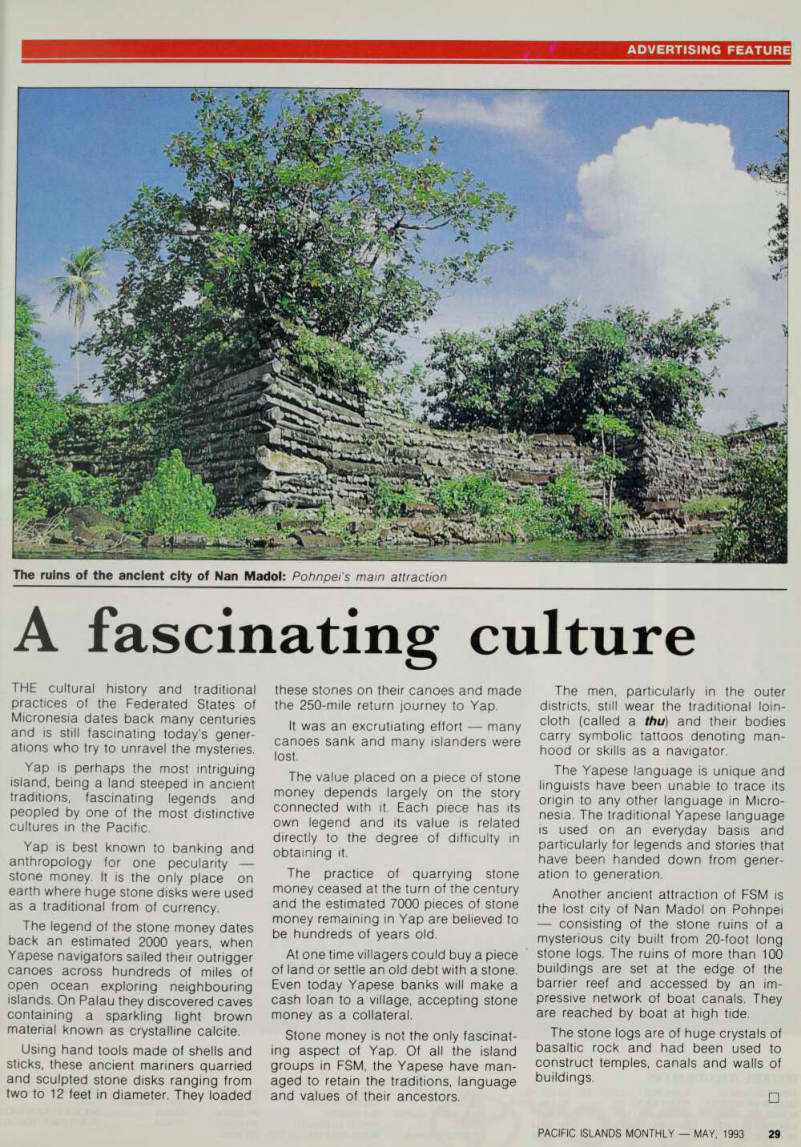
Another ancient attraction of FSM is the lost city of Nan Madol on Pohnpei consisting of the stone ruins of a mysterious city built from 20-foot long stone logs. The ruins of more than 100 buildings are set at the edge of the barrier reef and accessed by an im pressive network of boat canals. They are reached by boat at high tide.
The stone logs are of huge crystals of basaltic rock and had been used to construct temples, canals and walls of buildings. □
The ruins of the ancient city of Nan Madol: Pohnpei’s main attraction