Investing in the sea
p. 27 · Read in the full issue
Advertising Feature
TFIE economy of FSM is in many respects similar to the economies of other small Pacific islands. With the exception of deep sea fishing and opportunities for tourism development, there is a limited resource base, result ing in an imbalanced economy charac terised by ; • a dominant public sector almost wholly dependent on US grants and other external aid sources for its oper ations; • a heavy reliance on imports for all the country’s food and other requirements, with limited off-setting exports; and • limited development in the private sector activities outside retail and wholesale trade.
The external transactions of FSM is characterised foremost by a heavy and increasing reliance on imports, which include food, manufactured goods, ma chinery and vehicles and petroleum products. Exports consisting of agricul tural and fisheries products have re mained low. Tourism, however, has begun making an important contri bution, although the growth of this industry is relatively slow. Overall, the value of exports (including tourism) is less than 10 per cent of the value of imports.
The ocean is undoubtedly FSM’s most important resource. FSM’s EEZ covers
2.6 million square kilometres of ocean and contain the world's most productive tuna fishing grounds. Tuna resources include both surface schooling and deep water species.
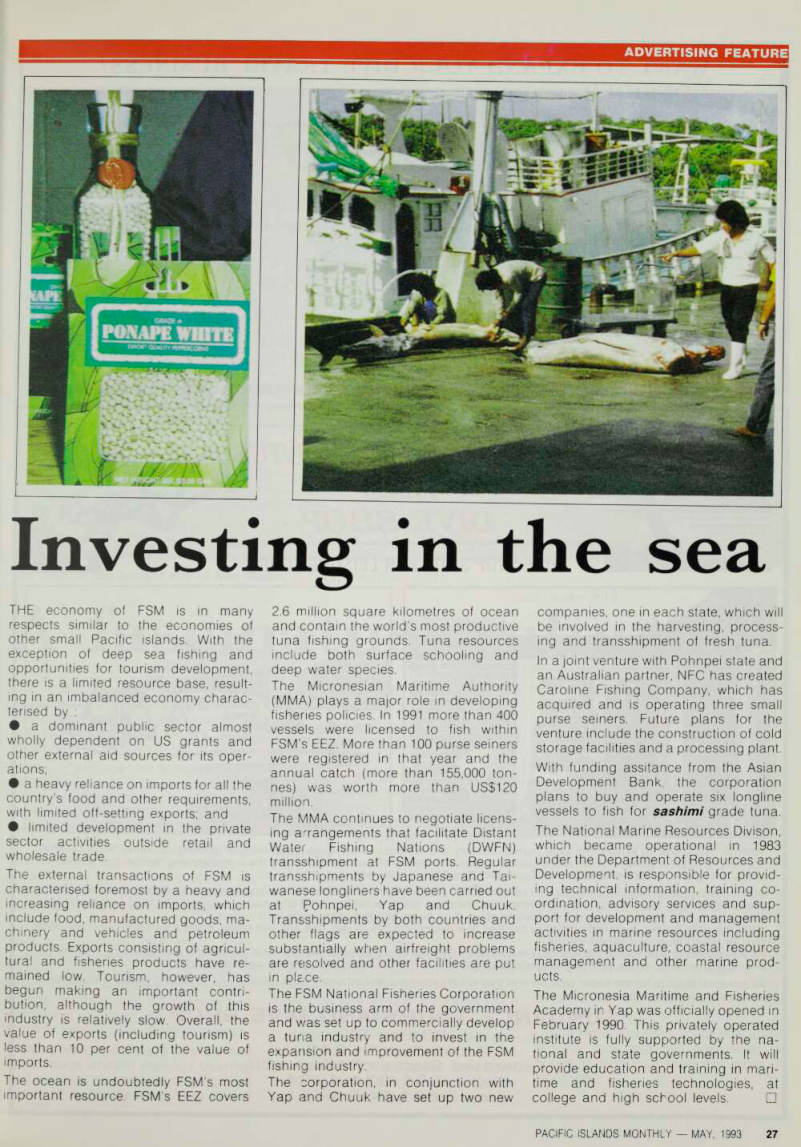
The Micronesian Maritime Authority (MMA) plays a major role in developing fisheries policies. In 1991 more than 400 vessels were licensed to fish within FSM's FEZ. More than 100 purse seiners were registered in that year and the annual catch (more than 155,000 ton nes) was worth more than US$l2O million.
The MMA continues to negotiate licens ing arrangements that facilitate Distant Water Fishing Nations (DWFN) transshipment at FSM ports. Regular transshipments by Japanese and Tai wanese longliners have been carried out at Pohnpei, Yap and Chuuk.
Transshipments by both countries and other flags are expected to increase substantially when airfreight problems are resolved and other facilities are put in place.
The FSM National Fisheries Corporation is the business arm of the government and was set up to commercially develop a tuna industry and to invest in the expansion and improvement of the FSM fishing industry.
The corporation, in conjunction with Yap and Chuuk have set up two new
companies, one in each state, which will be involved in the harvesting, process ing and transshipment of fresh tuna.
In a joint venture with Pohnpei state and an Australian partner, NFC has created Caroline Fishing Company, which has acquired and is operating three small purse seiners. Future plans for the venture include the construction of cold storage facilities and a processing plant.
With funding assitance from the Asian Development Bank, the corporation plans to buy and operate six longline vessels to fish for sashimi grade tuna.
The National Marine Resources Divison, which became operational in 1983 under the Department of Resources and Development, is responsible for provid ing technical information, training co ordination, advisory services and sup port for development and management activities in marine resources including fisheries, aquaculture, coastal resource management and other marine prod ucts.
The Micronesia Maritime and Fisheries Academy in Yap was officially opened in February 1990. This privately operated institute is fully supported by the na tional and state governments. It will provide education and training in mari time and fisheries technologies, at college and high school levels. □