Church And Politics
pp. 24-25 · Read in the full issue
Religion
By Bill Morton
When Tonga’s churches took an active role in the last elections were they going beyond the call of duty?
OVER the last six months two events have occurred in Tonga that will be remembered as shaping its future. In November 1992 the newly-formed Pro- Democracy Movement held its “Conven tion on the Constitution and Democ racy”. The convention embraced the concept of democracy and called for changes to the constitution. In February this year elections were held for the nine
Peoples' Representatives to the
30-member Legislative Assembly. Elec tion results reflected the call for change when six pro-democracy candidates were elected.
Firmly at the front of this call is one of Tonga’s strongest social institutions the Church. Key members of the country’s two biggest churches, the Free Wesleyan Church of Tonga and the Catholic Church have put their voices behind those of the politicians, academics and the people. Their support has added legitimacy to the politicians’ cause and
given them an entry into the hearts and minds of the people. At the same time, it has attracted criticism and accusations that the church should stay out of
policitcs.
One of the clearest signals of the Church’s involvement in political devel opments came with the formation of the Pro-Democracy Movement in August, 1992. Church leaders were chosen for prime positions on its committee. Cath olic priest Father Seluini Akau’ola be came the movement’s chairman. Fr Akau’ola is parish priest of the important Nuku’alofa parish. When he was out of the country early this year it was a member of the Free Wesleyan Church,
Reverend Simote Vea who took over the reigns as acting chairman. As its first
project the Pro-Democracy Movement
staged its November 1992 Convention.
Past and present church members fea tured prominently amongst the speakers.
The convention was opened by the former president of the Free Wesleyan Church of Tonga Rev Amanaki Havea and closed by the head of the Catholic Church in Tonga, Bishop Patelesio Finau.
Bishop Finau says he became involved in the convention in order to let people know where he stands. “I believe the idea behind the convention was a just cause.
It was an effort to better the political structure in Tonga. It dealt with very deep justice issues including the consti
tution needing changes to give people
rights and dignity. I hope what I have done is a lesson to the people. When they see me there they realise ‘this is the church’ because I represent the church.”
Bishop Finau also played a role in the recent elections in his capacity as editor of the widely read Catholic newspaper Taum.ua Lelei. He used his editorial column to make both pre and post election comments. While unable to openly support particular candidates or political camps, his position was clear.
Prior to the election he pointed out that, “We, the people, only choose nine representatives out of 30 members for a certain type of parliament.” He went on to comment, “The majority who are politically powerless in Tonga . . . are asking for a greater participation in the political process in the hope to put an end to the injustices committed against their human dignity and against their com mon possession.” After the election he said, “The election gives a clear message from the majority of the people of Tonga to our King and government,” adding that the result for the main island of Tongatapu was “a resounding vote for
democracy and major changes”.
Discussion of political issues has also appeared in the newspaper of the Free Wesleyan Church Tohi Fanongonongo of which Pro-Democracy Movement
member Simote Vea is the editor.
The presence of key church figures has attracted criticism from both within and without the church. The most common accusation is that church leaders have no role in the political arena and that the church should confine itself to spiritual and pastoral matters. This view appears to be held by Tonga's outspoken Police Minister, Hon Akau’ola (no relation to Fr Seluini Akau’olaj who is himself a lay preacher. Earlier this year he called on Bishop Finau through the letters section of Taumu’a Lelei to “refocus his consider able talents on pastoral duties” and exhorted him to “relinquish association with self centred, power hungry am bitious wolves”. Simote Vea says his own discussion of democracy and change within the pages of Tohi Fanongonongo has also drawn strong criticism, especially from older people as well as from many areas of the church itself.
Finau dismissed the view that the church should confine itself to spiritual matters. “Religion should be relevant to people and the issue of the day. Our stand in the church is that we take part in things when it is a question of justice or rights... the Church has to be where the people arc.”
Seluini Akau’ola also uses the argu ment that the church becomes involved in politics on questions of justice to explain his own involvement.
Akau’ola says he also encounters criticism for his role in the Pro- Democracy Movement and that people tell him he should “stay out of politics”.
“But politics is to do with good judge ment,” he says. “It should be good decisions for the people to affect the whole people, the majority. Christianity is about the common good of all. So you cannot use politics as a front to hide what is not right and then say “do not talk politics”. I am not talking about politics.
I am talking about justice. In this case it has to be directed into the political arena.”
Despite calls for the church to stay out of politics, it was the government itself which attempted to woo church leaders into forming a political party. Prior to the convention Prime Minister Baron Vaea called together Cabinet ministers and all Christian church leaders to discuss the formation of a “Christian Democratic Party”. Bishop Finau says he government was also asking church eaders to find candidates for the 1993 election. “I couldn’t believe it,” he says. 1 The government had been accusing me }f meddling in politics; now they were giving me and other churches a free land. I think they were trying to nanipulate the churches.” Widely seen is an exercise in misjudgment, the
meeting came to nothing. While the views of church members such as Finau, Akau’ola and Vea are clear, the Christian church in Tonga as a whole is not united in its support for change. The most notable exception is the fastest growing church in Tonga, the Mormon church. It did not participate in last year’s convention and it has steered clear of any association with political matters.
In particular the government has been able to point to the fact that the Tonga National Council of Churches also did not officially participate in the conven tion. This was because one of its four member churches (Catholic Church, Free Wesleyan Church of Tonga, Angli can Church and Free Constitutional Church of Tonga) did not wish to do so.
This excluded the council’s attendance as a whole, despite its members attending as individuals. □
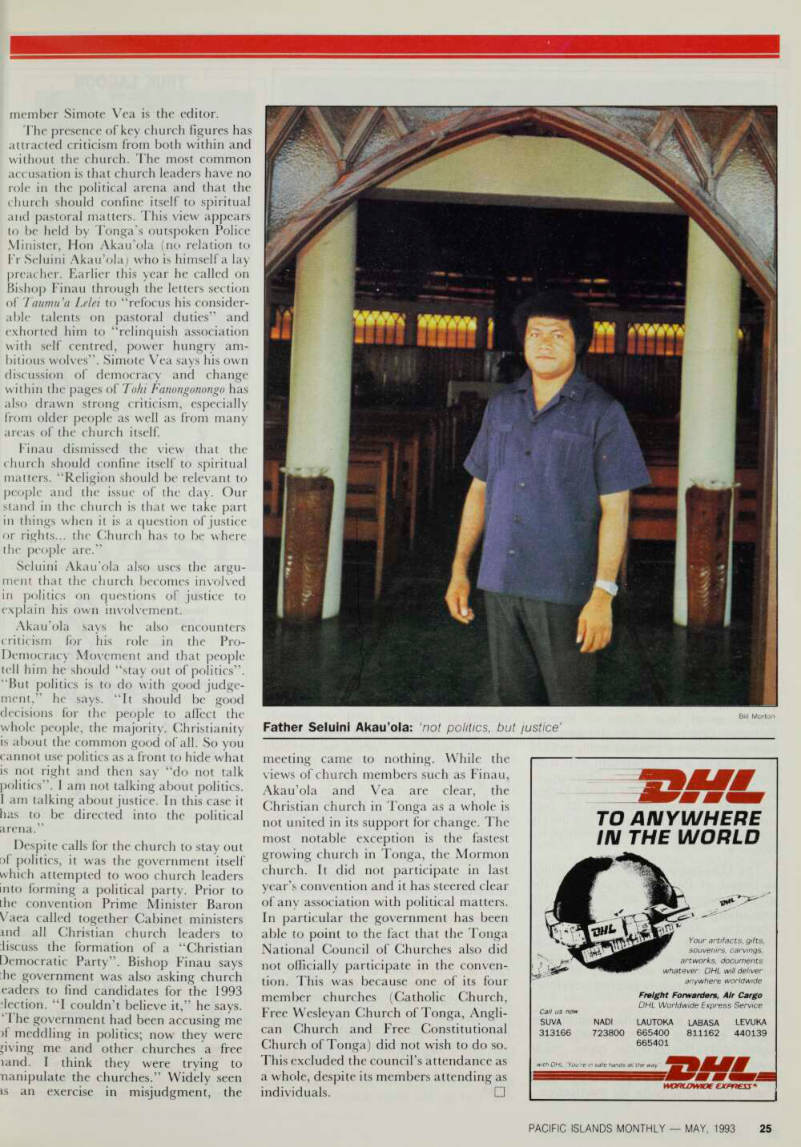
Father Seluini Akau’ola: 'not politics, but justice'
Bill Morton