A chapter ends
pp. 22-23 · Read in the full issue
papua new guinea
By Wally Hiambohn
THE two names sound alike Somare and Sir Maori. In 1975 one became the first prime minister and the other his deputy as they led Papua New' Guinea into independence on September 16.
Since then the names of Sir Michael Somare and Sir Albert Maori Kiki have remained synonymous with PNG poli tics.
They were both co-founders of the “Bully Beef Club” which was the begin ning of the now well established Pangu Pati the party which fought for and achieved PNG’s independence from Aus tralia and has continued to be a major force in the country’s politics for the last 17 years. (Pangu stands for Papua New
Guinea United.)
In March this year, quite by coinci dence, the two men Sir Michael and Sir Maori suddenly ended their long attachment with Pangu Pati. Sir Michael, 57, resigned from the party after 27 years of loyal service, and Sir Maori, 61, passed away at his Port Moresby home. The two incidents took place only days apart March 10 and March 13 respectively ending a chapter in Pangu Pati and PNG history.
Somare resigned because of his backroom political squabbles which made him a “foreigner” in the party. His departure came as a surprise, or as party members put it, “a shock” to many. After handing over the Opposition and Pangu Pati leadership to Jack Genia as had been planned and agreed upon about eight months ago, he announced his resignation from the party.
The party caucus had never discussed, let alone agreed to Somare leaving the Pangu Pati; it had only agreed to the change in party leadership. Announcing his resignation, he discarded a prepared statement and came up with his own, Michael Thomas Somare, the Chief and Father of the Nation, as he is known, said: “I am leaving Pangu Pati with a heavy heart. Pangu Pati today is not the party that I have known for the last 26 years. Although I would like to remain as an ordinary member of Pangu, I feel that the party has become foreign to me, as illustrated by incidents which have occurred in the last few days. I therefore, with regret, leave the party.”
Jack Genia, then Somare’s successor of only a few hours, said, “We were all surprised by his announcement. Obvi
ously he has his reasons for doing what he did. No one can stand in his way. It was his decision and his alone. However, we in Pangu still consider him to be a part of the party. He w ill continue to be a guiding star to the party, Pangu is united. It is as strong as it ever was.”
Genia, while expressing hope that Somare would return, said there w r as no danger of an exodus from the party, adding he would work on consolidating
his leadership and maintaining Pangu’s
position.
Earlier in parliament Genia had said of Somare: “A great man, the first chief minister, later foundation prime minis ter, the Father of the Nation, regional member of East Sepik and the leader of the largest surviving political party”. He was an “inspiration to PNG politics”.
Government spokesman Roy Yaki said, “It takes a great man to relinquish power voluntarily and no doubt Sir Michael Somare fits into this category.”
The next day Somare’s party unani mously rejected his resignation, but he had already made up his mind. He told Post Courier editor Oseah Philemon he did not want to remain and be bound by party politics but to play a role that was above parochial politics.
“I want to be free so that I can talk to leaders of various parties and offer advice whenever I feel necessary. I don’t want to be bound by party policies on various issues.
“Some people in Pangu say my ideas are out of date and they want me out of the way. I get the feeling that young people don’t want me around, therefore I feel I should isolate myself completely from the party. I don’t want to be seen as overshadowering Jack Genia ... just because I am with Pangu, some people say I am the real power behind the party.
It happened when Rabbie Namaliu was prime minister. Some people said I was running the party and making govern ment decisions.”
He said he now wanted to be left alone to concentrate on looking after his family welfare and that of his electorate, and would retire from politics in 1997.
Whether he will actually retire seems doubtful. He had spoken about retiring before but still remained in politics.
Speculation already abounds that he may join the government ranks and one suggestion has been that he is being considered for the Foreign Affairs port folio. Whatever Somare’s next move, one thing seems quite certain he is no
longer a contender for the country’s top job. ... Sir Albert Maori Kiki close friends said died from a heart attack. He had previously suffered a stroke which had partially paralysed the left side of his body.
He had worked as a medical officer, laboratory technician, welfare officer and patrol officer before becoming involved in politics.
While furthering his education at the Administrative Staff College for a year in 1965, he, with Somare and Sir Joseph Nombri and other students studying political science, formed the Bully Beef Club. This was the group which became the seed bed where the ideas of home rule, self government and independence began to germinate and take root.
In 1967 Sir Maori Kiki together with Sir Joseph Nombri and Sir Cecil Abel drafted a submission calling for immedi ate home rule and presented it to the constitutional committee. In 1972 he was elected to parliament as a member of the third House of Assembly.
He was appointed Minister for Lands and Environment from 1972 to 1974 under self government when Somare was chief minister. He was later appointed Minister for Foreign Affairs and Trade and Defence and then deputy prime minister.
He was awarded the knighthood in 1977 in recognition of his service to politics and the community.
After his defeat in the 1977 elections he left politics and served in several private sector organisations, including Kwila Insurance and Credit Corporation (PNG) Ltd.
In his eulogy, Somare said, “He w'as seen by many Australians as a dangerous man, a disruption to the easy going pace of colonial life. To understand why he stirred so many, you have to understand the nature of those times.
“It is true that independence cost PNG no lives a fact both Papua New Guinea and Australia can be grateful to for it has smoothed our subsequent relations. But it is not true that indepen dence came without a struggle, without suspicion, without harsh words and without the total dedication of men like Sir Albert Maori Kiki.”
Somare recalled that in 1964 at a local officers’ salary tribunal he met this “vicious outspoken unionist”. They teamed up with several others to later put together their thoughts and form PNG’s first political party. □
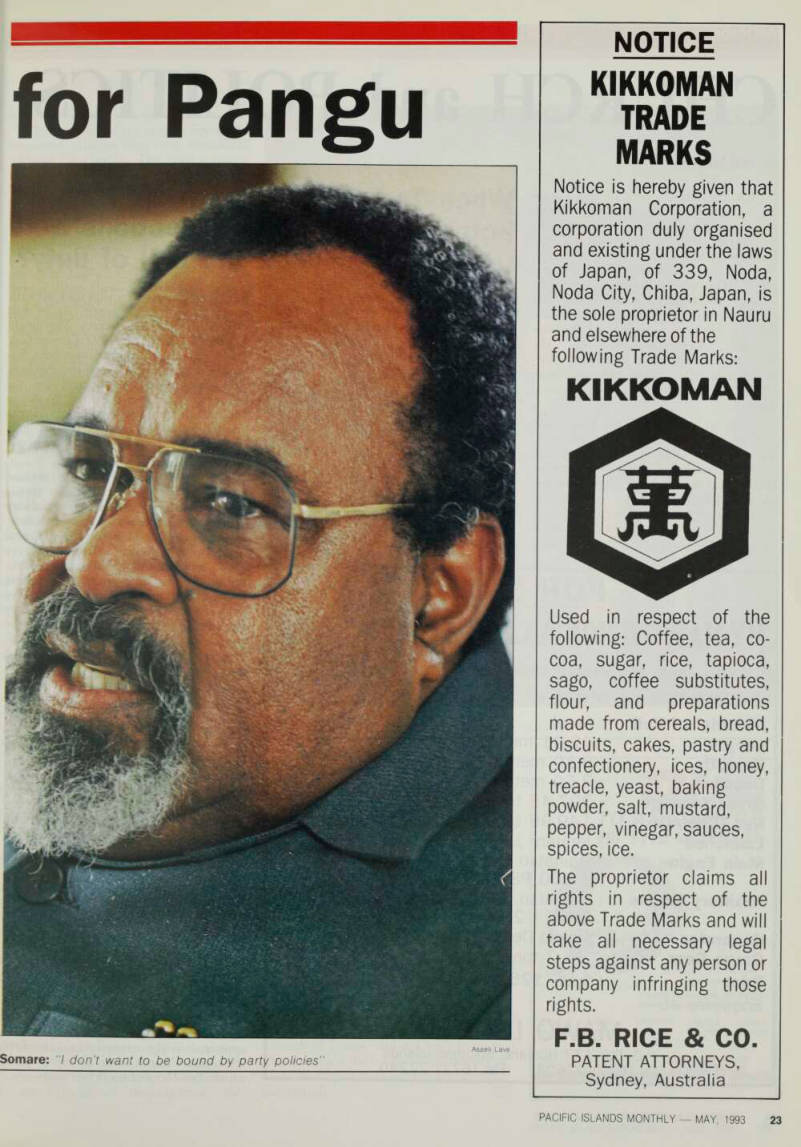
Somare: “I don't want to be bound by party policies"
Asaeli Lave