change
pp. 18-21 · Read in the full issue
Elections
The Solomons call for change
But are they a match for master politician, Mamaloni?
By Martin Tiffany
THERE is to be a general election in the Solomon Islands this month. That much is clear. What the outcome is of these elections is not so evident. With the Prime Minister standing as an indepen dent, new parties being formed, the economy in trouble and a general call for
change, many question marks hang over
these islands.
May 26 is the day circled for the elections. The man who is able to form and lead a government after this date will need every trick in the political book to solicit the numbers needed to form the government. Indications are it will be a numbers game once the results are announced.
Prime Minister Solomon Mamaloni had proved time and again he is a master magician when it comes to politics and especially when it comes to the numbers game. Take October 9, 1990, for ex ample, when he resigned from his ruling Alliance Party to form a government of national unity. He achieved this by dropping five ministers in his all-Alliance Cabinet and appointing five replace ments four from the Opposition and an Alliance backbencher. This move effectively weakened the Opposition and broke up the political parties. He remained in control of this unity until parliament was dissolved in March this year in preparation for the May elec tions.
Mamaloni was up to his wizardry again when it was announced early last month he would lead members of his national unity government into the national elections as the “National Unity Group”. He had earlier announced he
would stand as an independent and have ties with no party. The core of his group will be his 15-member cabinet and the seven government backbenchers in the last parliament. Group members will stand as independent candidates but band together with Mamaloni as Prime M inistcr if the group gets into power.
The group is expected to field candidates for ah' 47 seats. (The number of seats has risen from 38 for this election after a review of the constituencies as allowed for under the constitution. The maxi mum number of seats allowed is 50.) Earlier Mamaloni showed his political craftiness when he appointed Rex Horoi as ambassador to the United Nations.
Horoi, the former director of the Sol omon Islands College of Higher Educa tion, was expected to contest the West Makira seat the seat Mamaloni is contesting. It was rumoured Horoi had a good chance of winning. At present Mamaloni stands unopposed.
Another political ploy was the recent distribution of the Special Discretionary Fund by the government to each na tional parliament constituency. This fund was recently increased to SIS 100,000 550,000 of which was released in time for people to enjoy the benefits before the elections. People on out-lying islands and in remote villages now have tangible evidence new outboard motors, a new roof for their church the government is doing something for them.
The government has also made it difficult for civil servants to contest the elections. They now have to resign from their jobs first and, if unsuccessful, are
not guaranteed their jobs back. Despite
this an unprecedented 36 civil servants are contesting seats and are expected to
do well a cause of concern for Mamaloni as they are not supporting him. Most of them hold top jobs in government, so the usually slow govern ment machinery is now almost grinding to a stop adding to the country’s many
problems.
These problems include a deteriorat ing economy, a poor education system, the spill-over effect of the Bougainville conflict, a countrywide shortage of doc tors, malaria, government corruption, the goods tax, and public service weak ness. Many see the leaders themselves as creators of some, if not all, of these problems and the Mamaloni government making no major attempt to find sol utions.
But despite criticisms of Mamaloni’s performance in his four years at the helm, he rates the best chance in getting the job back. He is a seasoned politician who knows how to play the game, he has much grassroot support and there seems no one else who really stands out from the rest to challenge him for the job. In the end it may be a case of contending with the devil you know.
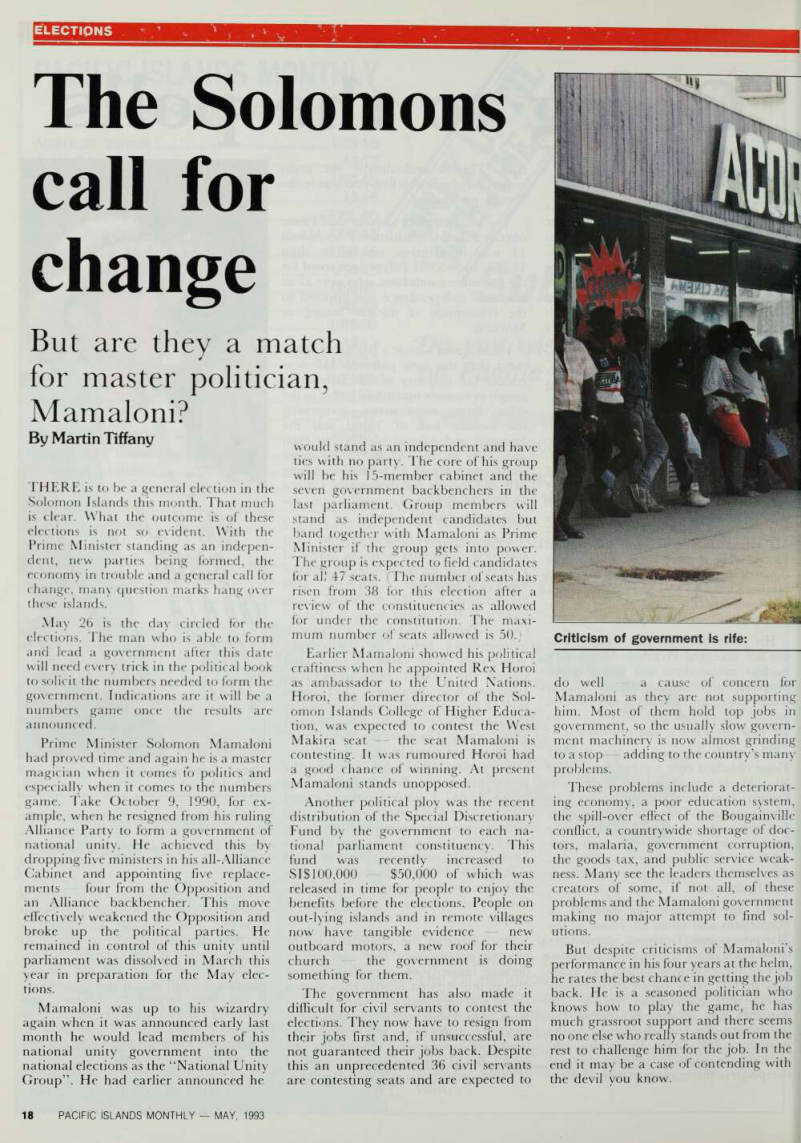
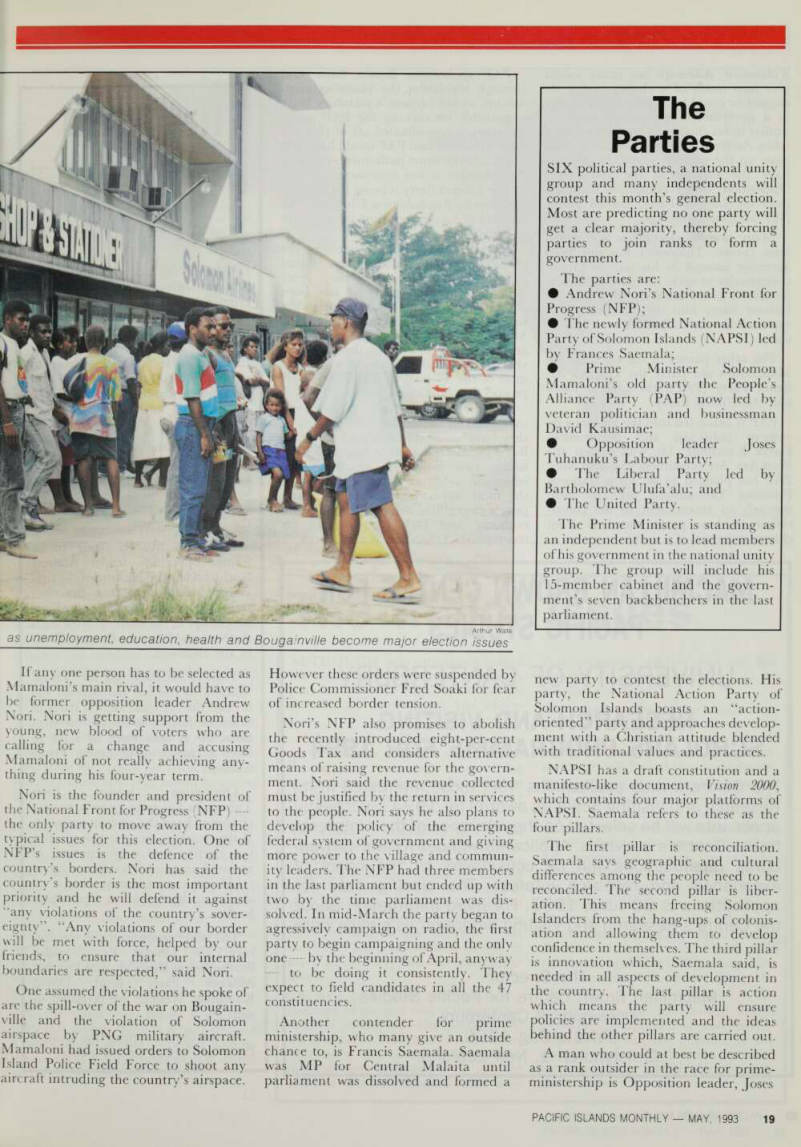
Criticism of government Is rife:
If any one person has to be selected as Mamaloni’s main rival, it would have to be former opposition leader Andrew Nori. Nori is getting support from the ,9 i 6 r i >oung, new oo o voters w o are amg or a c ange an accusing Mamalom ol not reallv achieving anyr s y thing during his lour-year term. & 7 Nori is the founder and president of the National Front for Progress (NFP) the only party to move away from the typical issues for this election. One of NFP’s issues is the defence of the country s borders. Nori has said the country s border is the most important priority and he will defend it against “any violations ol the country’s sovereignty’ . “Any violations of our border will be met with force, helped by our friends, to ensure that our internal boundaries are respected,” said Nori.
One assumed the violations he spoke of arc the spill-over of the war on Bougainville and the violation of Solomon airspace by PNG military aircraft.
Mamaloni had issued orders to Solomon Island Police Field Force to shoot any aircraft intruding the country’s airspace.
However these orders were suspended by Police Commissioner Fred Soaki for fear of increased border tension.
Nori’s NFP also promises to abolish
the recently introduced eight-per-cent
Goods Tax and considers alternative means of raising revenue for the govern ment. Nori said the revenue collected must be justified by the return in services to the people. Nori says he also plans to develop the policy of the emerging federal system of government and giving more power to the village and commun ity leaders. The NFP had three members in the last parliament but ended up with two by the time parliament was dis solved. In mid-March the party began to agressively campaign on radio, the first party to begin campaigning and the only one by the beginning of April, anyway to be doing it consistently. They expect to field candidates in all the 47 constituencies.
Another contender for prime ministership, who many give an outside chance to, is Francis Saemala. Saemala was MP for Central Malaita until parliament was dissolved and formed a
new party to contest the elections. His party, the National Action Party of Solomon Islands boasts an “action oriented” party and approaches develop ment with a Christian attitude blended with traditional values and practices.
NAPSI has a draft constitution and a manifesto-like document, Vision 2000 , which contains four major platforms of NAPSI. Saemala refers to these as the four pillars.
The first pillar is reconciliation.
Saemala says geographic and cultural differences among the people need to be reconciled. The second pillar is liber ation. This means freeing Solomon Islanders from the hang-ups of colonis ation and allowing them to develop confidence in themselves. The third pillar is innovation which, Saemala said, is needed in all aspects of development in the country. The last pillar is action which means the party will ensure policies are implemented and the ideas behind the other pillars are carried out.
A man who could at best be described as a rank outsider in the race for prime ministership is Opposition leader, Joses
Arthur Wate as unemployment, education, health and Bougamville become major election issues
Tuhanuku. Although not many would give him much of a chance, a few do suggest he could be a compromise choice in a government of national unity similar to his choice as Opposition leader when Andrew Nori stepped down. Nori gave up the position saying he did not have the support of the 16-member Opposition which comprises members from the Labour Party, United Party, NFP and independents.
Many saw his election as a compro mise choice. Tuhanuku has not been agressive enough in his role as Oppo sition leader to make his mark as a likely choice for prime minister. He leads the Labour Party into the election and is expected to win his Rennell and Bellona seat.
The other parties in the elections are Mamaloni’s old party the People’s Al liance Party (PAP), the Liberal Party and the United Party.
PAP is being led into the elections by veteran politician and businessman Davia Kausimae. He will contest the West Are ’Are constituency against Nori.
PAP has pledged to set up a National Planning Commission and to push through an amendment to the consti tution to ban party members from changing parties if it comes to power.
PAP spokesman Brown Sana said
through legislation the planning com
mission would become a statutory body responsible for turning the PAP mani festo into a co-ordinated set of planned activities. Saua said PAP would back two candidates for some parliamentary seat if they thought it was necessary.
The Liberal Party is being led into the elections by Bartholomew Ulufa’alu. His chances of becoming prime minister are
not high.
The sixth and last party contesting the elections is the United Party. Since former Prime Minister Sir Peter Kenilorea left the party it has been without a leader and has been somewhat
unfocused. Party spokesman Augustine
Manakako said his party had been keeping a low profile for the past four years. He said they planned to contest most of the 47 seats and had called for prospective candidates.
All the parties have given some indication of issues they will push for, they have made promises, and set goals.
But if the election is to be won or lost on issues, two issues economy and education stand out from the rest as the most important. There are many
people disgruntled with the deteriorating
economy and lack of plans for its redemption. Education is also a sore
point because of the lack of adequate junior secondary schools resulting in many children not being able to continue education and leading to unemploy ment. But as one wit commented, “Why educate our children when the economy is not growing and no new jobs are being created; we will only end up with well educated, unemployed youths”.
But Solomon Islanders are not known to vote along party lines or on issues.
They tend to vote for personalities rather then what they stand for. Most people in Honiara knew who they would be voting for. However a good number of these people were unsure what party their choice belonged to and only a very small number had any idea what policies the various parties had. It will be at least 20 years before the majority of the popu lation votes on issues or for a party concept. This is because the concept of Western-style democracy where one is swayed by campaign promises is not how they operate. You will get their vote if they know you or if you have done something to assist them, their village or
their community.
So the ballot boxes are set to tell their story this month, against a back-drop of a discontented people people who no longer want empty promises but action and a future for their children.
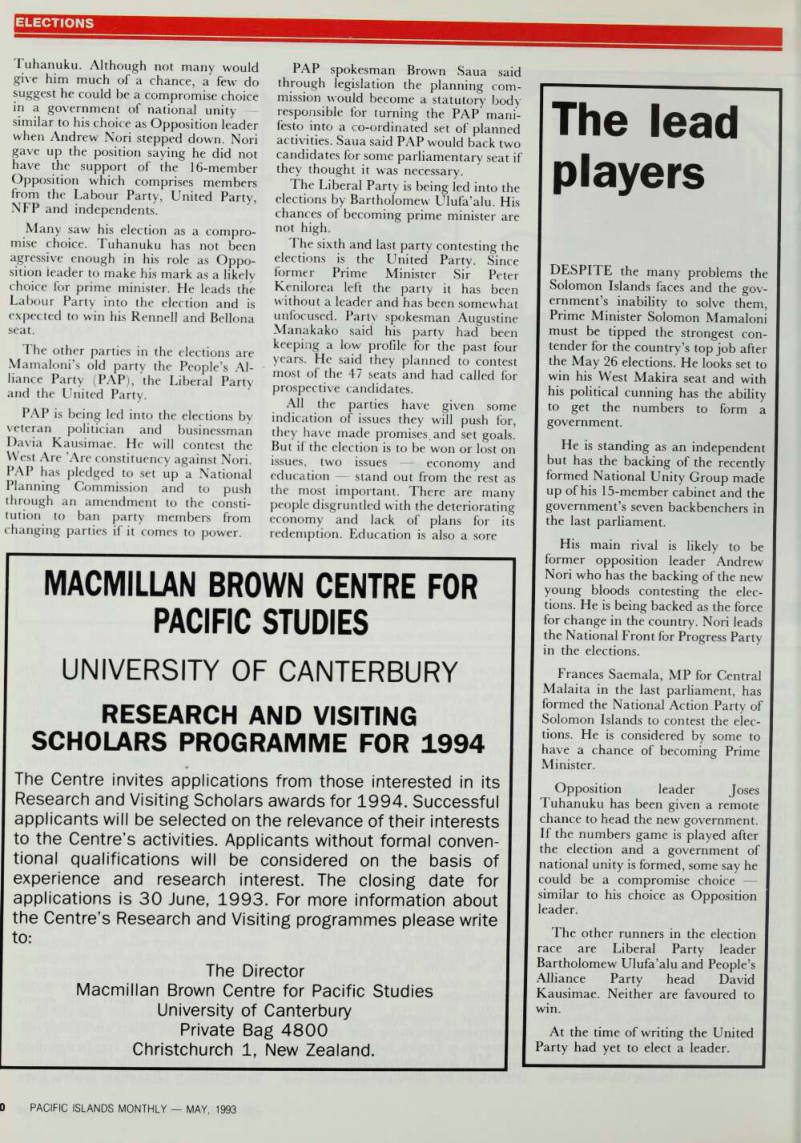
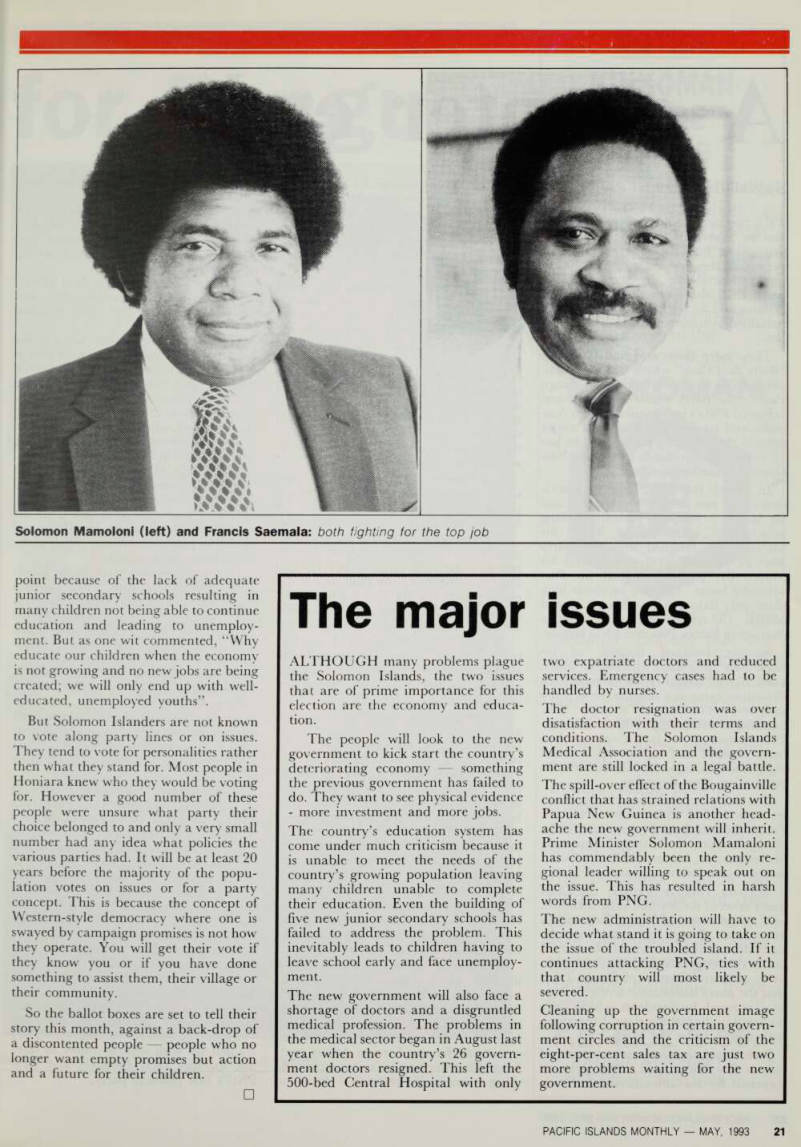
Solomon Mamoloni (left) and Francis Saemala: both fighting for the top job