Going to the polls
p. 17 · Read in the full issue
French Polynesia
By Bengt Danielsson
The March election in French Polynesia proved once more how unfair the colonial rule is for the islanders. It was a sort of “national” election to renew the French parliament, taking place at five year intervals, during which only two of the 577 MPs can be elected by the islanders. Consequently, these two anti colonial and anti-nuclear representatives of the Polynesian people have been unable, during the parliamentary sessions, to enforce the adoption of their requests and to reject any decisions and laws they consider unfavourable.
The only small reform applied this time by the French government con cerned the date of the local election, which in the past always occurred after the elections had been held in France. As the first round of this new election took place on March 13 in French Polynesia, but one week later in France, the first MP elected was local candidate Gaston Flosse, who, is more metropolitan than Polynesian, as he is the son of a French businessman and for 20 years has been the leader of the local section of the French Gaulliste RPR party.
His party boss, Jacques Chirac, who has not accepted President Mitterand’s nuclear moratorium and disarmament program, therefore immediately made a public statement, claiming this election proved the majority of the Polynesians are now pro-French and pro-nuclear.
The truth, however, is that Gaston Flosse obtained only a slight majority of 50 13 per cent of the votes in the small
eastern constituency, comprising the
Marquesas and Tuamotu archipelagoes
and the eastern half of Tahiti, mainly because about half of the voters are expatriate French soldiers, sailors, nu clear technicians, government officials and businessmen.
But an unusually big number of Polynesians also voted for Flosse in the Marquesas and Tuamotu islands, be
cause since being appointed prime min
ister of the local government two years ago, he had often visited these remote islands on government vessels and airplanes and generously offered the nhabitants gifts and advantages. As the ncumbent MP, Emile Vernaudon, did aot have the means to begin his electoral :ampaign in this manner at such an early
date. This is undoubtedly the main reason why he lost his five-year seat in the French parliament.
The total number of votes that Flosse obtained in this constituency on March 13 was nevertheless not more than 15,776, and 15,692 Polynesians voted for the five other candidates, who were all in favour of independence and opposed to the resumption of nuclear testing at Moruroa.
What makes Chirac’s laudatory state ment that this new patriotic MP rep resents the majority of the Polynesian people even more untruthful is that in the other, larger constituency, comprising the western half of Tahiti and the Leeward and Austral islands, less than one fifth of the 41,369 votes were obtained on March 13 by the incumbent MP and former collaborator of Gaston Flosse, Alexandre Leontieff, who ac cepted the colonial system.
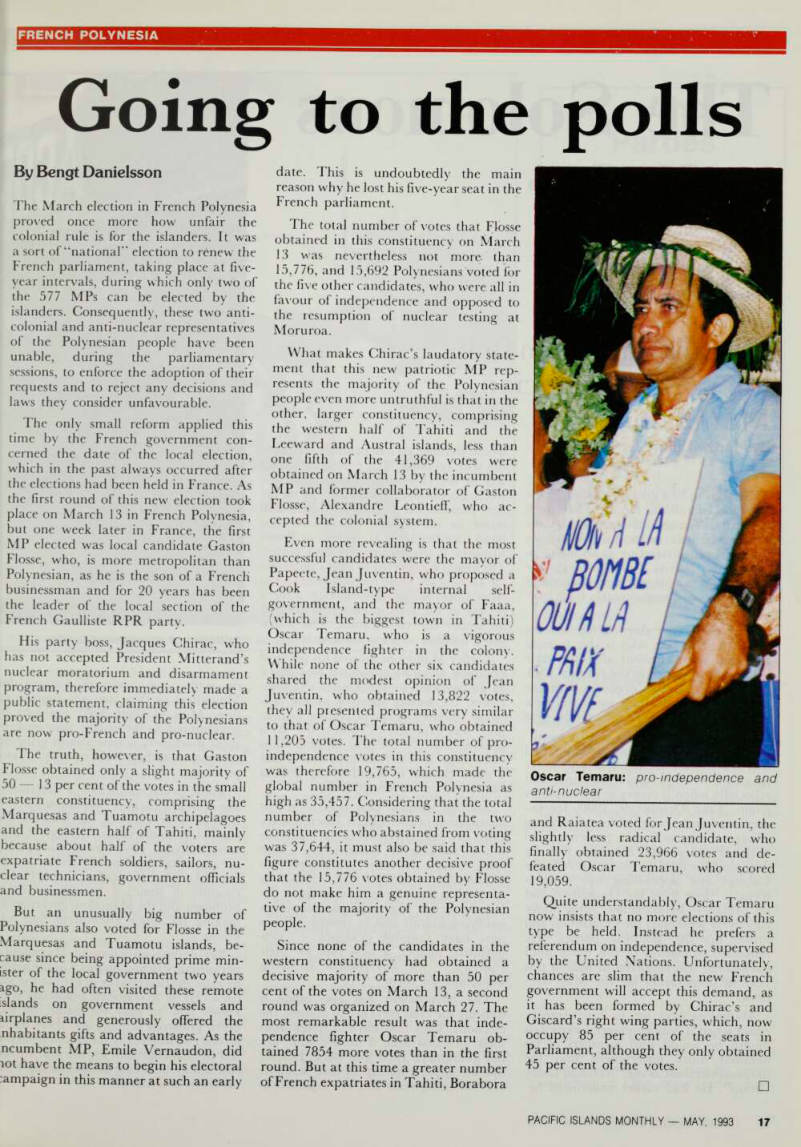
Even more revealing is that the most successful candidates were the mayor of Papeete, Jean Juventin, who proposed a Cook Island-type internal self government, and the mayor of Faaa, (which is the biggest town in Tahiti) Oscar Temaru, who is a vigorous independence fighter in the colony.
While none of the other six candidates hared the modest opinion of Jean Juventin, who obtained 13,822 votes, they all presented programs very similar to that of Oscar Temaru, who obtained 11,205 votes. The total number of pro independence votes in this constituency was therefore 19,765, which made the global number in French Polynesia as high as 35,457. Considering that the total number of Polynesians in the two constituencies who abstained from voting was 37,644, it must also be said that this figure constitutes another decisive proof that the 15,776 votes obtained by Flosse do not make him a genuine representa tive of the majority of the Polynesian
people.
Since none of the candidates in the western constituency had obtained a decisive majority of more than 50 per cent of the votes on March 13, a second round was organized on March 27. The most remarkable result was that inde pendence fighter Oscar Temaru ob tained 7854 more votes than in the first round. But at this time a greater number of French expatriates in Tahiti, Borabora
and Raiatea voted for Jean Juventin, the slightly less radical candidate, who finally obtained 23,966 votes and de feated Oscar Temaru, who scored 19,059.
Quite understandably, Oscar Temaru
now insists that no more elections of this type be held. Instead he prefers a referendum on independence, supervised by the United Nations. Unfortunately, chances are slim that the new French government will accept this demand, as it has been formed by Chirac’s and Giscard’s right wing parties, which, now occupy 85 per cent of the seats in Parliament, although they only obtained 45 per cent of the votes. □
Oscar Temaru: pro-independence and anti-nuclear