Bilney’s point of view
p. 13 · Read in the full issue
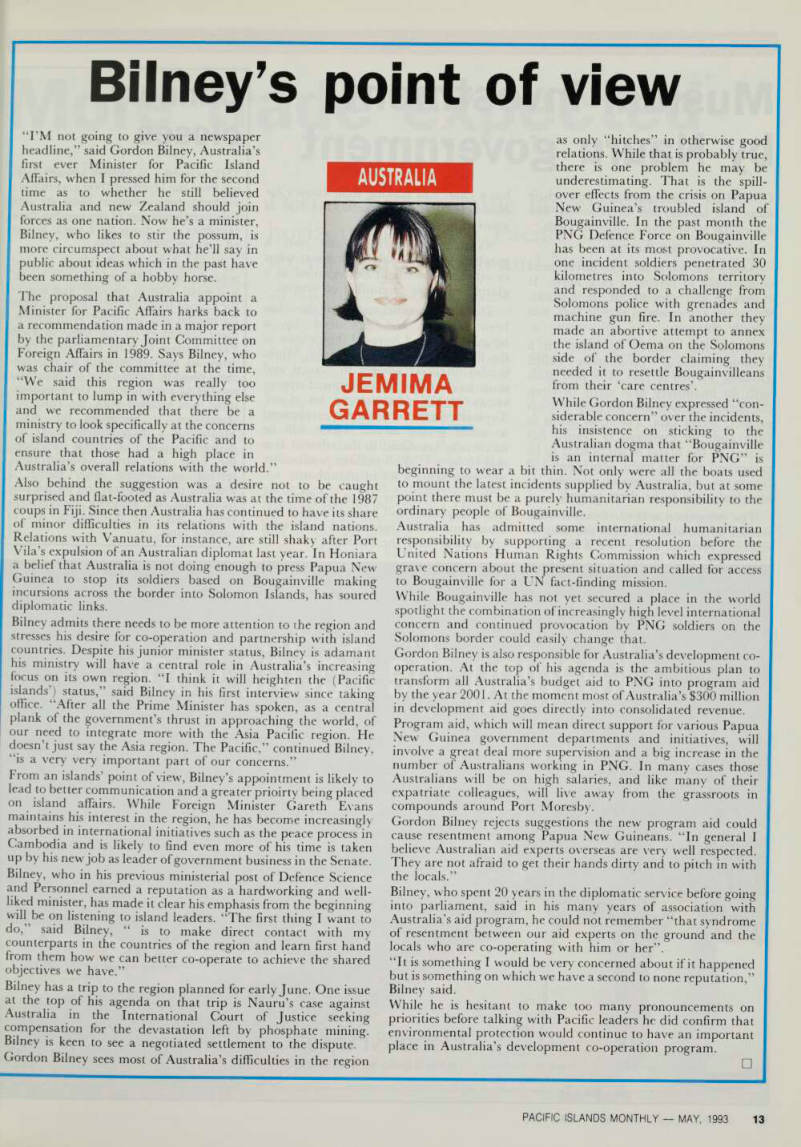
“I’M not going to give you a newspaper headline,” said Gordon Bilney, Australia’s first ever Minister for Pacific Island Affairs, when I pressed him for the second time as to whether he still believed Australia and new Zealand should join forces as one nation. Now he’s a minister, Bilney, who likes to stir the possum, is more circumspect about what he’ll say in public about ideas which in the past have been something of a hobby horse.
The proposal that Australia appoint a Minister for Pacific Affairs harks back to a recommendation made in a major report by the parliamentary Joint Committee on Foreign Affairs in 1989. Says Bilney, who was chair of the committee at the time, “We said this region was really too important to lump in with everything else and we recommended that there be a ministry to look specifically at the concerns of island countries of the Pacific and to ensure that those had a high place in Australia’s overall relations with the world.”
I Also behind the suggestion was a desire not to be caught surprised and flat-footed as Australia was at the time of the 1987 coups in Fiji. Since then Australia has continued to have its share of minor difficulties in its relations with the island nations.
Relations with Vanuatu, for instance, are still shaky after Port Vila’s expulsion of an Australian diplomat last year. In Honiara a belief that Australia is not doing enough to press Papua New Guinea to stop its soldiers based on Bougainville making incursions across the border into Solomon Islands, has soured diplomatic links.
Bilney admits there needs to be more attention to the region and stresses his desire for co-operation and partnership wdth island countries. Despite his junior minister status, Bilney is adamant his ministry will have a central role in Australia’s increasing focus on its own region. “I think it will heighten the (Pacific islands ) status,” said Bilney in his first interview since taking office. After all the Prime Minister has spoken, as a central plank of the government’s thrust in approaching the world, of our need to integrate more with the Asia Pacific region. He doesn t just say the Asia region. The Pacific,” continued Bilney, “is a very very important part of our concerns.”
From an islands’ point of view r , Bilney’s appointment is likely to lead to better communication and a greater prioirty being placed on island affairs. While Foreign Minister Gareth Evans maintains his interest in the region, he has become increasingly absorbed in international initiatives such as the peace process in Cambodia and is likely to find even more of his time is taken up by his new job as leader of government business in the Senate.
Bilney, who in his previous ministerial post of Defence Science and Personnel earned a reputation as a hardworking and well liked minister, has made it clear his emphasis from the beginning will, be on listening to island leaders. “The first thing I want to do, said Bilney, “ is to make direct contact with my counterparts in the countries of the region and learn first hand from them how we can better co-operate to achieve the shared objectives we have,”
Bilney has a trip to the region planned for early June. One issue at the top of his agenda on that trip is Nauru’s case against Australia in the International Court of Justice seeking compensation for the devastation left by phosphate mining.
Bilney is keen to see a negotiated settlement to the dispute.
Gordon Bilney sees most of Australia’s difficulties in the region
as only “hitches” in otherwise good relations. While that is probably true, there is one problem he may be underestimating. That is the spill over effects from the crisis on Papua New Guinea’s troubled island of Bougainville. In the past month the PNG Defence Force on Bougainville has been at its most provocative. In one incident soldiers penetrated 30 kilometres into Solomons territory and responded to a challenge from Solomons police with grenades and machine gun fire. In another they made an abortive attempt to annex the island of Oema on the Solomons side of the border claiming they needed it to resettle Bougainvilleans from their ‘care centres’.
While Gordon Bilney expressed “con siderable concern” over the incidents, his insistence on sticking to the
Australian dogma that “Bougainville
is an internal matter for PNG” is
beginning to wear a bit thin. Not only were all the boats used to mount the latest incidents supplied by Australia, but at some point there must be a purely humanitarian responsibility to the ordinary people of Bougainville.
Australia has admitted some international humanitarian responsibility by supporting a recent resolution before the United Nations Human Rights Commission which expressed grave concern about the present situation and called for access to Bougainville for a UN fact-finding mission.
While Bougainville has not yet secured a place in the world spotlight the combination of increasingly high level international concern and continued provocation by PNG soldiers on the Solomons border could easily change that.
Gordon Bilney is also responsible for Australia’s development co operation. At the top of his agenda is the ambitious plan to transform all Australia’s budget aid to PNG into program aid by the year 2001. At the moment most of Australia’s $3OO million in development aid goes directly into consolidated revenue.
Program aid, which will mean direct support for various Papua New Guinea government departments and initiatives, will involve a great deal more supervision and a big increase in the number of Australians working in PNG. In many cases those Australians will be on high salaries, and like many of their expatriate colleagues, will live away from the grassroots in compounds around Port Moresby.
Gordon Bilney rejects suggestions the new program aid could cause resentment among Papua New Guineans. “In general I believe Australian aid experts overseas are very well respected.
They are not afraid to get their hands dirty and to pitch in with the locals.”
Bilney, who spent 20 years in the diplomatic service before going into parliament, said in his many years of association with Australia’s aid program, he could not remember “that syndrome of resentment between our aid experts on the ground and the locals who are co-operating with him or her”.
“It is something I would be very concerned about if it happened but is something on which we have a second to none reputation,”
Bilney said.
While he is hesitant to make too many pronouncements on priorities before talking with Pacific leaders he did confirm that environmental protection would continue to have an important place in Australia’s development co-operation program.