The tuna dilemma
pp. 9-11 · Read in the full issue
Fisheries
The debate continues on what is a fair return from the islands’ only real resource its ocean. Economist Roman
Grynberg reports.
IT is only five years now since the nations of the Forum Fisheries Agency signed their first multi-lateral fisheries access agreement with the United States. That treaty was a land mark and brought to an end virtually a decade of acrimony, vitriol and open confrontation that many feared would push the island states of the South Pacific into what was then the Soviet camp. All this is history now but once again tuna fish diplomacy is ready to become an issue in the region’s affairs. As is fitting the 1990 s actors are different, the conflict is now with the Asian distant water fishing nations (DWFNs, pronounced Dwifins) and relations with the US are back on an even keel.
The new problem with tuna is much like the old one. The Pacific island nations (PIN) have since the United Nations Convention on the Law of the Sea had official international recognition of their 200-mile exclusive economic zone (FEZ). The problem was that the US, under pressure from its tuna boat lobby and Congress, never recognised the right
of nations over highly migratory species
affish in those EEZs. The argument went that because tuna migrates long dis ances, the Pacific island nations had no ■ights over fish that happened to be in heir FEZ.
For very obvious reasons, PIN did not juite see it that way, for while they did lot own the fish, they certainly had clear egal rights to sell rights to catch those ish while they were in their FEZ and ome PIN decided to use the powers they lad under the Law of the Sea Conven ion to seize US tuna vessels that were
[legally fishing. Papua New Guinea
eized the Damca in 1982 and under the nfamous Magnuson Act the US hreatened to impose mandatory sanc ions on PNG in retaliation. This was Dllowed by the Jeanette Diana episode /hen in June 1984 the Solomon Islands eized another US purse seiner fishing legally in its waters. What followed was rude lesson in tuna diplomacy for the ;land nations. Under pressure from the American Tuna Boat Association the US nposed an export embargo on Solomon slands fish products as well as other
etaliatory measures.
It was only when relations between NG and the US began to sour and resident leremia Tabai of Kiribati gned a fisheries access agreement with le Soviets that alarm bells started to )und in Washington. This was soon
followed by an agreement between Vanuatu and the USSR. It became clear in Washington that a change in policy was necessary and after several long years of negotiations the US signed a multi lateral treaty with the 16 members of the Forum Fisheries Agency. This treaty was certainly the Forum’s most successful effort at regional co-operation. The 1987 treaty gave the island nations an agree ment whereby the US paid
were paying PNG in their bilaterial negotiations. In large measure as a result of the USA-FFA treaty, negotiations between Japan and PNG collapsed in January 1987 and Japanese vessels have never returned to PNG waters to fish for tuna.
Following the treaty, relations with the US have improved dramatically. The Soviets left the Pacific soon after the initial agreements expired. Ironically, in
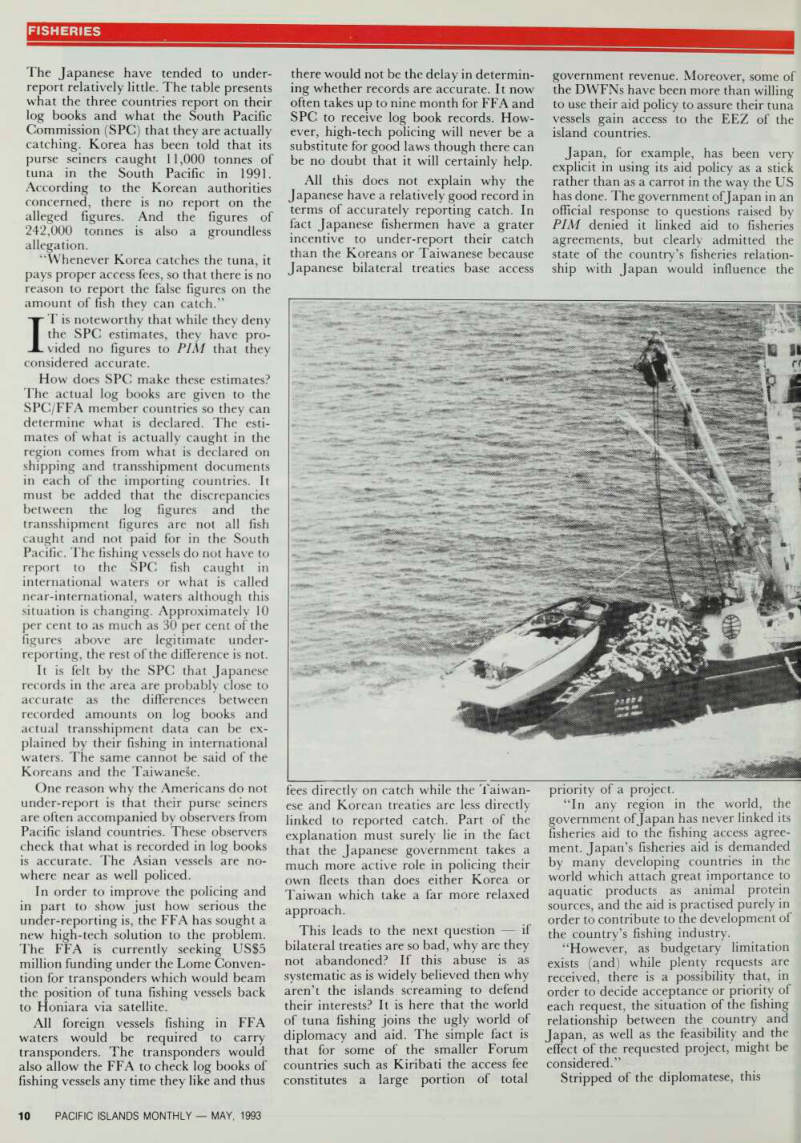
Estimated Catch by Purse Seiners in the South Pacific (metric tonnes, 1991)
Note: These are estimates of purse seiner fleets and do not include catches by Longline and pole and line fleets operating in the South Pacific.
Source: South Pacific Commission.
approximately nine per cent of the value of their catch as access fees to PIN.
Clearly, there was no way in which the American Tuna-Boat Association (ATA) was willing to pay nine per cent of the value of the catch, so in order to solve the problem, the US decided to pay almost 75 per cent from aid money. In effect, the ATA would only pay two per cent. The actual fees paid by the association amounted to US$4 million per annum in the revised 1991 treaty. This amounted to less than two per cent of the value of the catch. The rest, made up of $l4 million per annum, was in the form of grants from the US aid budget.
Under the current treaty arrangement US vessel owners pay only US$5O,OOO per vessel for the first 40 vessels and then after that US$6O,OOO per vessel up to a maximum of 40 vessels. The industry also pays $250,000 per annum into a techni cal assistance fund.
This nine per cent figure was unprece dented over twice what the Japanese
the last month Russian purse seiners have returned to the South Pacific. A Singa porean company has leased 10 Russian purse seiners which are in Honiara and will be fishing in Solomon waters.
Since 1987 PIN have seen the nine per-cent figure as a good but probably unachievable benchmark. With the ex ception of the US no one except Taiwan (which only four FFA members recog nise) has been willing to consider discuss ing a multi-lateral treaty. The reason is simple. For the DWFNs it is better to negotiate with one poor under-developed island country than with all 16 of them.
In 1991 the FFA estimated the DWFNs took over one million tonnes of tuna from the waters of its member states. Of this the US fleet took an estimated 205,000 tonnes and there is little doubt about the accuracy of this figure. The same cannot be said of Korea and Taiwan who massively under-report their catches.
Japan Korea Taiwan Log book entries 94,000 11,000 26,000 SRC estimates 170,000 242,000 176,000
The Japanese have tended to under report relatively little. The table presents what the three countries report on their log books and what the South Pacific Commission (SPC) that they are actually catching. Korea has been told that its purse seiners caught 11,000 tonnes of tuna in the South Pacific in 1991.
According to the Korean authorities concerned, there is no report on the alleged figures. And the figures of 242,000 tonnes is also a groundless
allegation.
“Whenever Korea catches the tuna, it pays proper access fees, so that there is no reason to report the false figures on the amount of fish they can catch.”
IT is noteworthy that while they deny the SPC estimates, they have pro vided no figures to PIM that they considered accurate.
How does SPC make these estimates?
The actual log books are given to the SPC/FFA member countries so they can determine what is declared. The esti mates of what is actually caught in the region comes from what is declared on shipping and transshipment documents in each of the importing countries. It must be added that the discrepancies between the log figures and the transshipment figures are not all fish caught and not paid for in the South Pacific. The fishing vessels do not have to report to the SPC fish caught in international waters or what is called near-international, waters although this situation is changing. Approximately 10 per cent to as much as 30 per cent of the figures above are legitimate under reporting, the rest of the difference is not.
It is felt by the SPC that Japanese records in the area are probably close to accurate as the differences between recorded amounts on log books and actual transshipment data can be ex
plained by their fishing in international
waters. The same cannot be said of the Koreans and the Taiwanese.
One reason why the Americans do not under-report is that their purse seiners are often accompanied by observers from Pacific island countries. These observers check that what is recorded in log books is accurate. The Asian vessels are no where near as well policed.
In order to improve the policing and in part to show just how serious the under-reporting is, the FFA has sought a new high-tech solution to the problem.
The FFA is currently seeking US$5 million funding under the Lome Conven tion for transponders which would beam the position of tuna fishing vessels back to Honiara via satellite.
All foreign vessels fishing in FFA waters would be required to carry transponders. The transponders would also allow the FFA to check log books of fishing vessels any time they like and thus
there would not be the delay in determin ing whether records are accurate. It now often takes up to nine month for FFA and SPC to receive log book records. How ever, high-tech policing will never be a substitute for good laws though there can be no doubt that it will certainly help.
All this does not explain why the Japanese have a relatively good record in terms of accurately reporting catch. In fact Japanese fishermen have a grater incentive to under-report their catch than the Koreans or Taiwanese because Japanese bilateral treaties base access
fees directly on catch while the Taiwan ese and Korean treaties are less directly linked to reported catch. Part of the explanation must surely lie in the fact that the Japanese government takes a much more active role in policing their own fleets than does either Korea or Taiwan which lake a far more relaxed
approach.
This leads to the next question if bilateral treaties are so bad, why are they not abandoned? If this abuse is as systematic as is widely believed then why aren’t the islands screaming to defend their interests? It is here that the world of tuna fishing joins the ugly world of diplomacy and aid. The simple fact is that for some of the smaller Forum countries such as Kiribati the access fee constitutes a large portion of total
government revenue. Moreover, some of the DWFNs have been more than willing to use their aid policy to assure their tuna vessels gain access to the FEZ of the island countries.
Japan, for example, has been very explicit in using its aid policy as a stick rather than as a carrot in the way the US has done. The government ofjapan in an official response to questions raised by PIM denied it linked aid to fisheries agreements, but clearly admitted the state of the country’s fisheries relation ship with Japan would influence the
priority of a project.
“In any region in the world, the government ofjapan has never linked its fisheries aid to the fishing access agree ment. Japan’s fisheries aid is demanded by many developing countries in the world which attach great importance to aquatic products as animal protein sources, and the aid is practised purely in order to contribute to the development of the country’s fishing industry.
“However, as budgetary limitation exists (and) while plenty requests are received, there is a possibility that, in order to decide acceptance or priority of each request, the situation of the fishing relationship between the country and Japan, as well as the feasibility and the effect of the requested project, might be considered.”
Stripped of the diplomatese, this
means ‘no fisheries access; no aid funds for your fishing industry’. According to senior Fiji government officials, Fiji’s boat building project was cut off by Japan because it refused to sign a bilateral access agreement. In response to the allegation, the government ofjapan responded: “The fisheries projects requested by the Fiji government were difficult to execute because Fiji’s GNP per capita ($ll7O in 1990) exceeds substantially the standard set by the Japanese government for the countries suitable to Japan’s grant
aid (SI 195 or less). The situation above mentioned has already been explained to the Fiji government and, therefore, the Japanese government never committed itself to the said projects.”
The Japanese are one of the region's major aid donors and few' of the smaller islands are willing to quibble over what is mistakenly believed to be a few tuna fish when much larger issues of aid and international diplomacy are at stake.
Japan has made it perfectly clear it will not sign a multi-lateral treaty like the US with the FFA. According to FFA offic
ials, the Japanese do not even recognise the FFA, although this is vehemently denied by the Japanese. An official response from Tokyo said: “The govern ment ofjapan thinks that to keep current bilateral agreements is more reasonable than to create a multi-lateral treaty with FFA countries because Japanese vessels’ demand to access (is) to EEZs of only limited countries, so that it is difficult to sign an access agreement including the countries without demand.” This re sponse makes little sense as it is possible to sign a multi-lateral treaty based on access fees for only those countries where one fishes.
The tuna issue is proof that in the end regional trade ministers will put trade in tuna on the back burner when compared to aid funds coming from Tokyo, Seoul and Taipei. As long as the South Pacific nations continue to accept the under reporting and the poor bilateral treaties, and they are perfectly aware that is happening, they will continue.
Approximately 55 per cent of the world’s canning tuna comes from the South Pacific and it is one of the few areas where the region has real clout and enough resources to one day wean ourselves from aid and stand on our own feet. As soon as Pacific island leaders stand up together and say they are no longer willing to accept the abuse of the only abundant renewable resource they have, then Tokyo, Seoul and Taipei will take the issue away from their fisheries departments and their tunaboat lobbies and return it to foreign affairs and to the prominence it deserves.
In the long run a reasonable access fee will have to be paid. That day, however, will only come when Pacific island leaders demonstrate unity and finally demand their rights to a fair return on their resources rather than accept aid as a substitute for mutually advantageous trade. □