Sweet,
pp. 56-57 · Read in the full issue

sweet corn
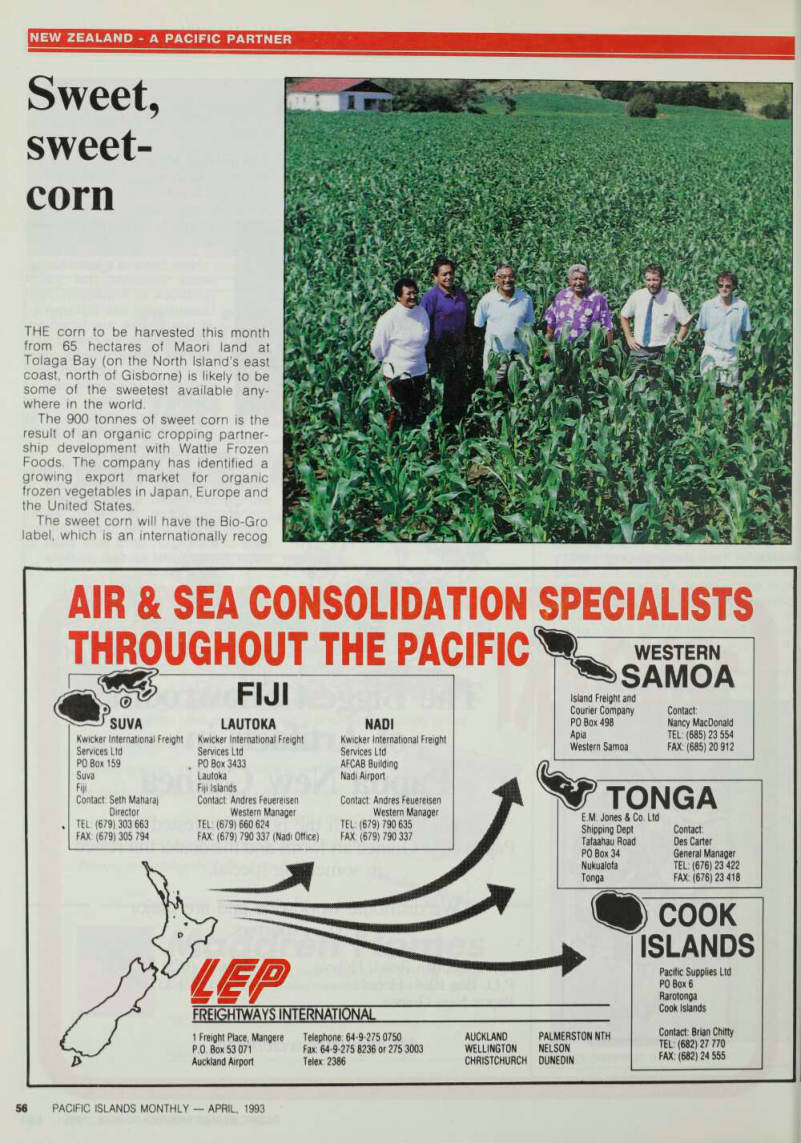
THE corn to be harvested this month from 65 hectares of Maori land at Tolaga Bay (on the North Island’s east coast, north of Gisborne) is likely to be some of the sweetest available any where in the world.
The 900 tonnes of sweet corn is the result of an organic cropping partner ship development with Wattie Frozen Foods. The company has identified a growing export market for organic frozen vegetables in Japan, Europe and the United States.
The sweet corn will have the Bio-Gro label, which is an internationally recog
nised organic standard with very strict rules about what is clean, green and organic.
There is a lot of land on the east coast which has had little or no chemicals applied to it, which means it has great potential for Bio-Gro production. The land that will yield the sweeter corn in Tolaga Bay is administered by the Paripoupou Trust on behalf of 1000 landowners. Bounded by steep native bush on one side and the Hikuwai River on the other, the two adjacent blocks had been leased for grazing for 50 years. The land was flood damaged in 1988 by Cyclone Bola. In 1992 the owners decided they would manage their own asset and farm the land themselves.
They were not alone, however, in seeing the potential for their land. 3 rivate contractors who had worked with Wattie Frozen Foods approached he Trust with a proposal for growing organic sweet corn. The partnership vith Wattie’s evolved when the company approached Te Puni Kokiri (New Zea and Ministry of Maori Development) vith a proposal to process and market he corn.
Rei Kohere. Te Rum Kokiri service broker in Gisborne, says from that
point the whole project became an important learning experience for every one involved. ‘The landowners were quite clear about the role they wanted to play in relation to their land, but knew they needed advice and resources to develop it and improve its productivity.”
The contractors had the knowledge and expertise in Bio-Gro and Te Puni Kokin’s MANA scheme provided estab lishment finance. The Trust could not use the land as security for a private sector loan because of the terms of the Trust Deed.
Te Puni Kokiri also helped with project development. ‘‘Our focus was always with the landowners,” says Rei Kohere. "We had to make sure the project met everyone’s requirements but the landowners’ position was, and still is, our priority. Our task was to make sure the owners had what they needed to make informed decisions and be there whenever it appeared that their position was being overlooked.”
Today the landowners’ position is one of strength. ‘‘We have a direct involvement in a well developed asset that promises to be both productive and profitable,” says Trust chairman Nolan Raihania. "We’re
looking forward to obtaining Bio-Gro status for ourselves. And we’re excited by what this means for the whole region.”
For Wattie’s, the project is also exciting. Wattie Frozen Foods agricul ture manager in Gisborne, Dr Stuart Davis, says that Wattie’s have made the Bio-Gro market a strategic priority in recent years. ‘‘Producing Bio-Gro vegetables is good for Wattie's, and good for New Zealand’s frozen vegetable market. Flere on the East Coast there’s great potential for New Zealand to trade on its clean green image.”
Overseas buyers are prepared to pay a premium for Bio-Gro vegetables, and because growers of organic vegetables run greater risk and incur added costs, they also get paid double the price they would receive for conventional veg etables.
For the landowners, Bio-Gro is also a label they’re very comfortable with. As Nolan Raihania points out, ‘‘From our perspective Bio-Gro is what traditional Maori cultivation techniques have al ways been about. What’s important now is to make organic farming profitable.” □ (Reproduced from the Te Puni Kokin Newsletter)