Manufactured exports - at the forefront
pp. 52-53 · Read in the full issue
ONE of the most surprising aspects of economic change in New Zealand is that with the lowering of border protec tion in the form of tariffs and licensing, manufactured exports have increased sharply. In 1966, for example, manufac tured exports accounted for a mere 2.7 per cent of total exports. By 1992, they had risen to 26.6 per cent of the total.
What is more, New Zealand manufactur ers export their products almost entirely without subsidies and assistance.
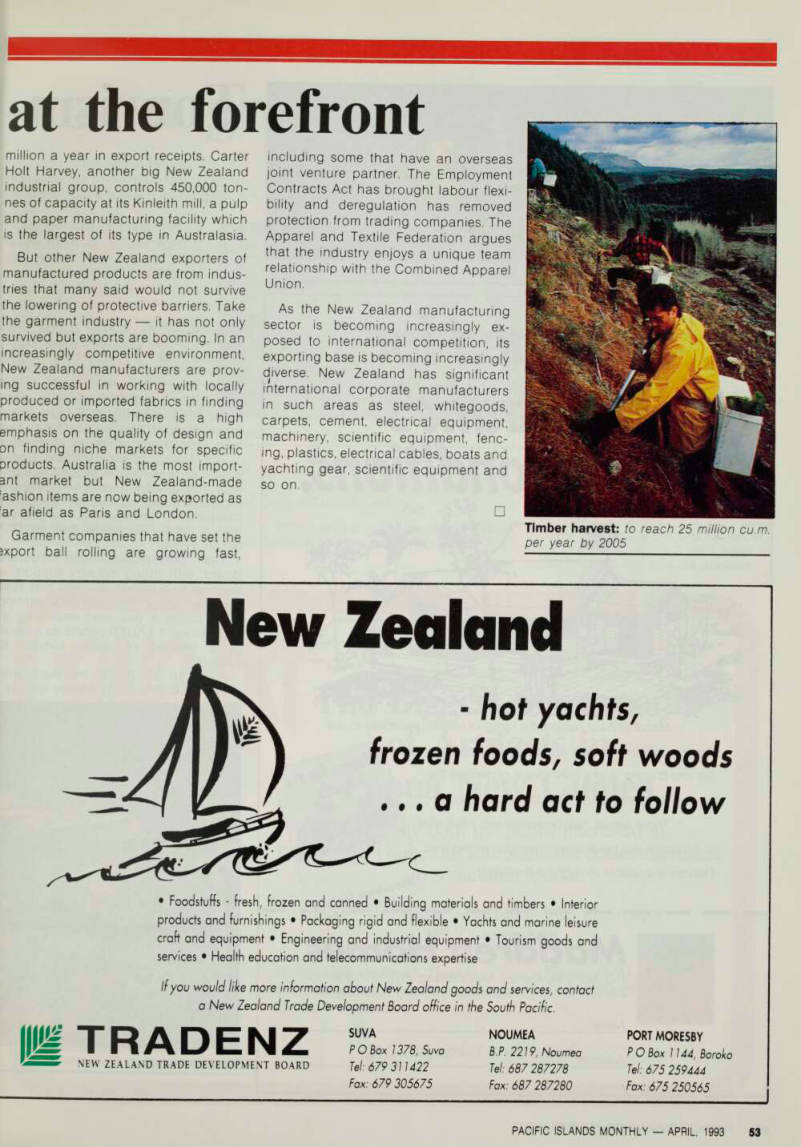
Some of New Zealand’s main export manufacturers are largely involved in processing New Zealand’s primary products, with forestry being the most obvious example in this area. This is an exciting area for New Zealand as at a time when there is an increasing short age of wood supplies worldwide, the sustainable production capacity of New Zealand forests will double by the year 2010.
New Zealand’s largest exporter of manufactured goods is in fact Tasman Pulp and Paper, a subsidiary of Fletcher Challenge, and it earns over NZ$4OO
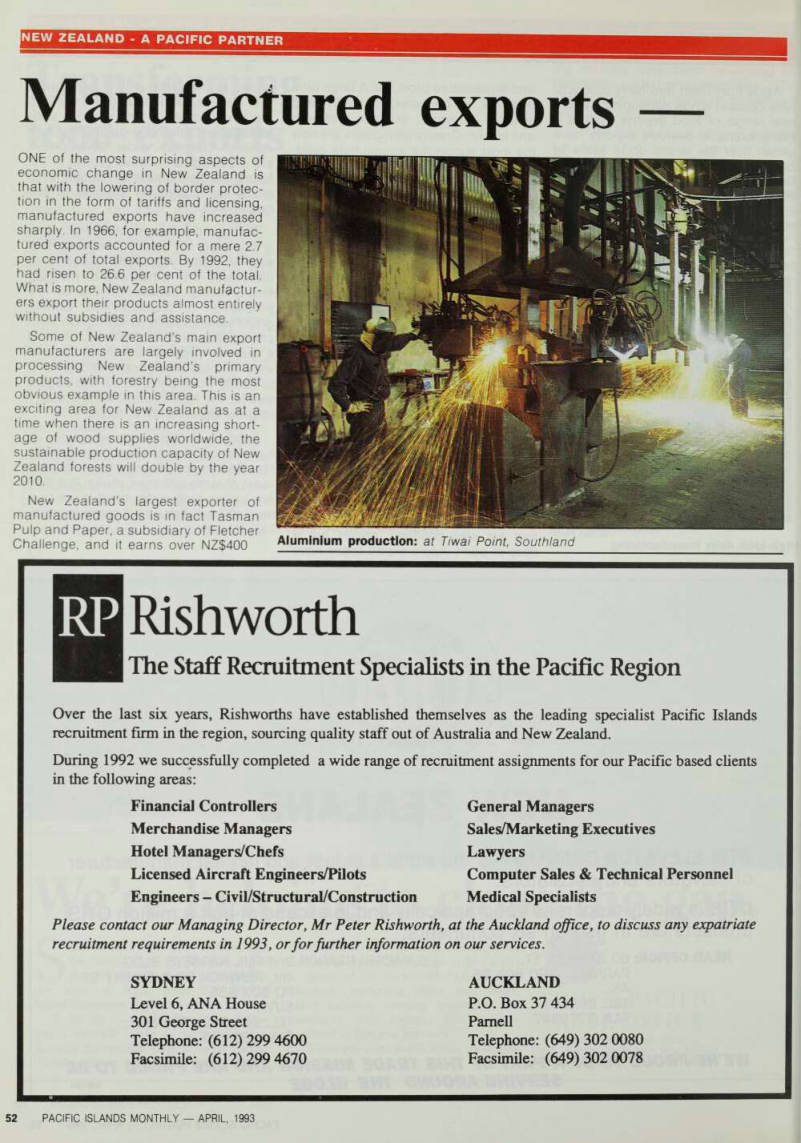
Aluminium production: at Tiwai Point, Southland
million a year in export receipts. Carter Holt Harvey, another big New Zealand industrial group, controls 450,000 ton nes of capacity at its Kinleith mill, a pulp and paper manufacturing facility which is the largest of its type in Australasia.
But other New Zealand exporters of manufactured products are from indus tries that many said would not survive the lowering of protective barriers. Take the garment industry it has not only survived but exports are booming. In an increasingly competitive environment, New Zealand manufacturers are prov ing successful in working with locally produced or imported fabrics in finding markets overseas. There is a high emphasis on the quality of design and on finding niche markets for specific products. Australia is the most import ant market but New Zealand-made 'ashion items are now being exported as : ar afield as Paris and London.
Garment companies that have set the export ball rolling are growing fast,
including some that have an overseas joint venture partner. The Employment Contracts Act has brought labour flexi bility and deregulation has removed protection from trading companies. The Apparel and Textile Federation argues that the industry enjoys a unique team relationship with the Combined Apparel Union.
As the New Zealand manufacturing sector is becoming increasingly ex posed to international competition, its exporting base is becoming increasingly diverse. New Zealand has significant international corporate manufacturers in such areas as steel, whitegoods, carpets, cement, electrical equipment, machinery, scientific equipment, fenc ing, plastics, electrical cables, boats and yachting gear, scientific equipment and so on.
Timber harvest: to reach 25 million cu.m. per year by 2005