A step ahead
pp. 47-49 · Read in the full issue
SIMILAR in size to Japan or Italy and somewhat smaller than PNG, New Zealand combines high mountains with extensive hill country and lowland plains. Snow fields, swift flowing rivers and a long coastline add to the variety.
New Zealand is renowned inter nationally for its landscape and beauty.
Reflecting its South Pacific location, the sea is a key factor in New Zealand’s temperate mid-latitude climate. Sun and
rain are plentiful and winters are not particularly cold. But in any one place at any one time, the weather can change quite quickly.
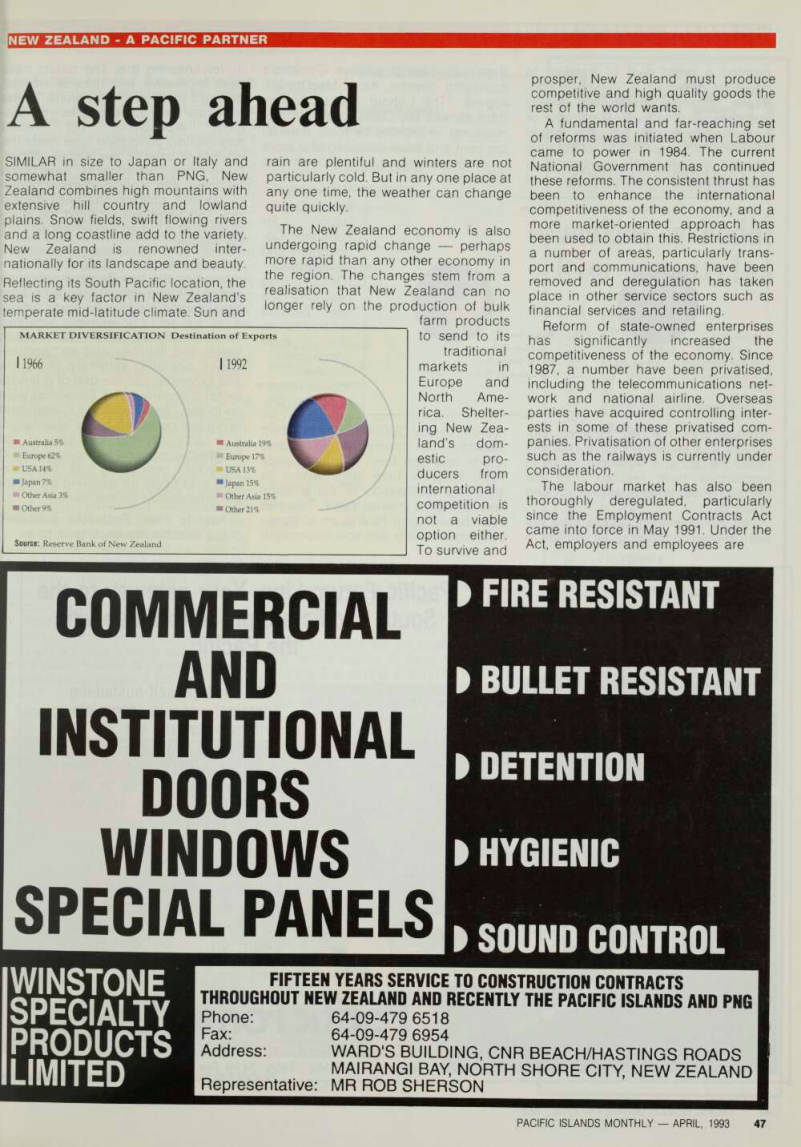
The New Zealand economy is also undergoing rapid change perhaps more rapid than any other economy in the region. The changes stem from a realisation that New Zealand can no longer rely on the production of bulk
farm products to send to its traditional markets in Europe and North Ame rica. Shelter ing New Zea land’s dom estic pro ducers from international competition is not a viable option either.
To survive and
prosper, New Zealand must produce competitive and high quality goods the rest of the world wants.
A fundamental and far-reaching set of reforms was initiated when Labour came to power in 1984. The current National Government has continued these reforms. The consistent thrust has been to enhance the international competitiveness of the economy, and a more market-oriented approach has been used to obtain this. Restrictions in a number of areas, particularly trans port and communications, have been removed and deregulation has taken place in other service sectors such as financial services and retailing.
Reform of state-owned enterprises has significantly increased the competitiveness of the economy. Since 1987, a number have been privatised, including the telecommunications net work and national airline. Overseas parties have acquired controlling inter ests in some of these privatised com panies. Privatisation of other enterprises such as the railways is currently under consideration.
The labour market has also been thoroughly deregulated, particularly since the Employment Contracts Act came into force in May 1991. Under the Act, employers and employees are
Source: Reserve Bank of New Zealand
granted a great deal of freedom to negotiate collective or individual con tracts. Collective bargaining usually takes place at the level of enterprise or workplace. Employees have the right to choose their representation for contract negotiation and union membership is not compulsory. Already the types of
arrangements reached between em ployers and employees have changed under the act and significant gains in productivity have resulted from the removal of outdated restrictive working practices.
The labour market reforms have not been without controversy but reaction to
them is increasingly positive. Comalco’s managing director, Kerry MacDonald, argues, “The Labour market reforms have allowed key Comalco productivity measures to improve by more than 30 per cent and have encouraged a more innovative, enthusiastic and committed workforce.
The Paris based Organ isation for Economic Co operation and Development (OECD) has described the New Zealand experience as “the most comprehen sive microeconom = ic reform pro gramme car
ried out by any OECD country in recent decades”. But macroeconomic policy reform has also been a priority since 1984, Reforms here were aimed at achieving stabilisation of the inflation rate to reduce interest rates. This has been based upon having an indepen dent Reserve Bank with sole responsible
ity for ensuring this. The results have been impressive, with rates of inflation amongst the lowest in the world. Efforts have also been made to reduce govern ment expenditure, but recent recessionary conditions have made the attempt to balance the budget difficult.
Government departments have been reformed, and a comprehensive reform of taxation policies has been carried out. This latter has included the intro duction of a broad valued-added GST tax system.
The Economist in October 1992 com mented on the New Zealand approach saying, “Britain should take a tip from New Zealand, the first country to publish a rational set of government accounts.
These include a balance sheet of public assets and liabilities and an “accrual based” operating statement of income and expenses, just like that of a private sector company.” The Economist went on to say, “New Zealand’s Government is not just collecting better information, it is also carrying out one of the toughest attacks on public spending in the world,” concluding that, “New Zea land also offers an excellent model for an independent central bank.”
Already New Zealand’s economic policy reforms are starting to bear
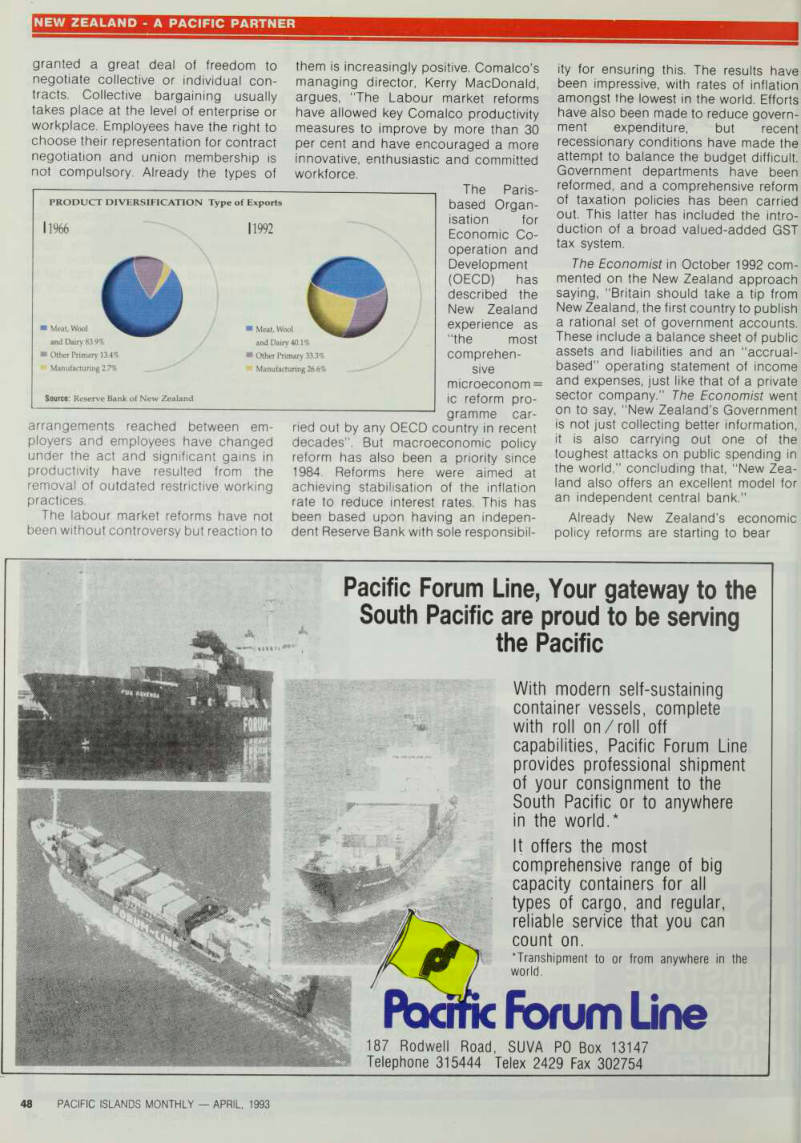
Source: Reserve Bank of New Zealand
fruit. New Zealand has, for example, been successful in substantially lessen ing its dependence on a narrow range of agricualtural exports by diversifying its product range while increasing the level of value added in its products.
Whilst it is still a world leader in the efficient production of dairy products, wool and meat, less than half its export earnings now come from these product areas. Instead, exports of other products have increased rapidly, including manu factured exports which today account for more than a quarter of the total.
New Zealand’s main export markets have also been diversified, today being spread through Asia, North America, Europe and Australia. Around 22 per cent of GDP is exported.
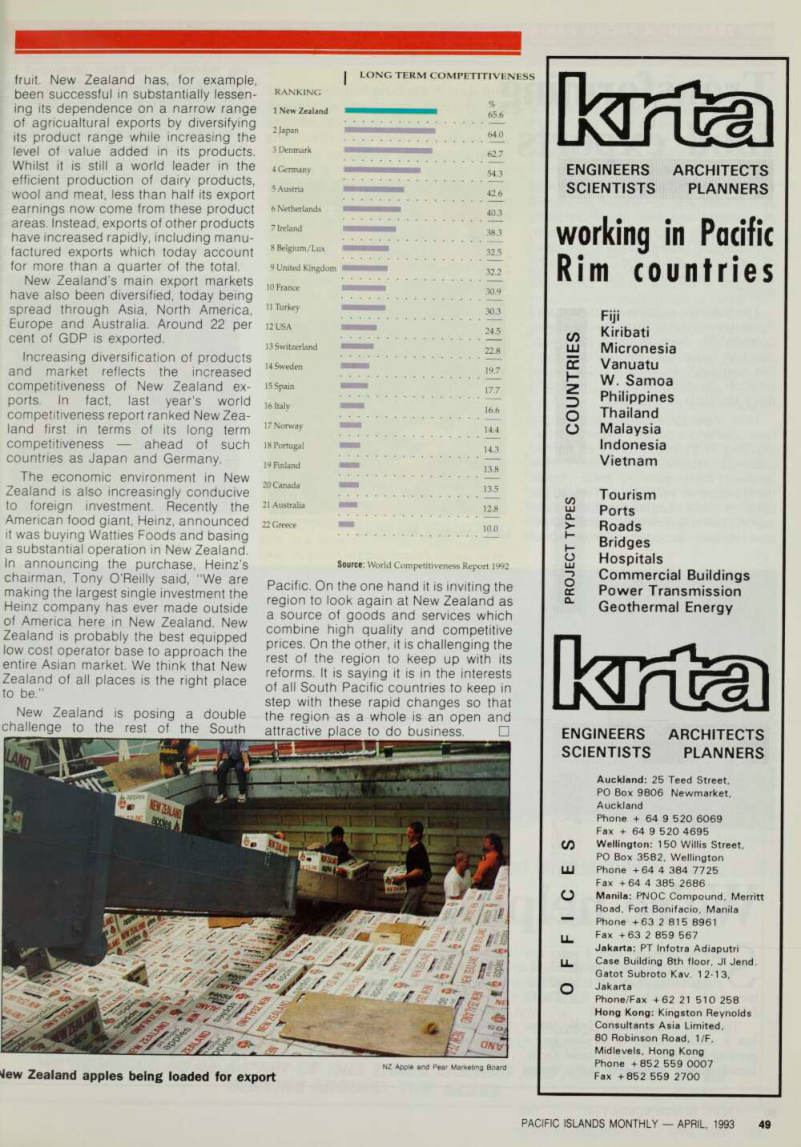
Increasing diversification of products and market reflects the increased competitiveness of New Zealand ex ports. In fact, last year’s world competitiveness report ranked New Zea land first in terms of its long term competitiveness ahead of such countries as Japan and Germany.
The economic environment in New Zealand is also increasingly conducive to foreign investment. Recently the American food giant, Heinz, announced it was buying Watties Foods and basing a substantial operation in New Zealand.
In announcing the purchase, Heinz’s chairman, Tony O’Reilly said, “We are making the largest single investment the Heinz company has ever made outside of America here in New Zealand. New Zealand is probably the best equipped low cost operator base to approach the entire Asian market. We think that New Zealand of all places is the right place to be.’’
New Zealand is posing a double challenge to the rest of the South
Pacific. On the one hand it is inviting the region to look again at New Zealand as a source of goods and services which combine high quality and competitive prices. On the other, it is challenging the rest of the region to keep up with its reforms. It is saying it is in the interests of all South Pacific countries to keep in step with these rapid changes so that the region as a whole is an open and attractive place to do business. □
New Zealand apples being loaded for export
Source: World Competitiveness Report 1992
NZ Apple and Pear Marketing Board