Tappin[?] the region
pp. 42-45 · Read in the full issue
IN MARCH 1991, New Zealand’s Foreign Minister, Don McKinnon, delivered a speech on New Zealand in the South Pacific to the Institute of International Affairs. It charted a new emphasis in New Zealand’s policy in the region.
McKinnon began by saying, “Open access and willingness to listen are fundamental. We are not about preach ing or lecturing or claiming special insight or moral superiority. We don’t like being treated this way ourselves and we won’t be dumping it on others. And we are not I might add getting ourselves caught up in a long and circular review process. Instead we are getting on with the job of bringing New Zealand’s South Pacific policies into a more contemporary focus. And it’s not before time an injection of realism is long overdue”.
McKinnon admitted New Zealand had made some mistakes in the past. “By the
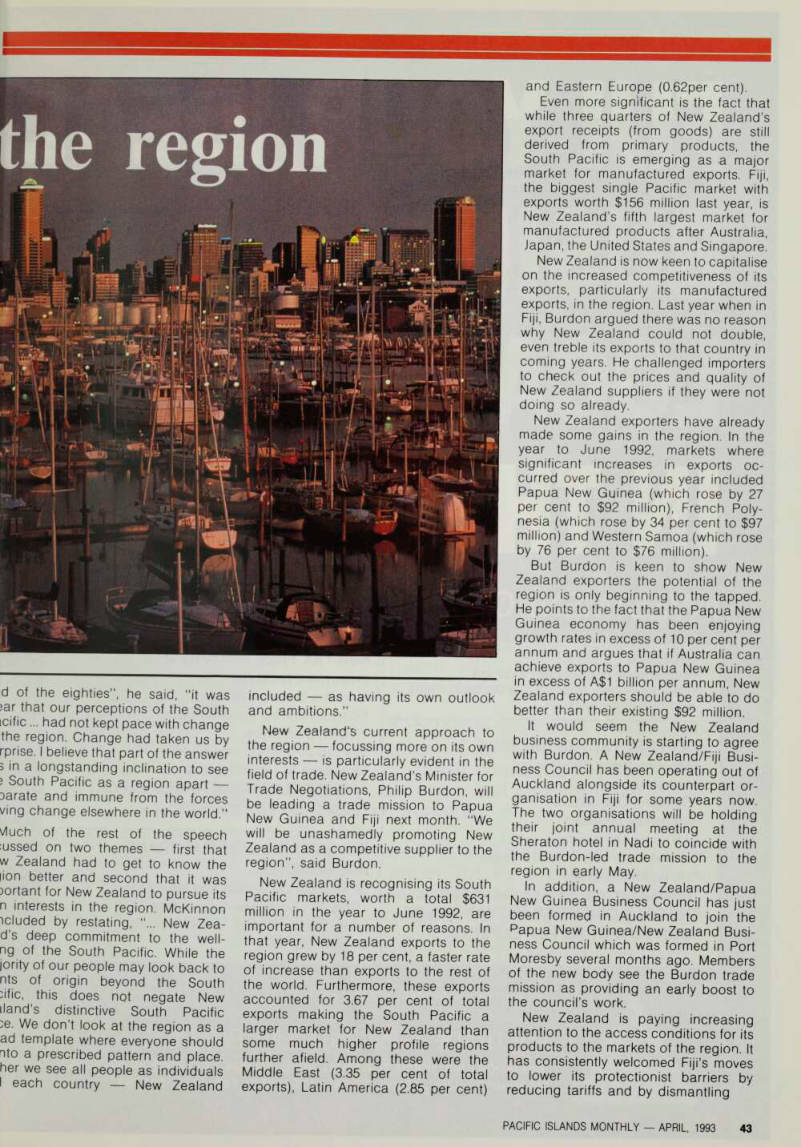
The Auckland skyline: from Westhaven [?]
d of the eighties”, he said, “it was ?ar that our perceptions of the South icific... had not kept pace with change the region. Change had taken us by rprise. I believe that part of the answer s in a longstanding inclination to see J South Pacific as a region apart Darate and immune from the forces ving change elsewhere in the world.” vluch of the rest of the speech :ussed on two themes first that w Zealand had to get to know the lion better and second that it was )ortant for New Zealand to pursue its n interests in the region. McKinnon icluded by restating, ”... New Zea d’s deep commitment to the well ng of the South Pacific. While the jority of our people may look back to nts of origin beyond the South 3ific, this does not negate New Hand's distinctive South Pacific :e. We don’t look at the region as a ad template where everyone should nto a prescribed pattern and place, her we see all people as individuals I each country New Zealand
included as having its own outlook and ambitions.”
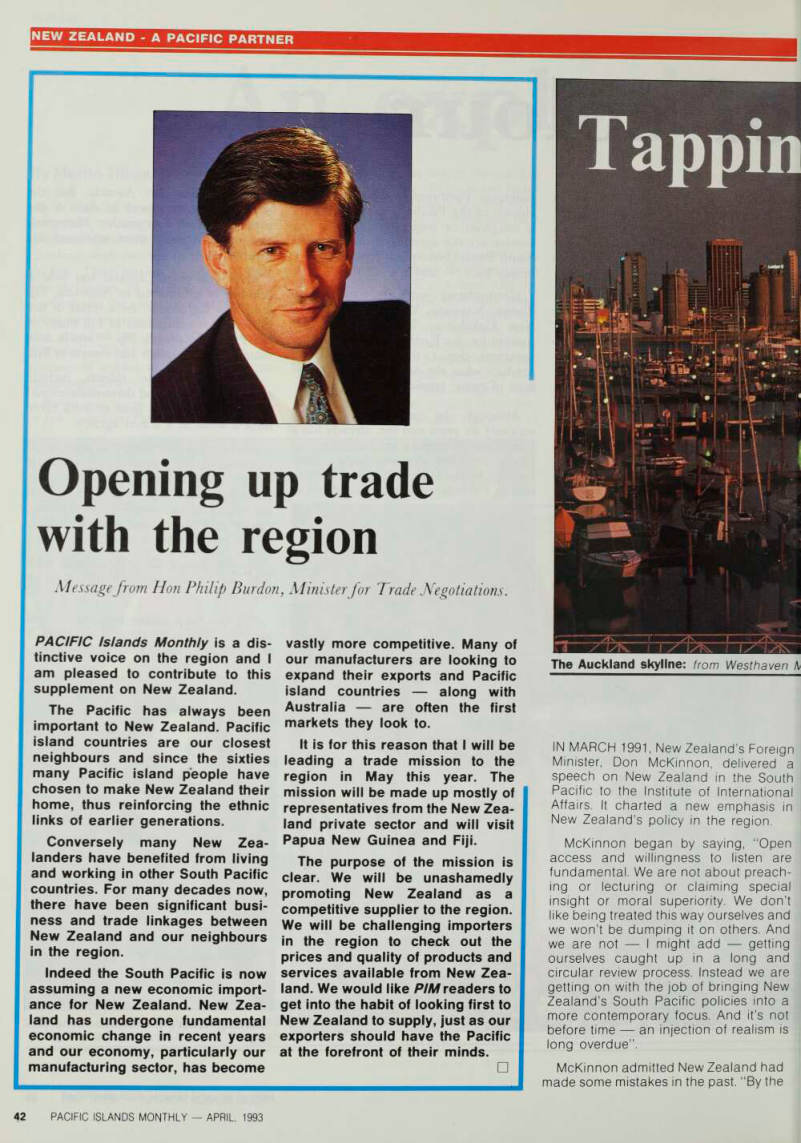
New Zealand's current approach to the region focussing more on its own interests is particularly evident in the field of trade. New Zealand's Minister for Trade Negotiations, Philip Burden, will be leading a trade mission to Papua New Guinea and Fiji next month. "We will be unashamedly promoting New Zealand as a competitive supplier to the region”, said Burdon.
New Zealand is recognising its South Pacific markets, worth a total $631 million in the year to June 1992, are important for a number of reasons. In that year, New Zealand exports to the region grew by 18 per cent, a faster rate of increase than exports to the rest of the world. Furthermore, these exports accounted for 3.67 per cent of total exports making the South Pacific a larger market for New Zealand than some much higher profile regions further afield. Among these were the Middle East (3.35 per cent of total exports), Latin America (2.85 per cent)
and Eastern Europe (o.62per cent).
Even more significant is the fact that while three quarters of New Zealand’s export receipts (from goods) are still derived from primary products, the South Pacific is emerging as a major market for manufactured exports. Fiji, the biggest single Pacific market with exports worth $156 million last year, is New Zealand’s fifth largest market for manufactured products after Australia.
Japan, the United States and Singapore.
New Zealand is now keen to capitalise on the increased competitiveness of its exports, particularly its manufactured exports, in the region. Last year when in Fiji, Burdon argued there was no reason why New Zealand could not double, even treble its exports to that country in coming years. He challenged importers to check out the prices and quality of New Zealand suppliers if they were not doing so already.
New Zealand exporters have already made some gains in the region. In the year to June 1992, markets where significant increases in exports oc curred over the previous year included Papua New Guinea (which rose by 27 per cent to $92 million), French Poly nesia (which rose by 34 per cent to $97 million) and Western Samoa (which rose by 76 per cent to $76 million).
But Burdon is keen to show New Zealand exporters the potential of the region is only beginning to the tapped.
He points to the fact that the Papua New Guinea economy has been enjoying growth rates in excess of 10 per cent per annum and argues that if Australia can achieve exports to Papua New Guinea in excess of Asl billion per annum, New Zealand exporters should be able to do better than their existing $92 million.
It would seem the New Zealand business community is starting to agree with Burdon. A New Zealand/Fiji Busi ness Council has been operating out of Auckland alongside its counterpart or ganisation in Fiji for some years now.
The two organisations will be holding their joint annual meeting at the Sheraton hotel in Nadi to coincide with the Burdon-led trade mission to the region in early May.
In addition, a New Zealand/Papua New Guinea Business Council has just been formed in Auckland to join the p apua New Guinea/New Zealand Busi ness Council which was formed in Port Moresby several months ago. Members of the new body see the Burdon trade mission as providing an early boost to the council’s work.
New Zealand is paying increasing attention to the access conditions for its products to the markets of the region. It has consistently welcomed Fiji’s moves to lower its protectionist barriers by reducing tariffs and by dismantling
import licensing. At last year’s Fiji/New Zealand Business Council, Fiji’s Trade Minister, Harold Powell, promised to look into “reciprocal” access for Austra lian and New Zealand products where there was no domestic Fiji manufacture.
This was also seen as a step forward.
At the same time, Wellington is watching with interest the evolution of economic development policy in Papua New Guinea. Burdon says that during his time in PNG he will want to talk over with his counterparts what New Zealand has learned about the costs and risks involved in providing too high a protec tion for local enterprises.
While there is a lot of interest in New Zealand exports to the South Pacific, the position of South Pacific imports into Mew Zealand is disappointing. In the /ear to June 1992, these fell by $4 million :o $124 million. However, if phosphate mports from Nauru are excluded, im- Dorts from other countries fell by $l9 nillion. Fiji is the main source of imports rom the region at $67 million or 53 per 'ent of the total. Garments make up the 'ast bulk of New Zealand’s imports from : iji.