Refugees
pp. 34-35 · Read in the full issue
Science
Refugees on remote volcanoes
By Dieter Rinke
NIUAFO’OU, equidistant from West ern Samoa, Tavcuni, and the Vava’u group of Tonga, is the home of an
unconspicuous, though highly remark
able species of bird the Tongan
Megapode ( Megapodius prilchardii), locally
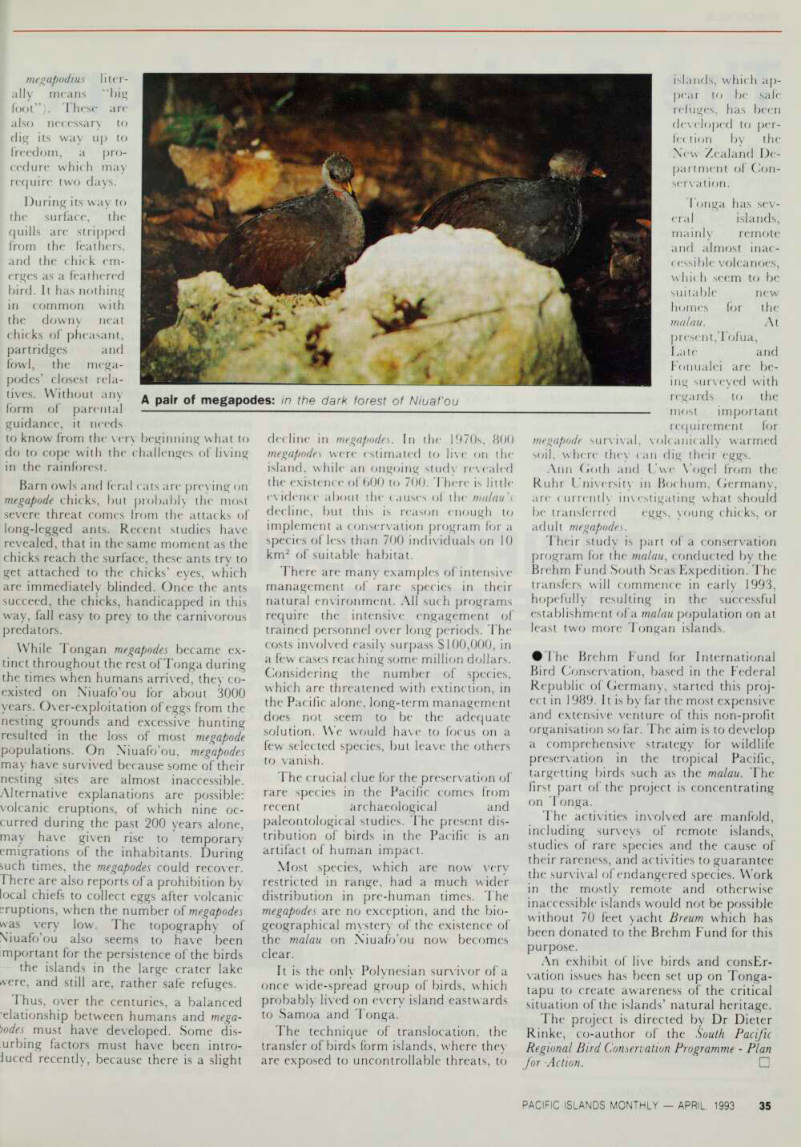
known as the malau. It is drab brown, not much bigger than the übiquitous banded rail, but has a most unusual breeding behaviour.
Unlike all other birds, mega pod es do not sit on their eggs to incubate them, but leave this task to external heal sources. In the case of the Tongan megapode, it is the heat from volcanic ducts which incubates and hatches the egg. So what the malau lacks in dramatic appearance is certainly made up for in its behaviour.
On Niuafo’ou, megapodes are now largely restricted to the caldera of the volcanic crater, an area not extending 10 km 2 . Thus, the malau , has the smallest range of any species of bird of similar or larger size. Their favourite habitat is the dense rainforest surrounding the lake within the crater, where they spend most of the day searching for food in the leaf litter. Insects, worms, and small fruit of forest trees are taken, possibly also small lizards and some seeds.
Tongan megapodes are monogamous, with a pair defendiing a territory all year round. A duet song, which is almost always initiated by the male, keeps the
pair bonded.
The nesting grounds are distributed around the crater lake (Vai Lain), and on the islands on the lake. Established sites have been used for generations, and each area is visited by several hens. Egg laying usually starts early in the morn ing. It is a laborious task to dig a burrow, sometimes two metres deep. After having laid the egg, the burrow has to be filled up again with soil.
Megapodes, especially the hens, pay a high price lor not actively incubating the egg, and for not having the sometimes
nerve-racking task of caring for a bunch of curious chicks. The hen produces an egg which is about 1/5 her weight. Only the'New Zealand kiw i lays an egg which is proportionately heavier. The malau egg needs to have enough protein to produce a chick, that is fully ready to fly and
completely independent it is ready to
cope with all the challenges of life in a tropical rain forest, without any parental guidance upon emergence from the soil.
The production of an egg keeps the
megapode pair permanently busy
searching for protein-rich food. I he male supports the female by providing her with the most nutritous food items he
finds. During the egg laying season, every lien has a personal peak of laying, and lays an egg every 10 to 12 days. It is still not known how many eggs are produced by an individual hen each year.
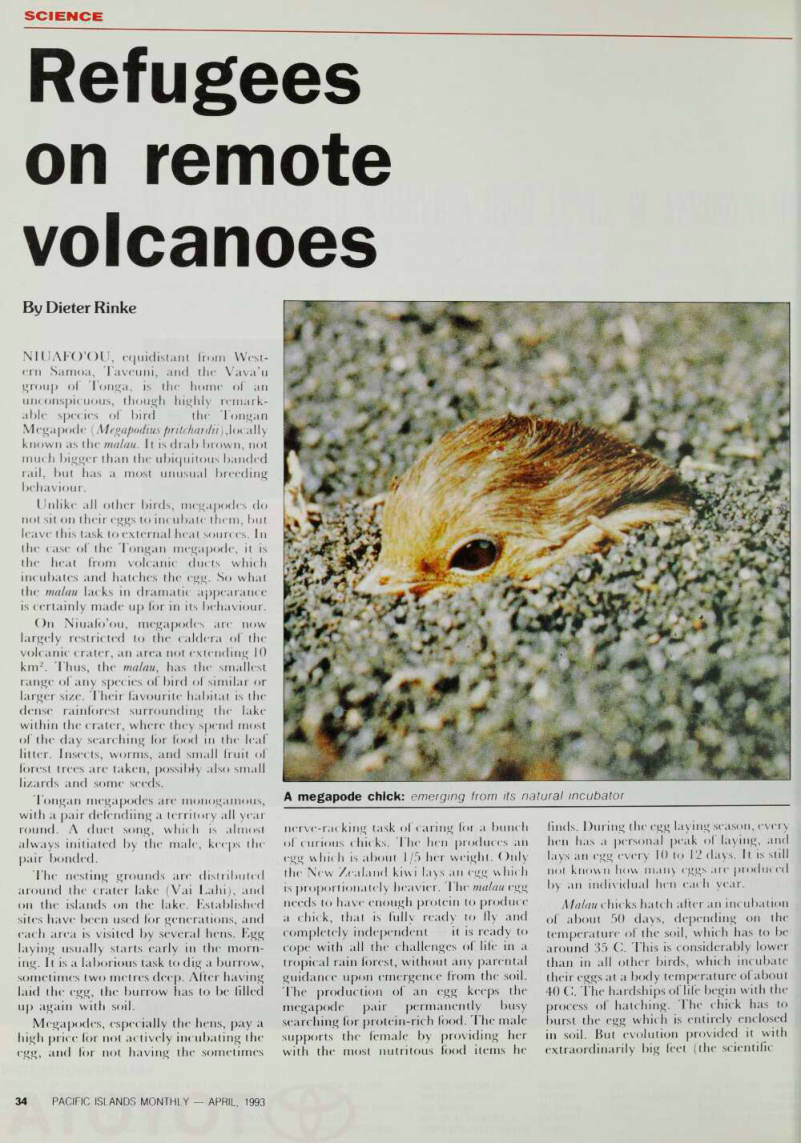
Malau chicks hatch after an incubation of about 50 days, depending on the temperature of the soil, which has to be around 35 C. This is considerably lower than in all other birds, which incubate their eggs at a body temperature of about 40 C. The hardships of life begin with the process of hatching. The chick has to burst the egg which is entirely enclosed in soil. But evolution provided it with extraordinarily big feet (the scientific
A megapode chick: emerging from its natural incubator
megapodius liter [ ally means “big foot”). These are also necessary to dig its way up to freedom, a pro cedure which may require two days.
During its way to the surface, the quills are stripped from the feathers, and the chick em erges as a feathered bird. It has nothing in common with the downy neat chicks of pheasant, partridges and fowl, the mega podes’ closest rela tives. Without any form of parental guidance, it needs
to know from the very beginning what to do to cope with the challenges of living in the rainforest.
Barn owls and feral cats are preying on megapode chicks, but probably the most severe threat comes from the attacks of long-legged ants. Recent studies have revealed, that in the same moment as the chicks reach the surface, these ants try to get attached to the chicks’ eyes, which are immediately blinded. Once the ants succeed, the chicks, handicapped in this way, fall easy to prey to the carnivorous predators.
While Tongan megapodes became cxtinct throughout the rest ofTonga during the times when humans arrived they COexisted on Niuafo’ou for about 3000 vears. Over-exploitation of eggs from the nesting grounds and excessWe hunting resulted in the loss of most populations. On .Niuafo’ou, may have survived because some of {heir nesting sites are almost inaccessible
Alternative explanations arc possible!
volcanic eruptions, of which nine occurred during the past 200 years alone may have given rise to temporary’emigrations of the inhabitants. During ~1 1pl . , , , suen times, the megapodes could recover. tu,,,. n i Pi- 1 here are also reports of a prohibition bv i,_„i i • r , 11 ‘ r . .local chiets to collect eggs alter volcanic r , , e ruptions, when the number of megapodes lA . ac i T i ? r c was very low. Ihe topography of , i v P p Niualo ou also seems to have been mportant for the persistence of the birds -ii • r .. , .ii * h and Urn hc J arge rate r r lake .vere, and still are, rather safe refuges.
I bus, over the centuries, 3. ba.la.nccd elationship between humans and mega- )odes must have developed. Some disurbing factors must have been introiuced recently, because there is a slight
decline in megapodes. In the 19705, 800 megapodes were estimated to live on the island, while an ongoing study revealed the existence of 600 to 700. There is little evidence about the causes of the malau s decline, but this is reason enough to implement a conservation program for a species of less than 700 individuals on 10 km 2 of suitable habitat.
There are many examples of intensive management of rare species in their natural environment. All such programs require the intensive engagement of
trained personnel over long periods. The
costs involved easily surpass 5100,000, in a few cases reaching some million dollars.
Considering the number of species, which arc threatened with extinction, in the Pacific alone, long-term management does not seem to be the adequate solution. We would have to focus on a few selected species, but leave the others to vanish.
The crucial clue for the preservation of rare species in the Pacific comes from recent archaeological and paleontological studies. The present dis tribution of birds in the Pacific is an artifact of human impact.
Most species, which arc now very restricted in range, had a much wider distribution in pre-human times. The megapodes are no exception, and the bio geographical mystery of the existence of the malau on Niuafo’ou now becomes clear.
It is the only Polynesian survivor of a once wide-spread group of birds, w hich probably lived on every island eastwards to Samoa and Tonga.
The technique of translocation, the transfer of birds form islands, w'hcrc they are exposed to uncontrollable threats, to
islands, which ap pear to be safe refuges, has been developed to per fection by the New /( aland De partment of Con servation.
Tonga has sev eral islands, mainly remote and almost inac cessible volcanoes, which seem to be suitable new homes for the malau. At presen t,Tofua, Late and Fonualei are be ing surveyed with regards to the
most important
requirement for
megapode survival, volcanically warmed soil, where they can dig their eggs.
Ann Goth and L'vve Vogel from the Ruhr University in Bochum, Germany, are currently investigating what should be transferred eggs, young chicks, or adult megapodes.
Their study is part of a conservation program for the malau , conducted by the Brehm Fund South Seas Expedition. The transfers will commence in early 1993, hopefully resulting in the successful establishment of a malau population on at least two more Tongan islands. • The Brehm Fund for International Bird Conservation, based in the Federal Republic of Germany, started this proj ect in 1989. It is by far the most expensive and extensive venture of this non-profit organisation so far. The aim is to develop a comprehensive strategy for wildlife preservation in the tropical Pacific, targetting birds such as the malau. The first part of the project is concentrating on Tonga.
The activities involved are manfold, including surveys of remote islands, studies of rare species and the cause of their rareness, and activities to guarantee the survival of endangered species. Work in the mostly remote and otherwise inaccessible islands would not be possible without 70 feet yacht Breum which has been donated to the Brehm Fund for this purpose.
An exhibit of live birds and consEr vation issues has been set up on Tonga tapu to create awareness of the critical situation of the islands’ natural heritage.
The project is directed by Dr Dieter Rinke, co-author of the South Pacific Regional Bird Conservation Programme - Plan for Action. □
A pair of megapodes: in the dark forest of Niuaf'ou