Ownership
pp. 30-31 · Read in the full issue
By Wally Hiambohn
PAPUA New Guinea media’s freedom has only once been seriously threatened.
That was in the form of a Media Bill initiated by Prime Minister Paias Wingti’s first government in 1989. The bill was the brainchild of then Communi cations Minister Gabriel Ramoi now serving a three-year jail term for misappropriating public funds.
The purpose of the bill was to come up with a unified legislation to be adminis tered by a quasi-judicial body, the Mass Media Tribunal. Under the proposal all media organisations would require a licence, granted by the Tribunal, to operate and licensing criteria would take into account national interest, fairness and effective ownership and control by Papua New Guineans.
The licence, valid for six months,would be renewed at the discretion of the Tribunal. The tribunal would also have the powers to direct or prohibit publi cation of material it considered, among other things, to be of “national import ance”.
Many saw it as a definite attempt by the government to restrict the freedom of the media in PNG. The Bill was eventually shelved and has not seen the light of day since.
The current VVingti government has made moves to address the issue oU communications with the aim of introducing a communications policy. As a
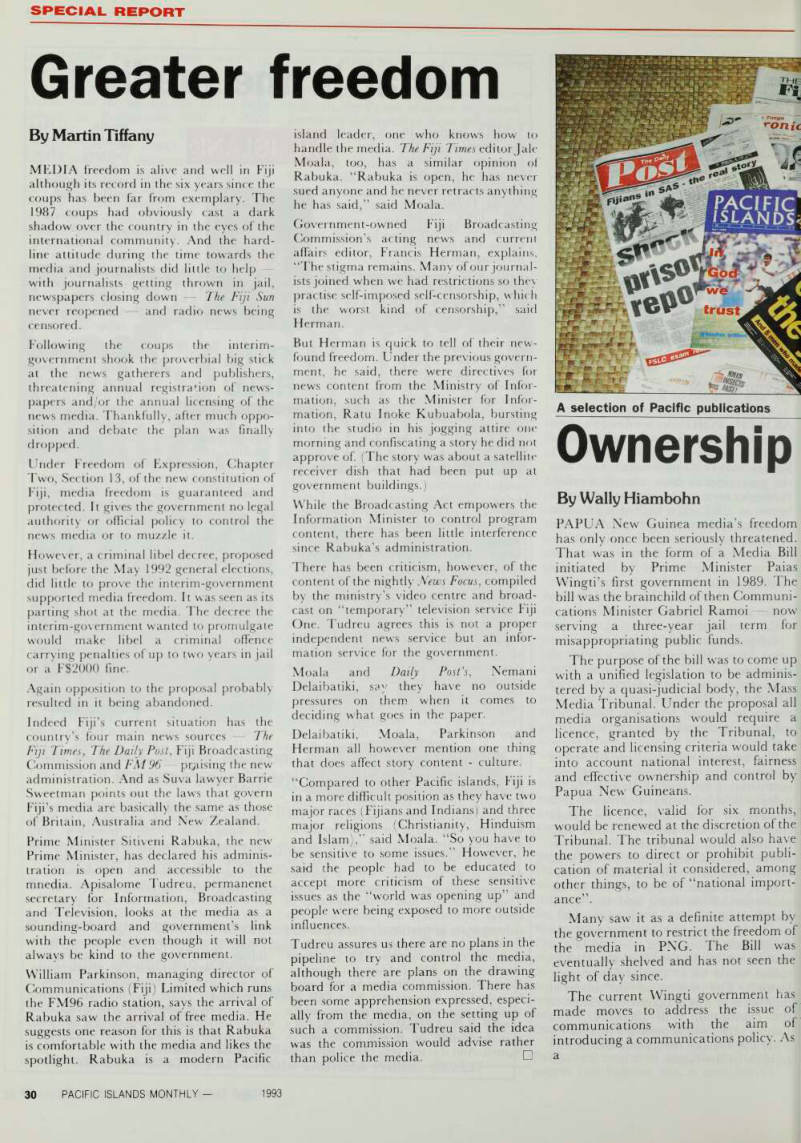
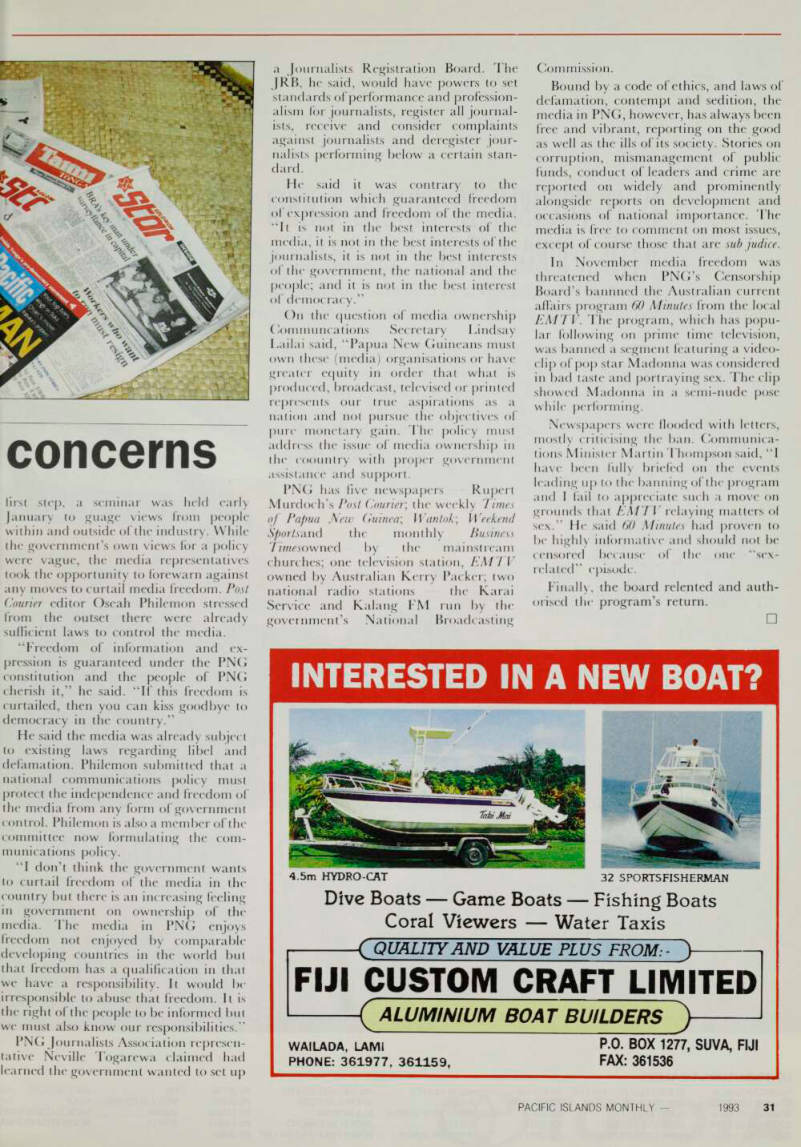
A selection of Pacific publications
first step, a seminar was held early January to guage views from people within and outside of the industry. While the government’s own views for a policy were vague, the media representatives took the opportunity to forewarn against any moves to curtail media freedom. Post Courier editor Oseah Philemon stressed from the outset there were already sufficient laws to control the media.
“Freedom of information and ex pression is guaranteed under the PNG constitution and the people of PNG cherish it,” he said. “If this freedom is curtailed, then you can kiss goodbye to democracy in the country.”
He said the media was already subject to existing laws regarding libel and defamation. Philemon submitted that a national communications policy must protect the independence and freedom of the media from any form of government control. Philemon is also a member of the committee now formulating the com
munications policy.
“I don’t think the government wants to curtail freedom of the media in the country but there is an increasing feeling in government on ownership of the media. The media in PNG enjoys
freedom not enjoyed by comparable
developing countries in the world but that freedom has a qualification in that we have a responsibility. It would be irresponsible to abuse that freedom. It is the right of the people to be informed but we must also know our responsibilities.”
PNG Journalists Association represen tative Neville Togarewa claimed had learned the government wanted to set up
a Journalists Registration Board. The JRB, he said, would have powers to set standards of performance and profession alism for journalists, register all journal ists, receive and consider complaints against journalists and deregister jour nalists performing below a certain stan dard.
He said it was contrary to the constitution which guaranteed freedom of expression and freedom of the media.
“It is not in the best interests of the media, it is not in the best interests of the journalists, it is not in the best interests of the government, the national and the people; and it is not in the best interest
of democracy.”
On the question of media ownership Communcations Secretary Lindsay Lailai said, “Papua New Guineans must own these (media) organisations or have greater equity in order that what is produced, broadcast, televised or printed represents our true aspirations as a nation and not pursue the objectives of pure monetary gain. The policy must address the issue of media ownership in the coountry with proper government assistance and support.
PNG has five newspapers Rupert Murdoch s Post Courier; the weekly Times of Papua New Guinea ; Wantok ; Weekend Sports&nd the monthly Business by the mainstream churches; one television station, EMTV owned by Australian Kerry Packer; two national radio stations the Karai Service and Kalang FM run by the government’s National Broadcasting
Commission.
Bound by a code of ethics, and laws of defamation, contempt and sedition, the media in PNG, however, has always been free and vibrant, reporting on the good as well as the ills of its society. Stories on corruption, mismanagement of public funds, conduct of leaders and crime are reported on widely and prominently alongside reports on development and occasions of national importance. The media is free to comment on most issues, except of course those that are sub judice.
In November media freedom was threatened when PNG’s Censorship Board’s bannned the Australian current affairs program 60 Minutes from the local EMTV. The program, which has popu lar following on prime time television, was banned a segment featuring a video clip of pop star Madonna was considered in bad taste and portraying sex. The clip showed Madonna in a semi-nude pose
while performing.
Newspapers were Hooded with letters, mostly criticising the ban. Communica tions Minister Martin Thompson said, “I have been fully briefed on the events leading up to the banning of the program and I fail to appreciate such a move on grounds that EM 7 V relaying matters of sex.” He said 60 Minutes had proven to be highly informative and should not be censored because of the one “sex
related” episode.
Finally, the board relented and auth orised the program’s return. □