Cries from anothers of land
pp. 24-25 · Read in the full issue
Women
By 'Atu Emberson-Bain
WAR exposes in the crudest possible way the destructive potential of human be ings. Indeed, throughout history, mili tary offensives and armed struggles have often generated human suffering and oppression on a scale that is difficult to comprehend, still less to reconcile with any kind of social values that acknowl edge the sanctity of human life.
Today, in the Pacific region, the crisis that continues to engulf the 160,000 inhabitants of the island of Bougainville underscores the human destruction as sociated with war and the political and economic calculations that commonly spawn it.
But there is also an obvious irony in that the price for war is commonly paid by those who have little, if anything, to do with the decision to engage in it. For example, rarely do women make war, but all too often they pay dearly for it.
Bougainville is no exception. The insistence on a military solution con tinues to threaten the livelihoods and welfare of ordinary Bougainvillean
people.
The chosen course of a military offensive by the Papua New Guinea government, and the economic and medical blockade, have brought social dislocation and deprivation of unprece dented proportions. Hundreds of lives have been lost and families have been split apart.
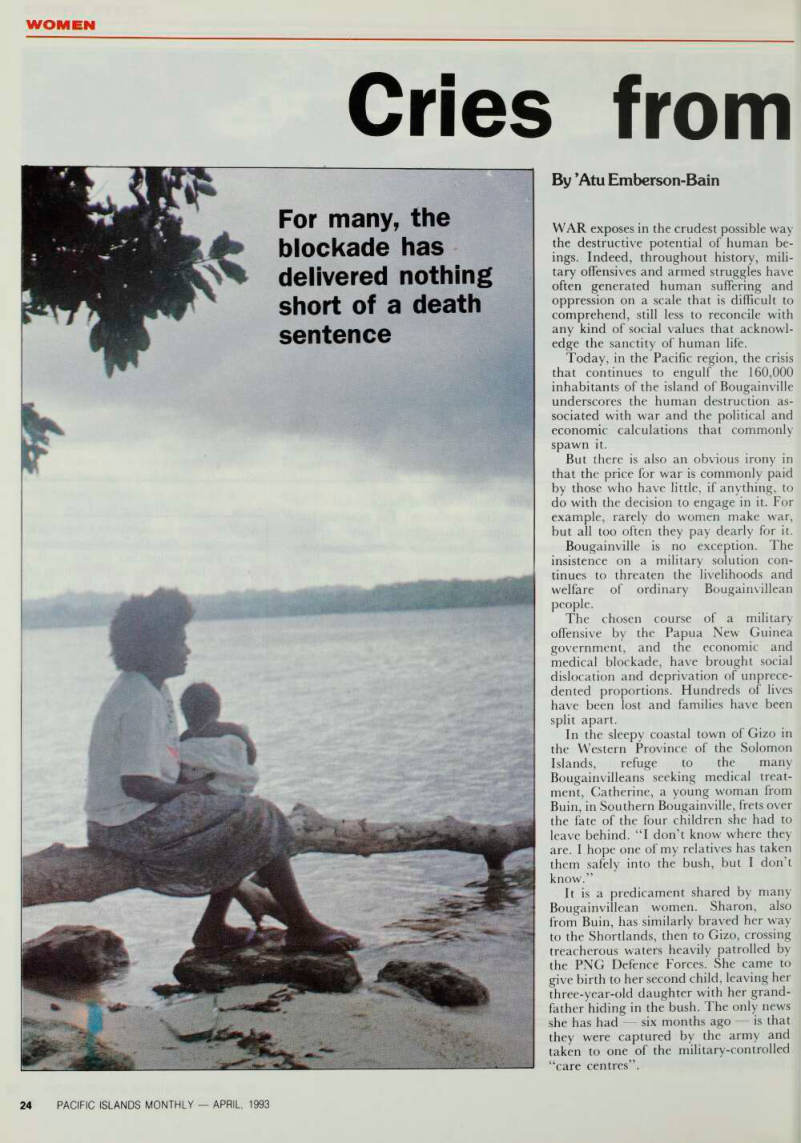
In the sleepy coastal town of Gizo in the Western Province of the Solomon Islands, refuge to the many Bougainvilleans seeking medical treat ment, Catherine, a young woman from Buin, in Southern Bougainville, frets over the fate of the four children she had to leave behind. “I don’t know where they are. I hope one of my relatives has taken them safely into the bush, but I don’t know.”
It is a predicament shared by many Bougainvillean women. Sharon, also from Buin, has similarly braved her way to the Shortlands, then to Gizo, crossing treacherous waters heavily patrolled by the PNG Defence Forces. She came to give birth to her second child, leaving her three-year-old daughter with her grand father hiding in the bush. The only news she has had — six months ago — is that they were captured by the army and taken to one of the military-controlled “care centres”.
For many, the blockade has delivered nothing short of a death sentence
Julie, a nurse on the island, has parents and siblings all in care centres controlled by the PNG military. She has seen none of them since 1989.
Probably the most deadly weapon for thousands of Bougainvilleans has been the blockade. The blockade has meant no electricity for the hospitals and health centres, critical shortages of life supporting drugs and medicines and a dangerous depletion of qualified medical personnel.
The blockade has meant a lack of facilities to deal with anything from childbirth to emergency cases. It has meant pregnant women have died need lessly in childbirth and that babies and young children have died from easily preventable diseases. No babies born after late 1989 have been immunised against killers like TB, measles and whooping cough. For many, the block ade has delivered nothing short of a death sentence.
The war has delivered other human horrors. One of them is the übiquitous “care centre”, which for Bougainvilleans is cynically called haus kalabus , a tok pidgin term which literally means prison house.
An estimate of the World Council of Churches in October, 1992 puts the number of people living in the centres at around 40,000, which represents a quar ter of the total population.
Stories abound of rapes of young women and resultant pregnancies, food shortages, controls on people’s move ments, human rights abuses, pay-back killings, and poor health services in the centres. For one young Bougainvillean mother currently in the Solomon Islands, “It is not safe to go back to the care centres. That is why many of us are running away because we have already felt the cruelty of these soldiers.”
The atrocities have hardened the women against the grief of losing their young men to the Bougainville Revol utionary Army (BRA) and created an ever stronger sense of commitment to the
independence struggle.
According to a Bukan woman whose husband is a church minister, “before when the BRA went out fighting and after the young men died, there would be a lot of crying and tears. But today, I think we’re running out of tears. We are seeing the loyalty of the young people who are dying in order to protect our and. They are making sacrifices for our reedom.”
Another woman echoes these send
ments. “We are proud of our young men because they are fighting for our country.
I mean when they die, it’s a reward for our boys there in Bougainville . . . We feel sad but when the reality comes, we just accept it because for us, it’s been going on a long time.”
There are other hardships to face, among them learning to walk the tight rope of life in the jungle. Bougainvilleans are not a nomadic people and they don’t normally live in the bush. They are used to cultivating gardens close to permanent homesteads. The physical difficulties and trauma of being continuously on the run from an enemy over the last four years is hard to imagine. Families leave with only what they can carry with them, and it is especially hard when they have to move with young children.
When the PNG forces landed at Tunuru mission, close to Arawa in central Bougainville in November 1992, Anna fled with a young two-year-old daughter. “We women faced a very hard time then, carrying children on our backs, and our luggage, running up further into the mountain. We had to move further from Arawa town because they were just throwing mortars, and helicopters were just spraying cars or any object moving around in town if they see.
It really happened there. ... I tell you my tears came out when we were running because it was really hard for me, carrying my child and all my things.”
According to Marilyn, a health worker from Arawa who has accompanied a woman patient to Honiara, life in the humid and densely forested environment of the jungle poses health hazards, not the least of which is a higher incidence of malaria and chest infection. The problem is compounded by the difficult ies of building houses that are warm.
Marilyn explains, “The higher you go, the temperatures get cooler.
Bougainvilleans are used to living in warmer places. And many people are now moving around with less clothing.
At the same time, the huts are not suitable —just roofs and maybe no walls.
Water is also a problem and people are either using the river or stream and bush for sanitary purposes. In our own environment, we would have pit latrines or flush toilets in our own houses.”
Another problem for those living in the bush is getting access to food gardens and, in Marilyn’s view, a rising incidence of malnutrition amongst children ap
pears to be linked to this. “It is not that there is a shortage of food. It is just that women are frightened to go to their gardens.”
When they do manage, women must make hurried visits just to collect food.
Food has to be cooked on open fires under cover of darkness to reduce the risk of coming under fire from PNG Defence
Force helicopters.
So what of the future? Is there a way ahead?
Marilyn believes the intervention of a peace-keeping task force would be a constructive move towards ending the war and resolving the crisis. “I believe where there is tension, it is always wise to have somebody with neutral feelings to come in and maybe become a coordi nator, provider or mediator of services, to maintain dialogue between the parties.
Through common understanding and
dialogue, we should be able to bring peace, harmony and unity among
Bougainvilleans, between Papua New
Guinea and Bougainville, and between our neighbouring countries, like the Solomon Islands.”
For Catherine, the lifting of the blockade and the restoration of health and other services represents the bottom line indeed the life line of her people.
Her voice trembles with emotion as she says, “You know, PNG has cut us off from services for such a long time, so they have to realise that . . , even without them, we have been surviving . . . they have punished us for so long . . . and they should stop.”
The cries of Bougainville’s women, the innocent victims of war, ring out. But will their cries be heard? Are peace and the restoration of a life line too much to ask for?
For Pacific island governments, the question must surely be asked whether there is not a moral obligation to respond constructively and humanely to the Bougainville crisis. To stare human suffering and violation in the face, and then to walk away, under the comfortable umbrella of minding one’s own business or respecting the crisis as an “internal problem”, is surely tantamount
to acquiescence.
Certainly, there is more than a touch of irony in the fact that in a part of the world where Christianity rules the re gional waves, finding the Good Samaritan among the region’s power brokers should appear to be such a tall order. □