Land of discontent
pp. 20-23 · Read in the full issue

Cover Story
WHILE some see Fijian nationalist Sakeasi Butadroka as a dangerous extremist, others regard him as a social pressure valve, allowing steam to be let off from time to time by bringing village-level Fijian concerns out into the open. In 1975, he provoked a bitter debate by moving in Parliament that all people of Indian origin in Fiji be deported to India at the expense of the former colonial ruler Britain. Then Prime Minister Ratu Sir Kamisese Mara accused Butadroka of peddling a “pernicious doctrine”. Now Butadroka, the man with the steely stare and trade mark bow-tie, is stirring the pot on the extremely sensitive issue of land ownership and control. And he is threatening to stage protests, using tactics such as what he calls “human roadblocks”. With the country facing a dilemma on the future treatment of indigenous land currently leased to Fiji Indian farmers, Suva based journalist Craig Skehan looks at central issues underlying the debate.ql
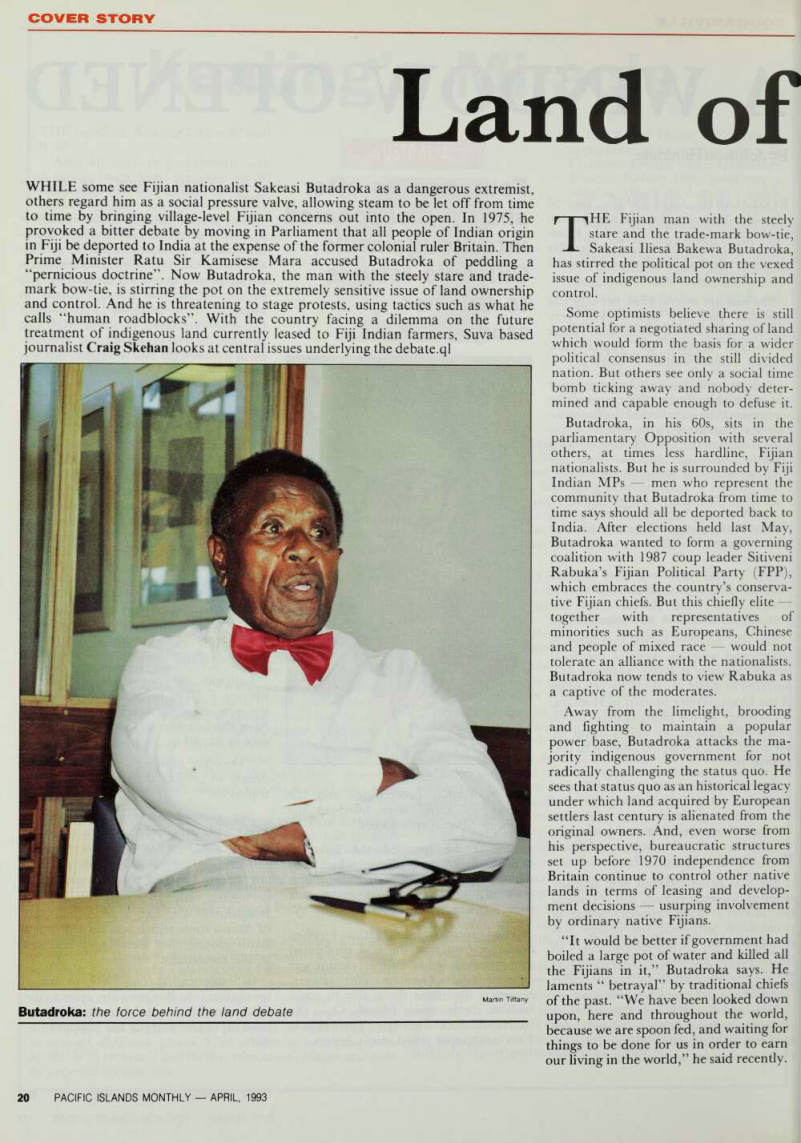
THE Fijian man with the steely stare and the trade-mark bow-tie, Sakeasi Iliesa Bakewa Butadroka, has stirred the political pot on the vexed issue of indigenous land ownership and control.
Some optimists believe there is still potential for a negotiated sharing of land which would form the basis for a wider political consensus in the still divided nation. But others see only a social time bomb ticking away and nobody deter mined and capable enough to defuse it.
Butadroka, in his 60s, sits in the
parliamentary Opposition with several
others, at times less hardline, Fijian nationalists. But he is surrounded by Fiji Indian MPs men who represent the community that Butadroka from time to time says should all be deported back to India. After elections held last May, Butadroka wanted to form a governing coalition with 1987 coup leader Sitiveni Rabuka’s Fijian Political Party (FPP), which embraces the country’s conserva tive Fijian chiefs. But this chiefly elite together with representatives of minorities such as Europeans, Chinese and people of mixed race would not tolerate an alliance with the nationalists.
Butadroka now tends to view Rabuka as a captive of the moderates.
Away from the limelight, brooding and fighting to maintain a popular power base, Butadroka attacks the ma jority indigenous government for not radically challenging the status quo. He sees that status quo as an historical legacy under which land acquired by European settlers last century is alienated from the original owners. And, even worse from his perspective, bureaucratic structures set up before 1970 independence from Britain continue to control other native lands in terms of leasing and develop ment decisions usurping involvement by ordinary native Fijians.
“It would be better if government had boiled a large pot of water and killed all the Fijians in it,” Butadroka says. He laments “ betrayal” by traditional chiefs of the past. “We have been looked down upon, here and throughout the world, because we are spoon fed, and waiting for things to be done for us in order to earn our living in the world,” he said recently.
Martin Tiffany Butadroka: the force behind the land debate
He unsuccessfully moved a motion in Parliament demanding that all issues related to control of natural resources be resolved before commencement of a review of the post-coup constitution
enshrining Fijian political dominance. As
well as extensive aquisition of alienated freehold land for traditional owners and payment of rents for Crown land, Butadroka’s nationalists want village proprietary rights on fishing grounds and royalties for mineral resources. Fellow nationalist Kolinio Qiqiawaqa says that if land and economic control issues were not resolved “we are on course for another explosion in the near future”.
In Fiji there are 1,822,921 hectares of land spread over several hundred islands in the Koro Sea. Some 1,519,956 hec tares is native land, of which 431,186 hectares is leased and 149,081 hectares is freehold. Bureaucratic red tape, and the fact that the government’s Native Lands Trust Board (NLTB) takes 25 per cent of lease payments to cover its own over heads, are specific sore points. Some people also question the fairness of
regional hereditary chiefs getting a large
slice of collected rents. But the really big underlying issue revolves around what will happen from 1996 onwards, as thousands of 30-year leases held by Indian farmers expire under the Agricul tural Landlords and Tenents Act
(ALTA). If indigenous Fijians resume
control of developed agricultural lands including sugar producing areas which
are Fiji’s biggest source of foreign
earnings - will productivity levels be maintained? There is past evidence that land returned to Fijian control has often been either less efficiently utilised or not used at all.
Freed from sugar plantation servitude by the 19205, Indian indentured labourers pressed for access to land. “I would say that the usage of land, not so much ownership in Fiji’s context, is in the blood of the Indians,” Opposition MP Ali Hussain says. “What use is it having a continent of land if you can’t utilise it in a productive manner?”
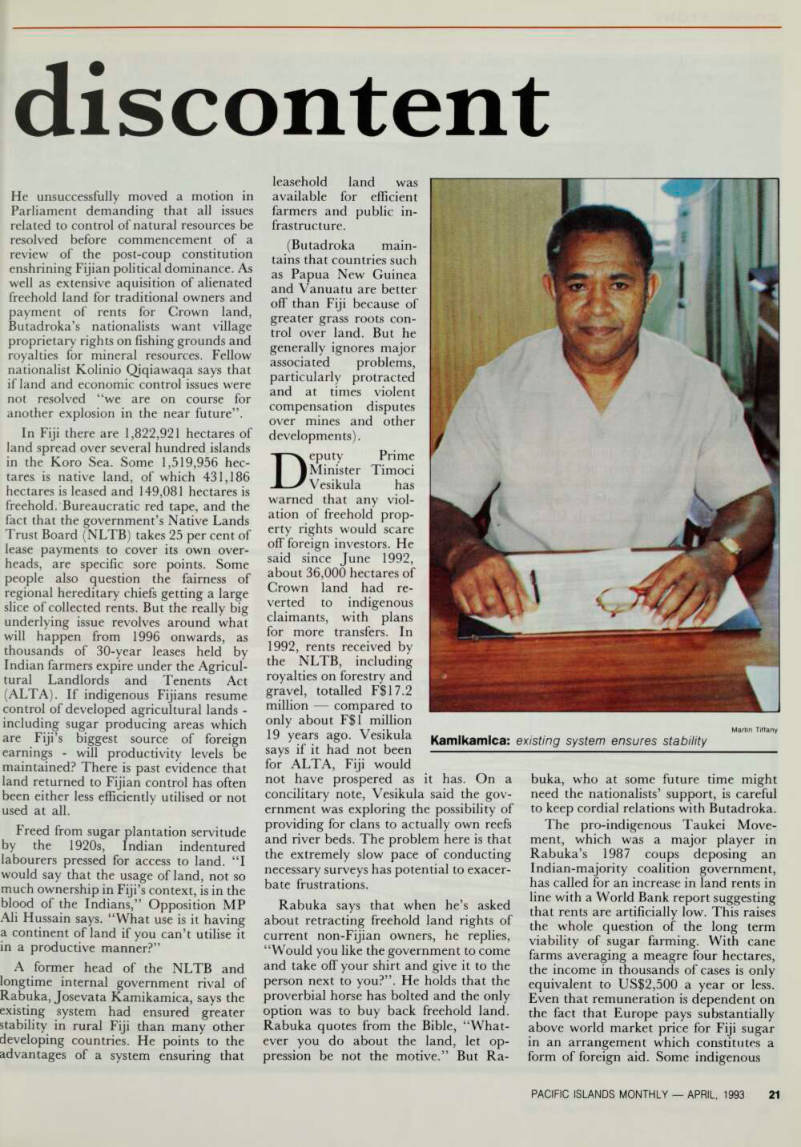
A former head of the NLTB and longtime internal government rival of Rabuka, Josevata Kamikamica, says the existing system had ensured greater stability in rural Fiji than many other developing countries. He points to the advantages of a system ensuring that
leasehold land was available for efficient farmers and public in frastructure. (Butadroka main tains that countries such as Papua New Guinea and Vanuatu are better off than Fiji because of greater grass roots con trol over land. But he generally ignores major associated problems, particularly protracted and at times violent compensation disputes over mines and other developments).
Deputy Prime
Minister Timoci Vesikula has warned that any viol ation of freehold prop erty rights would scare off foreign investors. He said since June 1992, about 36,000 hectares of Crown land had re verted to indigenous claimants, with plans for more transfers. In 1992, rents received by the NLTB, including royalties on forestry and gravel, totalled F 517.2 million compared to only about Fsl million 19 years ago. Vesikula says if it had not been for ALTA, Fiji would
not have prospered as it has. On a concilitary note, Vesikula said the government was exploring the possibility of providing for clans to actually own reefs and river beds. The problem here is that the extremely slow pace of conducting necessary surveys has potential to exacerbate frustrations. 0 , , . , , , , j Rabuka says that when he s asked about retracting freehold land rights of current non-Fijian owners, he replies, Would you like the government to come and take off your shirt and give it to the person next to you?”. He holds that the proverbial horse has bolted and the only option was to buy back freehold land.
Rabuka quotes from the Bible, “Whatever you do about the land, let oppression be not the motive.” But Ra-
buka, who at some future time might need the nationalists’ support, is careful to keep cordial relations with Butadroka.
The pro-indigenous Taukei Move ment, which was a major player in Rabuka’s 1987 coups deposing an Indian-majority coalition government, has called for an increase in land rents in line with a World Bank report suggesting that rent s are artificially low. This raises the whole tion J the long term viability of sugar f arming . With cane f arm s averaging a meagre four hectares, the i ncome in thousands of cases is only equivalent to U 552,500 a year or less, Even that remuneration is dependent on the fact that Europe pays substantially above world market price for Fiji sugar in an arrangement which constitutes a form of foreign aid. Some indigenous
Martin Tiffany Kamlkamica: existing system ensures stability
Fijians suggest that Indian sugar farmers don’t appreciate the extent of this assistance. Such artificial support, how ever, can’t last forever. If the sugar industry eventually collapses, economi
cally viable alternatives will need to be ur gently found. And it is difficult to predict at this stage just what the
implications
might be for
already strained
landlord/tenant
relationships.
On the wider political front, there have been hints that Rabuka and those close to him perceive po tential for the whole issue of land
to be used as a political tool. This implication is that if the Indian com munity learn to accept enshrined Fijian political dominance through the 1990 constitution, concessions could be forth coming on land security. This is what
might be labelled a carrot and stick approach; a reward for co-operation,
economic punishment for intransigence.
Butadroka, on the other hand, wants the future of land sorted out before consti-
tutional questions are even looked at.
The increasing stridency of Taukei Movement calls for return of land or hiking rents does not bode well for smooth resolution of communal differ ences.
On March 10, Fiji’s elderly President, Ratu Sir Penaia Ganilau, accused the Taukei Movement of sowing seeds of disunity. He defended the NLTB and urged a renewal of ALTA leases except
where indigenous Fijians had well thought out devel opment plans of their own. “We
must carefully
asses all issues re lating to land and decide wisely since land controls are the lifeline of our nation and our fu ture generations,” he said.
Meanwhile, Op
position Leader Jai Ram Reddy said he, along with the rest of the Fiji In dian community,
accept the principle of traditional Fijian land ownership. But he added dryly that other constitutional rights became a bit meaningless if at the end of the day Indians were left with no land to live on.
He also talked about the possibility of future national government subsidisation
NLTB office in Suva: administering native land
Martin Tiffany
of farm rents in order to protect the economy and individual families. Any tenant farmers forced to vacate their farms would need to be covered by some sort of resettlement program, he warned.
Governments of regional countries such as Australia and New Zealand follow the Fiji land debate closely. They under stand that if things fell apart here in terms of arrangements for land security, there could be a tide of would-be refugees to rival the estimated 30,000 Indians who left Fiji after the 1987 coups.
One of the factors that makes the current social, political and economic mix dangerous is that ethnic Fijian expectations were raised by Rabuka becoming Prime Minister. After all, he was the man who, with purported ‘divine’ inspiration, said he wanted to establish a new era of Fijians controlling their own destiny and resources. Buta droka suggests that if legitimate demands :an be met, a sort of utopia will prevail. ‘Once the Fijians are given rights over :heir resources, land and fishing grounds, hen we shall find a new Fiji,” he said.
Fhe non-Fijians will be more :omfortable and the Fijians will become lappier. Everyone will be thankful and 10 one will be sad.” However genuine dutadroka is in expressing such senti nents, the reality is that land is em broiled in the at times dirty business of lolitics. And even some people who illied themselves with Butadroka politi cly have been involved in controversies >ver alleged attempts to use influence to
gain control of land for personal advan tage. Ironies abound. For example part-
European businessman Tony Stephens,
who was Butadroka’s election campaign manager last year, caused a political furore over a behind-the-scenes nego tiated government compensation pay ment which if implemented would have seen him secure huge land estates. When it comes to land, there is no shortage of vested interests.
Looking for a brighter side to all this, there is a widespread acceptance that Fijians deserve every opportunity to develop skills necessary to expand their commercial use of land. This would arguably involve getting away from the partly inherited paternalism of the pres ent land administration system. Fijian statesman Ratu Sir Lala Sukuna once said, “At heart the Fijian may still be a subsistence agriculturalist, but with his head, often not so poor a head as some think, he see that he must be more.”
Land that forms islands its bound aries clearly defined by the sea - imbues a special psychological and emotional attachment. This emotional factor could complicate the search for solutions in Fiji if political and community leaders seek to exploit underlying sensitivities rather than sooth tensions. Fiji will pay a high price if efforts are not stepped up to find an equitable way of enhancing Fijian interests without unfairly disadvantaging hardworking Indian farmers.
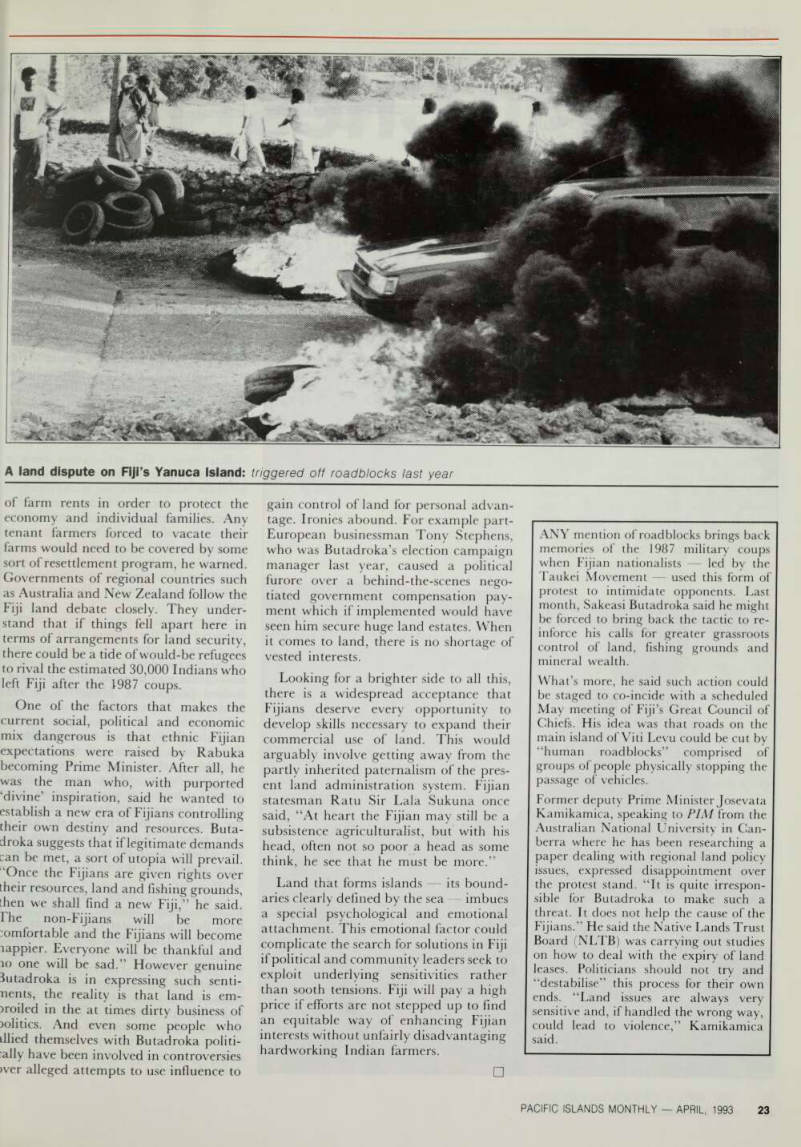
ANY mention of roadblocks brings back memories of the 1987 military coups when Fijian nationalists led by the Taukei Movement used this form of protest to intimidate opponents. Last month, Sakeasi Butadroka said he might be forced to bring back the tactic to re inforce his calls for greater grassroots control of land, fishing grounds and mineral wealth.
What’s more, he said such action could be staged to co-incide with a scheduled May meeting of Fiji’s Great Council of Chiefs. His idea was that roads on the main island of Viti Levu could be cut by “human roadblocks” comprised of groups of people physically stopping the passage of vehicles.
Former deputy Prime Minister Josevata Kamikamica, speaking to PIM from the Australian National University in Can berra where he has been researching a paper dealing with regional land policy issues, expressed disappointment over the protest stand. “It is quite irrespon sible for Butadroka to make such a threat. It does not help the cause of the Fijians.” He said the Native Lands Trust Board (NLTB) was carrying out studies on how to deal with the expiry of land leases. Politicians should not try and “destabilise” this process for their own ends. “Land issues are always very sensitive and, if handled the wrong way, could lead to violence,” Kamikamica said.
A land dispute on Fiji’s Yanuca Island: triggered off roadblocks last year