Land of Contrast and
pp. 54-55 · Read in the full issue
Yachting
By Sally Andrew
Vanuatu’s unique culture blends with its natural wonders to give a special attraction
LIGHT winds and flat seas had given us a smooth ride from Fiji 500 miles west to Vanuatu. By late afternoon on the fourth day out, a tell-tale smudge of gray appeared on the distant horizon. Twenty miles ahead lay Efate Island. Port Vila, Vanuatu’s southern port of entry and national capital, was still a good 40 miles away too far to make it into port before sundown so we reduced sail and planned for a dawn arrival.
The wind completely disappeared before sunrise, so we fired up the Yanmar diesel and motored past Pango Point. We anchored near the yellow quarantine buoy in Vila Bay. Within the hour, two gentlemen from customs and agriculture had arrived and cleared us. Welcome to Vanuatu!
Port Vila is one of the South Pacific’s most picturesque towns with many boars
moored Mediterranean-style along the
waterfront. The day had dawned warm and blue. The water inside the harbour was remarkably clear and was dotted with a few wind-surfers and para-sailors.
We motored past the Vanuatu Cruis ing Club and picked up a mooring off the beach at Iririki Island. Fellowship se cured, we rowed ashore to pick up mail and meet friends Erja and Glenn off US yacht Aku Ankka at the Waterfront Restaurant.
The afternoon was spent walking around Vila eating marvellous ice cream, buying cheap baguettes and beef, and poking around shops. The museum/ cultural center was filled with a wealth of artifacts and ethnological material.
North of town, just beyond the village of
Mele Maat, we followed a trail to a fantastic waterfall with freshwater pools and cascades in a jungle-like setting. It was heavenly.
Vila Harbour was packed with boats.
A French yacht Full was moored nearby.
We had met her single-handed skipper, Jean Baptiste, in Fiji’s Mamanuca group.
Limerick Lady, out of Australia was making her last stop before completing a seven-year and 60,000 mile circumnavi gation. On board were Lorenz, Janis, Yolly (age seven) and baby Fabienne, born in Suva the previous year.
Other sightings included Insatiable from California, Gwalarn from Alaska, Whimbrel from Colorado, Sulieka from England, Free Spirit from Canada, and more than 20 other yachts from around the world.
Market days in Port Vila are Wednes day, Friday and Saturday. Families and their produce arrive the night before and often you can make purchases as they set up their stalls. The following morning the market area comes alive with colour.
Fruits, vegetables, flowers, seashells, carvings, bracelets, baskets and t-shirts are sold by village women dressed in bright (and often huge) Mother Hubbard dresses.
We filled our bags with pumpkins, pomeloes, Chinese cabbage, green pep pers, tomatoes and coconuts. Provisioned with plenty of food, we left Port Vila.
Devil’s Point, 10 miles outside tin harbour, has a nasty reputation fo rough seas where wind and current clash We must have timed it right. Condition were benign and we anchored a Tukutuku. During the night the wind switched, and by early morning we wen “rock and rolling” at anchor as a larg< westerly swell rolled straight into th< bay. We weighed anchor at daybreak The sky was clear as we sailed past “Hat’ (Eretoka) Island and into Havannal Harbour via the Hilliard Channel.
With the winds behind us, we crossec tacks with a woman paddling fron Lelepa Island to the mainland. Having only seen men and boys aboard outrig gers in the past, I cheered her on with £ smile and a wave, which she returned Deep inside the harbour, we tucked intc a small bay on the south side of Most Island.
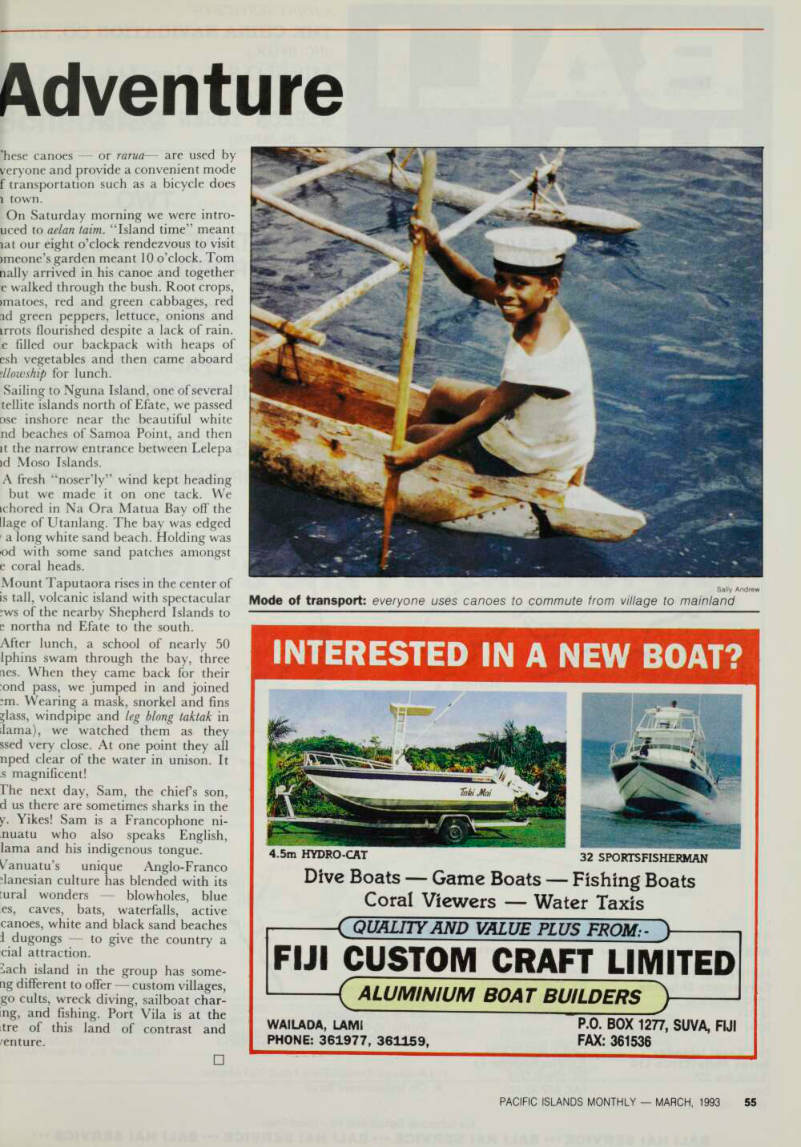
The next day we joined two othei hachts, Che’gar from New Zealand and Papa Kilo from Hull, Great Britain whc were anchored on the other side of the harbour. We had many visitors that afternoon as canoe after canoe stopped by to say hello. Men, women, children, even a dog who stretched across an outrigger thwart snoozing.
The villagers from Moso Island grow vegetables on the mainland and paddle back and forth cross the harbour every day commuting to and from their village.
"hese canoes —or rarua — are used by veryone and provide a convenient mode f transportation such as a bicycle does i town.
On Saturday morning we were intro uced to aelan taim. “Island time” meant lat our eight o’clock rendezvous to visit >meone’s garden meant 10 o’clock. Tom nally arrived in his canoe and together e walked through the bush. Root crops, unatoes, red and green cabbages, red id green peppers, lettuce, onions and irrots flourished despite a lack of rain, e filled our backpack with heaps of esh vegetables and then came aboard dlowship for lunch.
Sailing to Nguna Island, one of several tellite islands north of Efate, we passed dsc inshore near the beautiful white nd beaches of Samoa Point, and then it the narrow entrance between Lelepa id Moso Islands.
A fresh “noser’ly” wind kept heading but we made it on one tack. We ichored in Na Ora Matua Bay off the llage of Utanlang. The bay was edged r a long white sand beach. Holding was od with some sand patches amongst e coral heads.
Mount Taputaora rises in the center of is tall, volcanic island with spectacular of the nearby Shepherd Islands to e northa nd Efate to the south.
After lunch, a school of nearly 50 Iphins swam through the bay, three ics. When they came back for their :ond pass, we jumped in and joined mi. Wearing a mask, snorkel and fins ?lass, windpipe and leg blong taktak in llama), we watched them as they ssed very close. At one point they all nped clear of the water in unison. It
s magnificent!
Ehe next day, Sam, the chiefs son, d us there are sometimes sharks in the y. Yikes! Sam is a Francophone ni nuatu who also speaks English, lama and his indigenous tongue.
Vanuatu’s unique Anglo-Franco
danesian culture has blended with its tural wonders blowholes, blue es, caves, bats, waterfalls, active canoes, white and black sand beaches i dugongs to give the country a cial attraction. iach island in the group has some tig different to offer custom villages, go cults, wreck diving, sailboat char ing, and fishing. Port Vila is at the tre of this land of contrast and venture.
Sally Andrew Mode of transport: everyone uses canoes to commute from village to mainland