Government funds dry up
pp. 51-53 · Read in the full issue
Sports
By Jann Iorns
Papua New Guinea’s future as a regional leader in sports is under jeopardy as the government excludes grants from its budget
PAPUA New Guinea’s sporting com munity is shell-shocked in the wake of the
Wingti government’s 1993 National
Budget and its preclusion of an annual allocation to the National Sports Pro gram. The PNG Sports Federation says it will no longer be able to send representatives to international compe titions or to maintain the existing level of
onshore competition.
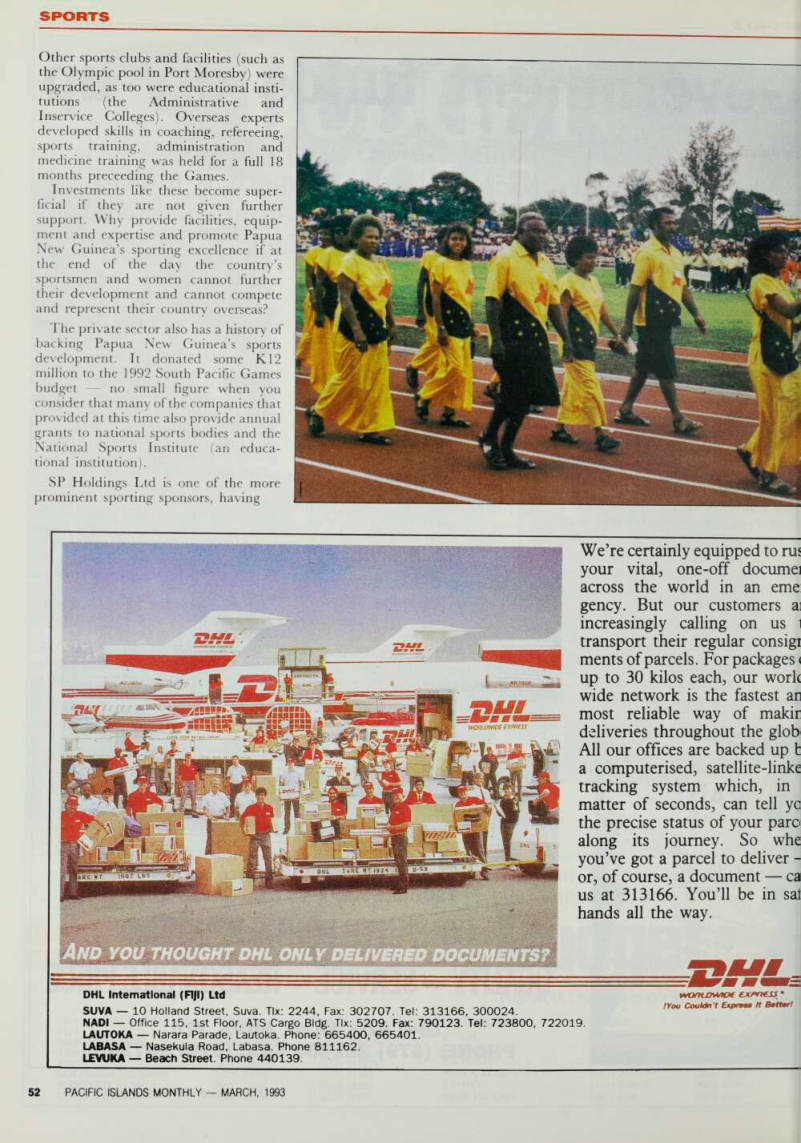
Papua New Guinea is the South Pacific’s number one sporting nation. It won more medals than any other partici pating nation at the South Pacific Games n 1991 (44 golds, 28 silver and 27 bronze). The PNG Sports Federation 'ears the country will lose its supremacy.
Certainly, without representation at the Vlini South Pacific Games in Vanuatu ater this year, or the South Pacific james in Tahiti in 1995, rival nations of Vew Caledonia, Tahiti or Fiji stand to :laim Papua New Guinea’s stronghold.
The PNG Sports Federation says it ilso had plans to send a representative earn to the 1994 Commonwealth Games md the 1996 Olympic Games. But what )f these plans now?
John Dawanicura, head of the PNG >ports Federation, says, “It’s only the econd year of a four-year plan. If the government bows out now, we under nine all that we’ve done to promote ports people and to establish Papua New
Guinea as a country of sporting excel lence.”
“Giving our people overseas exposure is vital,” Dawanicura says. “We have to send our top sportsmen and women to international competitions, and that requires a lot of financial support. In the past, government has understood and helped to provide some of this support.”
Even if the Federation finds alterna tive support (say from the corporate sector) so that the country’s sport speople can, in 1993, compete overseas, there’s still the pressing issue of having to meet the Federation’s running costs and the expense involved in maintaining Papua New Guinea’s seat on the international sporting committees’ (the International Olympic Committee, the Common wealth Games Foundation and the South Pacific Games Council) expenses pre viously met by government.
“The Federation has always attended the annual general assemblies of the international committees,” Dawanicura says, “plus attended other meetings and seminars. We’ve always had a commit
ment to making sure our people get to the major international events. Now, with the absence of national government support, we’re not so sure we’ll be able to.”
From all accounts, the Wingti govern ment seems to have slipped the carpet out from under the Federation’s feet. The former Pangu government provided an annual budget of between K 50,000 to K 100,000 to the Federation (for running costs and for distribution as discretionary grants to individuals and clubs, and other special grants such as the K 100,000 grant to the national rugby league team for its 1992 South Pacific tour). The former government also pumped some K 34.4 million into the 1991 South Pacific Games.
The significance of this investment is simply that for the first time ever Papua New Guinea had world class sports facilities and equipment, and the advice and encouragement of overseas sporting
specialists.
Two major stadiums the Sir John Guise stadium in Port Moresby and the Sir Ignatius Kilage Stadium in Lae were built especially for the Games.
Other sports clubs and facilities (such as the Olympic pool in Port Moresby) were upgraded, as too were educational insti tutions (the Administrative and Inservice Colleges). Overseas experts developed skills in coaching, refereeing, sports training, administration and medicine training was held for a full 18 months preceeding the Games.
Investments like these become super ficial if they are not given further support. Why provide facilities, equip ment and expertise and promote Papua New Guinea’s sporting excellence if at the end of the day the country’s sportsmen and women cannot further their development and cannot compete and represent their country overseas?
The private sector also has a history of backing Papua New Guinea’s sports development. It donated some Kl 2 million to the 1992 South Pacific Games budget no small figure when you consider that many of the companies that provided at this time also provide annual grants to national sports bodies and the National Sports Institute (an educa tional institution).
SP Holdings Ltd is one of the more prominent sporting sponsors, having
>vided annual grants to sports associ 3ns for many years and a separate K 2 llion contribution to the 1991 South :ific Games. In 1993 it will also ugurate the sportsmen-of-the-year ard, costing K 50,000 annually. The GBC (Papua New Guinea Banking rporation) is another strong sup ter, donating at least K 35,000 each r to the National Sports Institute, fhe International Olympic Commit is another organisation demonstra y consistent support for sports devel nent in Papua New Guinea. It itributes between U 5545,000 to 1,000 annually, and has done so since 12 through the I.O.C’s Solidarity •gram. The Solidarity Program aims levelop competitors in Olympic sports
well as training specialists in related
fiplines of administration and medi s. In 1992, the program assisted the G Sports Federation with clinics in
letics, boxing, lawn tennis, shooting
I judo. athletics is likely to one of the hardest by the decision. Papua New Guinea excelled at competitive athletics, rung gold at the South Pacific Games 991, 1987, 1979, 1971 and 1969, the ii South Pacific Games in 1989 and 5, and the Oceania Athletics Cham nships in 1990. Sama Sasama, the :ional Coaching Director for Ath :s, reports on the likely future of letics.
Our athletes need overseas exposure. n that the Federation has no finance
to subsidise athletes’ attendance at inter national competitions, the PNG Athletics Union will have to rely solely on private sector and community sponsorship.”
“The Union is going to have to do a lot more fundraising and individuals will be more responsible for raising finance than they’ve ever needed to be before,”
Sasama says. “If they can’t find the money, they won’t go.”
Team sports like rugby league and basketball will also suffer from the absence of government support for the
National Sports Program. Thirty-five
different sporting bodies are affiliated to the Federation and they all require finance to hold inter-club and inter
provincial championships. Securing pri
vate sector support, as an alternative to the historic Federation grant, may prove difficult for some bodies, especially those not located in provinces with major industries.
Martin Adamson, President of the PNG Rugby League Association, pre dicts on the future of rugby league as a national sport. “We’ll be pushing to maintain the standard we’ve achieved.
This year, unlike last year, we won’t be able to send the national team (Kumuls) overseas. We also won’t be able to
develop the junior players because we
won’t have the finance for training clinics and junior league championships. Junior development is important,” Adamson says. “We have to promote new players up through the grades. We’re already noticing a lack of new talent. If we don’t watch out, rugby league will disappear.”
The PNG Sports Commission, another body responsible for sports development, is also short-changed by the Wingti government’s decision. The commission is a new statutory authority, established in February 1992, with the express responsibility of maintaining the two big stadiums in Port Moresby and Lae. It also has the role of developing sports at the community level, on a nationwide basis. A further task is to oversee the operation of the National Sports Insti tute where most of the training clinics, secondary school phys-ed teacher training and other educational programs take place.
For 1993, some money is allocated to the PNG Sports Commission K 900,000 for stadium maintenance, KBOO,OOO for the commission’s internal running costs and K 822,000 for con tinued operation of the National Sports Institute. But there’s no allocation for sports development; no way of ensuring that the sporting facilities and insti tutions as established don’t turn into
white elephants.
John Kambuou, the commission’s Executive Director, says there’s dire need to develop sports in the rural communi ties. Equipment and training are sorely
needed. Jan Waddy, the commission’s Director of Sports, exemplifies this - “Some schools have only one ball for say 30 or 40 students, and maybe a total of three or four balls in total. That’s it for their sports equipment.”
The tragedy is that sport and rec reation are pivotal to Papua New Guinea culture. For centuries rural villagers engaged in traditional ceremony and dance, as well as hunting, spear and dart throwing. Coastal communities were active in fishing and canoeing. Most of these activities continue today, in much the same form as they always have.
Combined with the traditional forms of recreation is the growing emergence of urban gymnasiums and clubs, offering a range of racquet, team and_water sports.
It is natural to expect the people of Papua New Guinea to want to partici pate in these new modern sports.
But the picture is bleak. Without adequate support there will be no sports clubs. The national identity may disap pear as a result. Sport is seen as an important mechanism in uniting Papua New Guinea’s 700 different cultural/ lingual groups. Seven thousand of the country’s 3.53 million people joined together for the 1991 South Pacific Games, people representing communities from all over the country. For the two weeks of competition, crime miraculously came to a standstill.
Kambuou and Dawanincura reiterate the role of sport in bringing people together, in instilling a sense of national pride and, to some extend, addressing the country’s law and order problem.
“Also, we have a lot of natural flair and talent in Papua New Guinea,”
Kambuou says. “A lot of that talent isn’t seen at national championships, where selection to international competitions takes place. Some of our most promising sportsmen and women aren’t getting beyond the district and provincial com petitions, either because their club can’t afford to affiliate with the national association or because the individuals themselves can’t afford to travel to participate in the selection trials.”
There are many areas that need financial support if Papua New Guinea’s sporting development is to continue.
Both the PNG Sports Commission and the PNG Sports Federation have their hearts set on an era of development. The Federation is likely to move into some hard and fast campaigning among the private sector (seeing as the international competitions are drawing close), and it will also likely lobby Cabinet. Let’s hope these efforts prove successful. There’s still time. The Wingti government may even retract its earlier decision and help to mount a first-class challenge to secure the country’s title as the number one sport ing nation in the South Pacific. □