Realising the potential
pp. 32-33 · Read in the full issue
Architecture
By Liz Thompson
‘Buildings are the biggest, and in many ways, the most important artefacts a culture produces’
RAPID development in the Pacific Island nations has seen the old tra ditional environments of the indigenous people replaced, wholesale, by Western models of building and townscape. Al though most countries have policies to ensure the development of their natural environments is consonant with local cultural values, there have been no corresponding policies towards the built environment partly because of an absence of models for such development.
One firm is working towards the creation of such models.
David Week is director of Pacific Architecture, a firm based in Sydney but with projects in many parts of the Pacific.
“Buildings,” he says, “are the biggest, and in many ways the most important artefacts a culture produces. If you surround people 100 per cent with the artefacts of a foreign culture, within one generation they’ll lose their own. And, for Pacific countries, buildings are artefacts they can control. They’re never going to make their own cars, or stereo systems, or refrigerators. But they can produce their own buildings.”
Week has been working for 15 years on models of planning and architecture which fuse the best of local culture with modern management and technology.
This work is now bearing fruit. For the second time in three years, a project by Week’s firm has won the annual Papua New Guinea Institute of Architects/ James Hardie Housing Award. The first time was in 1990, for its Provincial Government Staff Housing Project on the island of Bougainville; then again in 1992 for a group of four government houses in Palmalmal, East Ne>v Britain.
1991 also saw an international jury select Pacific Architecture’s scheme for a Kanak cultural centre for a short-list of three, from an original 170 contenders.
And the company has now been invited to work farther afield, with a large-scale, low-cost housing project based on an analysis of South Indian culture now under construction in Vellore, near Madras.
These projects illustrate PA’s core philosophy to evolve and improve the local building culture, rather than re place it with some supposedly superior import. Russell Hall, the jury chairman on the 1990 award, stated the 18 houses built for the North Solomons Provincial government had “successfully achieved its stated aims in a technically competent and beautiful manner. It reflected the culture and climate in which it exists and because of this, its acceptance is assured.
Such an approach will produce a sympathetic and appropriate architec ture for Papua New Guinea.”
Week feels that while there are often laws encouraging local control of the business and land and an awareness of the importance of cultural traditions, this awareness is not carried through into
policies on housing and towns. He sees two reasons for this. The first is that the built environment is a normal part of day-to-day life, that the people are not conscious of it and its tremendous effect on them. The second is that, historically, people have only been presented with two, supposedly mutually exclusive op tions either the purely traditional architecture, or imported Western archi tecture.
Traditional buildings are not perma nent, they don’t have modern con veniences like electricity, water, or in door toilets, they’re not insect proof, banks won’t lend on them, and building regulations often prohibit. So they turn to “modern” buildings this often means hot, ugly, and expensive fibro boxes.
Week is working to define and estab lish a middle ground permanent buildings with modern comforts and amenities, but thoroughly grounded in the local culture, in their materials, workmanship, and design. The result is synthesis or as Week calls it, a “fusion” of the best of the traditional and the modern.
The detailed process of working out such a fusion has been developed primar ily through a long series of projects in Papua New Guinea. This process in volves looking both at traditional archi tecture and at what people are doing in new, non-traditional settlements re settlement schemes, villages, informal urban settlements where people are designing and building for themselves.
This sort of study reveals indigenous architectural and settlement patterns.
Some are traditional, some are new.
The process takes these patterns, and studies how they have evolved around the local economy, and way of life,
climate, and history. Then the patterns are translated into a form in which they can be used into contemporary buildings.
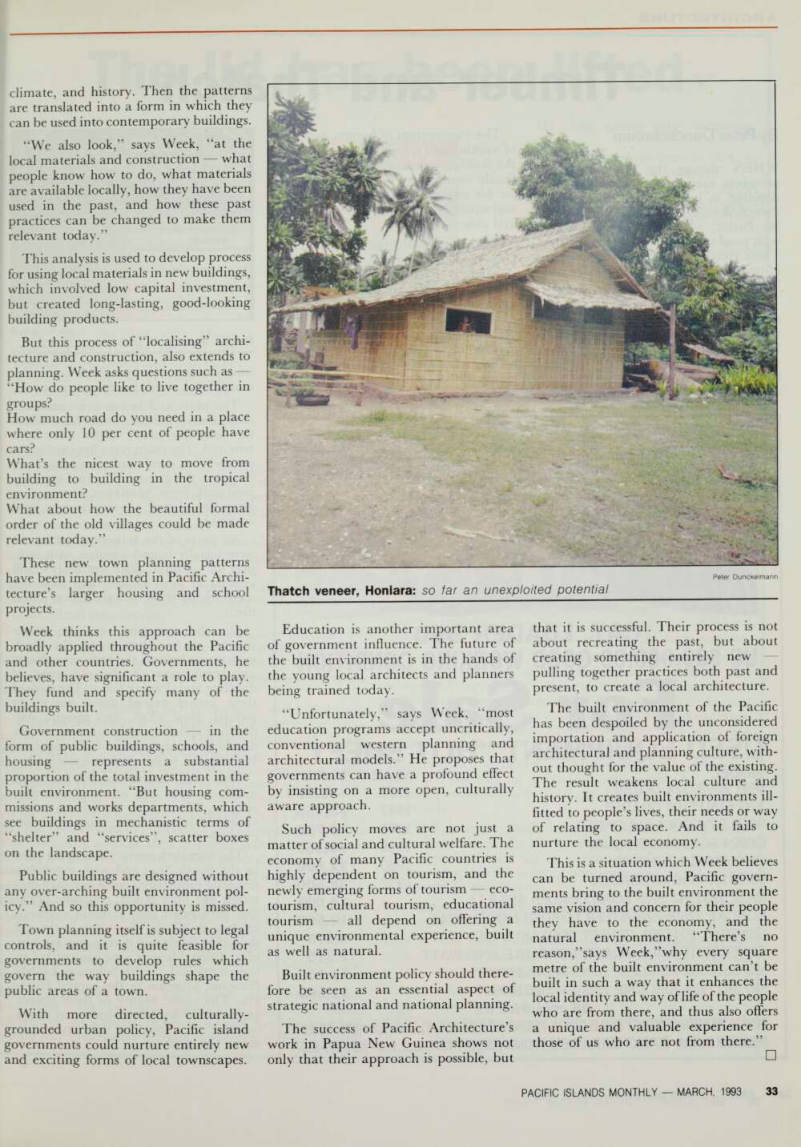
“We also look,” says Week, “at the local materials and construction what people know how to do, what materials are available locally, how they have been used in the past, and how these past practices can be changed to make them relevant today.”
This analysis is used to develop process for using local materials in new buildings, which involved low capital investment,
but created long-lasting, good-looking
building products.
But this process of “localising” archi tecture and construction, also extends to planning. Week asks questions such as “How do people like to live together in
groups?
How much road do you need in a place where only 10 per cent of people have cars?
What’s the nicest way to move from building to building in the tropical environment?
What about how the beautiful formal order of the old villages could be made relevant today.”
These new town planning patterns have been implemented in Pacific Archi tecture’s larger housing and school projects.
Week thinks this approach can be broadly applied throughout the Pacific and other countries. Governments, he believes, have significant a role to play.
They fund and specify many of the buildings built.
Government construction in the form of public buildings, schools, and housing represents a substantial proportion of the total investment in the built environment. “But housing com missions and works departments, which see buildings in mechanistic terms of “shelter” and “services”, scatter boxes on the landscape.
Public buildings are designed without any over-arching built environment pol icy.” And so this opportunity is missed.
Town planning itself is subject to legal controls, and it is quite feasible for governments to develop rules which govern the way buildings shape the public areas of a town.
With more directed, culturally grounded urban policy, Pacific island governments could nurture entirely new and exciting forms of local townscapes.
Education is another important area of government influence. The future of the built environment is in the hands of the young local architects and planners being trained today.
“Unfortunately,” says Week, “most education programs accept uncritically, conventional western planning and architectural models.” He proposes that i f A (T e governments can have a profound effect by insisting on a more open, culturally
aware approach.
Such policy moves are not just a matter of social and cultural welfare. The economy of many Pacific countries is highly dependent on tourism, and the newly emerging forms of tourism ecotourism, cultural tourism, educational tourism all depend on offering a unique environmental experience, built as well as natural. „ r i ii .i Built environment policy should therer , i fore be seen as an essential a pec of strategic national and national planning.
The success of Pacific Architecture’s work in Papua New Guinea shows not only that their approach is possible, but
that it is successful. Their process is not about recreating the past, but about creating something entirely new pulling together practices both past and present, to create a local architecture. , The bu ‘ l( environment of the Pacific has bee " despoiled by the unconsidered importation and application of foreign architectural and planning culture w«h out thought for the value ol the existing, « weakens local cukure and h crea(es built environmen ,s ill fitted to people’s lives, their needs or way of relating to space. And it fails to nurture the local economy, This is a situation which Week believes can turne d around, Pacific govern ments bring to the built environment the same vision and concern for their people they have to the economy, and the natural environment. “There’s no reason,’’says Week,’’why every square metre of the built environment can’t be t built in such a way that it enhances the > fufeofthe people there> and thus a]so offers a unique and valuable experience for those of us who are not from there.”
D
Peter Dunckelmann
Thatch veneer, Honiara: so far an unexploited potential