Tackling perpetrators
p. 29 · Read in the full issue
Violence
By Christine Hatcher
ON Rarotonga, in the Cook Islands, reports of domestic violence have in creased to an alarming average of 10 per week, police inspector Piho Rua recently told a Family and Law seminar. As suming the 10 reports are on the 4228 women between the ages of 14-44 (Census 1991) and there are no repeat reports, this means that, annually, 12 per cent of those women on Rarotonga are subject to reported violence. Many more incidents, go unreported.
Awareness of this, combined with reported and unreported rape numbers, led to the opening of the women’s crisis centre, Punanga Tauturu, in May 1991, followed by Te Akapuanga, a men’s anti violence group, in June, this year.
As a Pacific “first” the men’s group took up the cause after it became apparent that repeat attacks occurred after women obtained help from the centre.
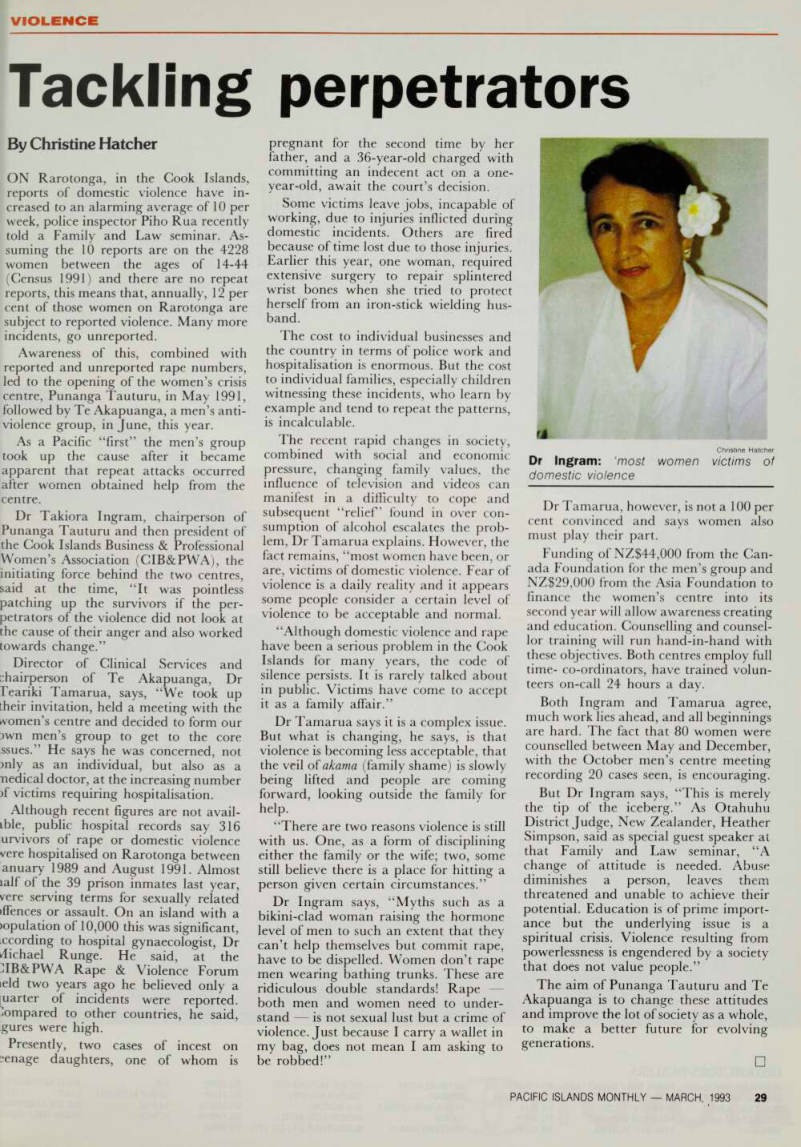
Dr Takiora Ingram, chairperson of Punanga Tauturu and then president of the Cook Islands Business & Professional Women’s Association (CIB&PWA), the initiating force behind the two centres, said at the time, “It was pointless patching up the survivors if the per petrators of the violence did not look at the cause of their anger and also worked
towards change.”
Director of Clinical Services and :hairperson of Te Akapuanga, Dr Feariki Tamarua, says, “We took up their invitation, held a meeting with the women’s centre and decided to form our )wn men’s group to get to the core ssues.” He says he was concerned, not mly as an individual, but also as a nedical doctor, at the increasing number
)f victims requiring hospitalisation.
Although recent figures are not avail ible, public hospital records say 316 urvivors of rape or domestic violence
vere hospitalised on Rarotonga between
anuary 1989 and August 1991. Almost lalf of the 39 prison inmates last year, vere serving terms for sexually related ►ffences or assault. On an island with a >opulation of 10,000 this was significant,
ccording to hospital gynaecologist, Dr
dichael Runge. He said, at the CIB&PWA Rape & Violence Forum icld two years ago he believed only a [uarter of incidents were reported.
Compared to other countries, he said, gures were high.
Presently, two cases of incest on menage daughters, one of whom is
pregnant for the second time by her father, and a 36-year-old charged with committing an indecent act on a one year-old, await the court’s decision.
Some victims leave jobs, incapable of working, due to injuries inflicted during domestic incidents. Others are fired because of time lost due to those injuries.
Earlier this year, one woman, required extensive surgery to repair splintered wrist bones when she tried to protect herself from an iron-stick wielding hus band.
The cost to individual businesses and the country in terms of police work and hospitalisation is enormous. But the cost to individual families, especially children witnessing these incidents, who learn by example and tend to repeat the patterns, is incalculable.
The recent rapid changes in society, combined with social and economic pressure, changing family values, the influence of television and videos can manifest in a difficulty to cope and subsequent “relief’ found in over con sumption of alcohol escalates the prob lem, Dr Tamarua explains. However, the fact remains, “most women have been, or are, victims of domestic violence. Fear of violence is a daily reality and it appears some people consider a certain level of violence to be acceptable and normal.
“Although domestic violence and rape have been a serious problem in the Cook Islands for many years, the code of silence persists. It is rarely talked about in public. Victims have come to accept it as a family affair.”
Dr Tamarua says it is a complex issue.
But what is changing, he says, is that violence is becoming less acceptable, that the veil of akama (family shame) is slowly being lifted and people are coming forward, looking outside the family for
help.
“There are two reasons violence is still with us. One, as a form of disciplining either the family or the wife; two, some still believe there is a place for hitting a person given certain circumstances.”
Dr Ingram says, “Myths such as a bikini-clad woman raising the hormone level of men to such an extent that they can’t help themselves but commit rape, have to be dispelled. Women don’t rape men wearing bathing trunks. These are ridiculous double standards! Rape both men and women need to under stand is not sexual lust but a crime of violence. Just because I carry a wallet in my bag, does not mean I am asking to be robbed!”
Dr Tamarua, however, is not a 100 per cent convinced and says women also must play their part.
Funding of NZ544,000 from the Can ada Foundation for the men’s group and NZ529,000 from the Asia Foundation to finance the women’s centre into its second year will allow awareness creating and education. Counselling and counsel lor training will run hand-in-hand with these objectives. Both centres employ full time- co-ordinators, have trained volun teers on-call 24 hours a day.
Both Ingram and Tamarua agree, much work lies ahead, and all beginnings are hard. The fact that 80 women were counselled between May and December, with the October men’s centre meeting recording 20 cases seen, is encouraging.
But Dr Ingram says, “This is merely the tip of the iceberg.” As Otahuhu District Judge, New Zealander, Heather Simpson, said as special guest speaker at that Family and Law seminar, “A change of attitude is needed. Abuse diminishes a person, leaves them threatened and unable to achieve their potential. Education is of prime import ance but the underlying issue is a spiritual crisis. Violence resulting from powerlessness is engendered by a society that does not value people.”
The aim of Punanga Tauturu and Te Akapuanga is to change these attitudes and improve the lot of society as a whole, to make a better future for evolving generations.
Christine Hatcher Dr Ingram: ‘most women victims of domestic violence