Issues b[?]nd the elections
pp. 12-13 · Read in the full issue
THE 1993 election for People’s Rep resentatives in Tonga highlighted grow ing political division within the country..
While people from the outer islands? considered a range of issues when casting} their vote, Tongatapu voters made aj clear choice between two political camps,,
each espousing opposing ideologies.
The first camp represented the status? quo, under which the power of the King} and the nobles would be preserved and J parliament would continue to be domi nated by members not elected by the;
people.
The other camp represented funda- • mental change to this system. With j “democracy”as its catchword, the pro- • change camp called for a reduction in the * King’s powers from head of state to a j state figurehead, and for a parliament elected by the people. Such a call J challenged the thinking of those Tongans ; happy with the present system. In j particular, it threatened those main tained in positions of power by the ; system, most notably the nobles.
Because the People’s Representatives ; are a minority in parliament the election itself could not directly bring about this
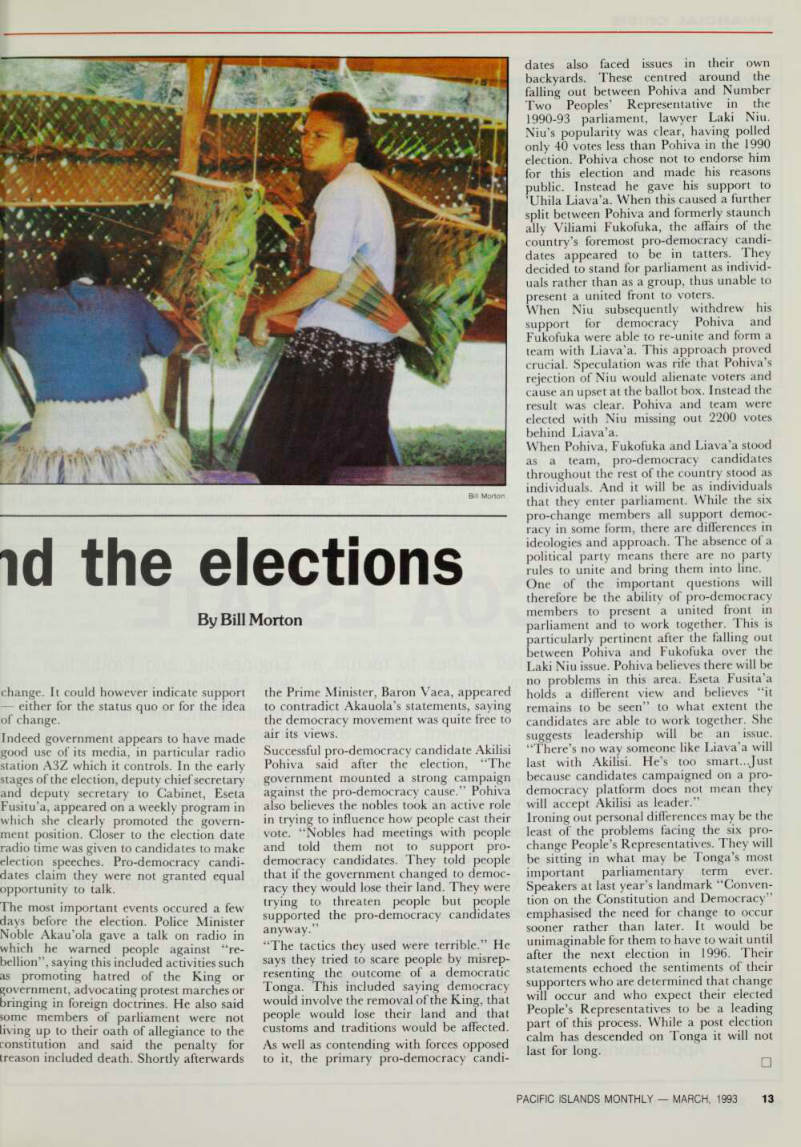
Casting their vote: in polling booths on[?]
By Bill Morton
change. It could however indicate support either for the status quo or for the idea of change.
Indeed government appears to have made good use of its media, in particular radio station A3Z which it controls. In the early stages of the election, deputy chief secretary and deputy secretary to Cabinet, Eseta Fusitu’a, appeared on a weekly program in which she clearly promoted the govern ment position. Closer to the election date radio time was given to candidates to make election speeches. Pro-democracy candi dates claim they were not granted equal opportunity to talk.
The most important events occured a few days before the election. Police Minister Noble Akau’ola gave a talk on radio in which he warned people against “re bellion”, saying this included activities such as promoting hatred of the King or government, advocating protest marches or bringing in foreign doctrines. He also said some members of parliament were not living up to their oath of allegiance to the constitution and said the penalty for treason included death. Shortly afterwards
the Prime Minister, Baron Vaea, appeared to contradict Akauola’s statements, saying the democracy movement was quite free to air its views.
Successful pro-democracy candidate Akilisi Pohiva said after the election, “The government mounted a strong campaign against the pro-democracy cause.” Pohiva also believes the nobles took an active role in trying to influence how people cast their vote. “Nobles had meetings with people and told them not to support pro democracy candidates. They told people that if the government changed to democ racy they would lose their land. They were trying to threaten people but people supported the pro-democracy candidates anyway.”
“The tactics they used were terrible.” He says they tried to scare people by misrep resenting the outcome of a democratic Tonga. This included saying democracy would involve the removal of the King, that people would lose their land and that customs and traditions would be affected.
As well as contending with forces opposed to it, the primary pro-democracy candi
dates also faced issues in their own backyards. These centred around the falling out between Pohiva and Number Two Peoples’ Representative in the 1990-93 parliament, lawyer Laki Niu.
Niu’s popularity was clear, having polled only 40 votes less than Pohiva in the 1990 election. Pohiva chose not to endorse him for this election and made his reasons public. Instead he gave his support to ’Uhila Liava’a. When this caused a further split between Pohiva and formerly staunch ally Viliami Fukofuka, the affairs of the country’s foremost pro-democracy candi dates appeared to be in tatters. They decided to stand for parliament as individ uals rather than as a group, thus unable to present a united front to voters.
When Niu subsequently withdrew his support for democracy Pohiva and Fukofuka were able to re-unite and form a team with Liava’a. This approach proved crucial. Speculation was rife that Pohiva’s rejection of Niu would alienate voters and cause an upset at the ballot box. Instead the result was clear. Pohiva and team were elected with Niu missing out 2200 votes behind Liava’a.
When Pohiva, Fukofuka and Liava’a stood as a team, pro-democracy candidates throughout the rest of the country stood as individuals. And it will be as individuals that they enter parliament. While the six pro-change members all support democ racy in some form, there are differences in ideologies and approach. The absence of a political party means there are no party rules to unite and bring them into line.
One of the important questions will therefore be the ability of pro-democracy members to present a united front in parliament and to work together. This is particularly pertinent after the falling out between Pohiva and Fukofuka over the Laki Niu issue. Pohiva believes there will be no problems in this area. Eseta Fusita’a holds a different view and believes “it remains to be seen” to what extent the candidates are able to work together. She suggests leadership will be an issue.
“There’s no way someone like Liava’a will last with Akilisi. He’s too smart.. Just because candidates campaigned on a pro democracy platform does not mean they will accept Akilisi as leader.”
Ironing out personal differences may be the least of the problems facing the six pro change People’s Representatives. They will be sitting in what may be Tonga’s most important parliamentary term ever.
Speakers at last year’s landmark “Conven tion on the Constitution and Democracy” emphasised the need for change to occur sooner rather than later. It would be unimaginable for them to have to wait until after the next election in 1996. Their statements echoed the sentiments of their supporters who are determined that change will occur and who expect their elected People’s Representatives to be a leading part of this process. While a post election calm has descended on Tonga it will not last for long. n
Bill Morton