A question of time
pp. 11-12 · Read in the full issue
Cover Stories
By Bill Morton
The real message from the Tongan elections is that support for change is real. The government would like it to go away, but it is unlikely to do so.
TONGAN people went to the polls last month to vote for “Peoples’ Representa tives” to the country’s Legislative As sembly. The nine elected members will sit in parliament alongside 12 ministers handpicked by the King and nine “Nobles Representatives” chosen by 33 Noble families.
The 1993 election held special signifi cance. It was a test of countrywide support for the concepts of change and democracy.
Election results have caused the pro democracy camp to claim victory and the government to play-down this claim.
Six of the nine elected candidates are pro democracy; one is pro government and two have not yet revealed their al legiances.
Akilisi Pohiva, sitting representative for the main island of Tongatapu was re flected for his third successive parliamen tary term. He claims the election served as a referendum for people’s support for :hange. “We are very pleased with the "esult. It is a clear mandate for change md a clear message to the government.”
The results reveal regional differences n the country’s endorsement of democ •acy. Voters on Tongatapu elected :andidates to three seats. They gave iverwhelming support to Pohiva and wo fellow pro-democracy candidates /iliami Fukofuka and ’Uhila Liava’a. \mong them they captured 57 per cent )f the vote. The remaining vote was pread amongst another 12 candidates fom both the pro-democracy and pro government causes.
The outer island group of Ha’apai lected candidates for two seats. It howed it is following in the footsteps of
fongatabu by choosing pro-democracy
andidates Tesina Fuko and ’Uliti Uata. fhe unsuccessful third place-getter was
ilso pro-democracy. Most significantly,
la’apai rejected outspoken pro government member Viliami Afeaki.
Results from the other outer islands re not as clear-cut and suggest voters onsidered a range of issues in addition □ the question of democratic change, /ava’u (two seats) ousted both sitting nembers. It chose pro-democracy candi ate Masao Paasi for the first seat but
lected independent Samiu Vaipulu to
lie second, ’Eua (one seat) stayed onservative and re-elected its pro overnment member. The Niuas (one fat) booted out its conservative mem er, giving victory to the only woman
member in the House, ’Ofa Fusitu’a. Her intentions are not yet clear.
Compared to the 1990 election when pro-reform candidates won five out of nine seats, the 1993 election represents only a small improvement for the cause of change in Tonga. However, ’ Akilisi Pohiva says he expects pro-democracy numbers to increase through support from Samiu Vaipulu. Pohiva states Vaipulu joined him in a walk-out from parliament when they were both mem bers, between 1987-1990. Both Vaipulu and Fusitu’a will be under intense pressure to declare their positions in relation to democracy.
The crucial question which now stands out is how the election will affect the
process of change in Tonga. In previous elections pro-reform candidates cam paigned from a platform of cleaning up the act of government, citing corruption and misuse of funds at the highest levels.
In this election the stakes were much higher. As a result of the November 1992 “Convention on the Constitution and Democracy” the issue of “democracy” rocketted to the top of the political agenda. It was immediately in the election spotlight. The entire fabric of Tongan society was now under question, with pro-change candidates arguing for a reduction of the King’s powers and calling for a parliament with all 30 members elected by the people.
The election demonstrates that not all Tonga’s 95,000 “commoners” want such
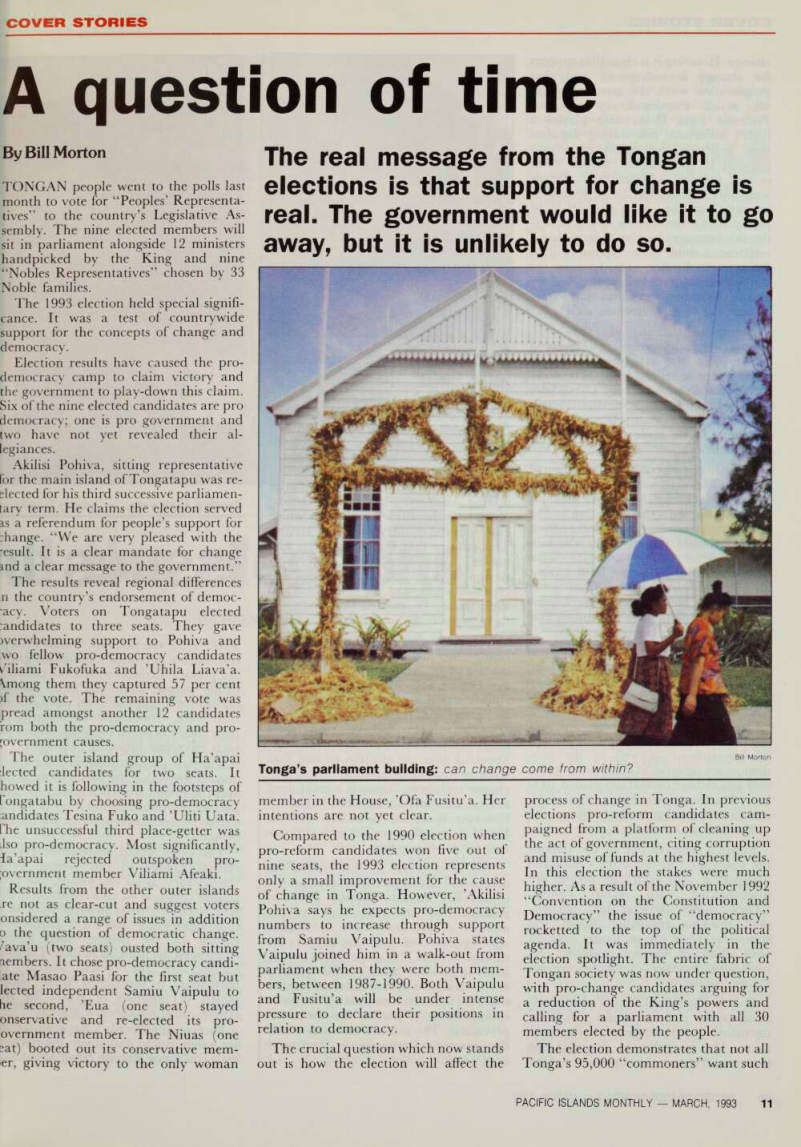
Tonga’s parliament building: can change come from within?
change. However it is clear that support for change is widespread and that people now want the government to take action. Pro-democracy supporter, Professor Futa Helu, who played a highly influential role during the elec tion, believes government must now respond to the peoples’ wishes. “The overall message is quite clear. People want our constitution to be looked at seriously and they want changes to be instituted. Government is now consider ing this message in order to formulate a response. I think their response will be different to former ones because the trend is very clear. I believe they will try and make some concessions that would at least erode their hold on society.”
Acting chairman of the Pro- Democracy Movement, Reverend Simote Vea also says the message to government is self-evident. “The clear
victory for Pro-Democracy Candidates
confirms that Tonga is moving towards
full democracy. Constitutional changes
will have to be made to make Tonga more democratic.”
Prior to the election the government made it clear it had no intention of considering change. Since the election it has re-aflirmed this position. The strongest statement has come from Prime Minister Baron Vaea, who said that Tongan people did not want democracy and that they liked having an elite leadership drawn from noble background. He added they were quite happy living with their traditions and accepted the role of the hierarchy.
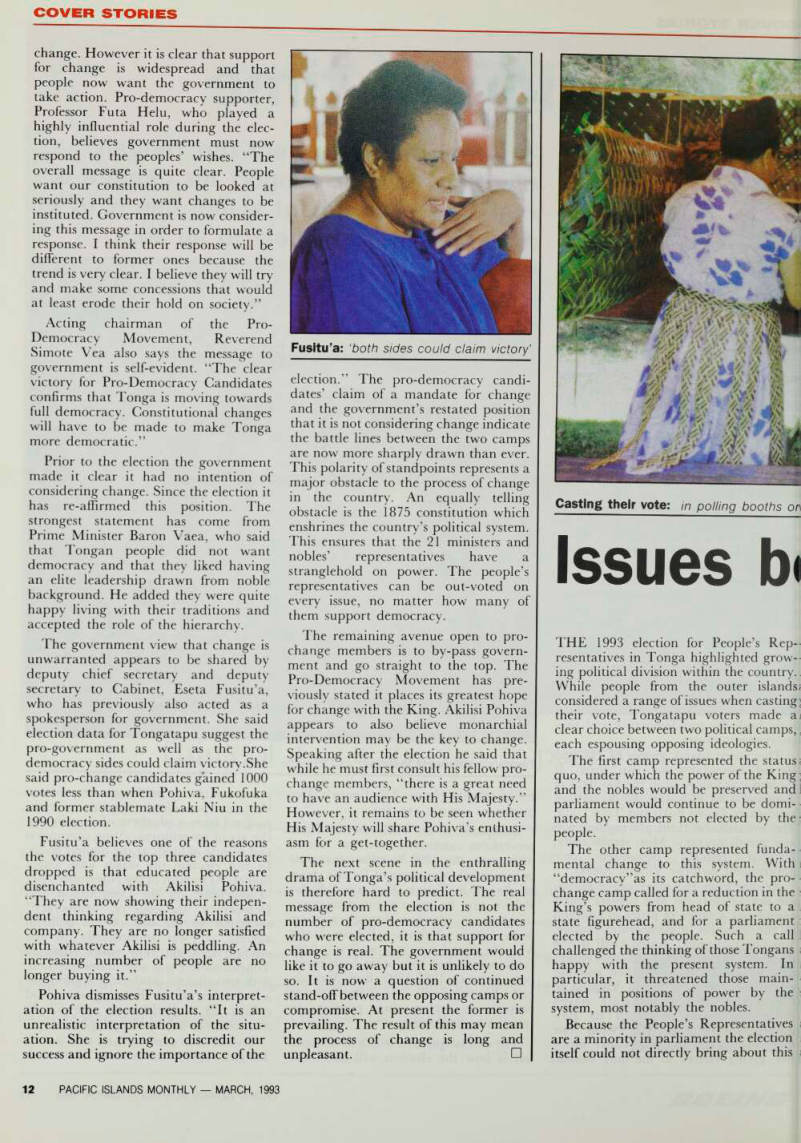
The government view that change is unwarranted appears to be shared by deputy chief secretary and deputy secretary to Cabinet, Eseta Fusitu’a, who has previously also acted as a spokesperson for government. She said election data for Tongatapu suggest the pro-government as well as the pro democracy sides could claim victory. She said pro-change candidates gained 1000 votes less than when Pohiva, Fukofuka and former stablemate Laki Niu in the 1990 election.
Fusitu’a believes one of the reasons the votes for the top three candidates dropped is that educated people are disenchanted with Akilisi Pohiva.
“They are now showing their indepen dent thinking regarding Akilisi and company. They are no longer satisfied with whatever Akilisi is peddling. An increasing number of people are no longer buying it.”
Pohiva dismisses Fusitu’a’s interpret ation of the election results. “It is an unrealistic interpretation of the situ ation. She is trying to discredit our success and ignore the importance of the
election.” The pro-democracy candi dates’ claim of a mandate for change and the government’s restated position that it is not considering change indicate the battle lines between the two camps are now more sharply drawn than ever.
This polarity of standpoints represents a major obstacle to the process of change in the country. An equally telling obstacle is the 1875 constitution which enshrines the country’s political system.
This ensures that the 21 ministers and nobles’ representatives have a stranglehold on power. The people’s representatives can be out-voted on every issue, no matter how many of them support democracy.
The remaining avenue open to pro change members is to by-pass govern ment and go straight to the top. The Pro-Democracy Movement has pre viously stated it places its greatest hope for change with the King. Akilisi Pohiva appears to also believe monarchial intervention may be the key to change.
Speaking after the election he said that while he must first consult his fellow pro change members, “there is a great need to have an audience with His Majesty.”
However, it remains to be seen whether His Majesty will share Pohiva’s enthusi asm for a get-together.
The next scene in the enthralling drama of Tonga’s political development is therefore hard to predict. The real message from the election is not the number of pro-democracy candidates who were elected, it is that support for change is real. The government would like it to go away but it is unlikely to do so. It is now a question of continued stand-off between the opposing camps or compromise. At present the former is prevailing. The result of this may mean the process of change is long and
unpleasant. □
Fusitu’a: ‘both sides could claim victory’