A major economic force
p. 45 · Read in the full issue
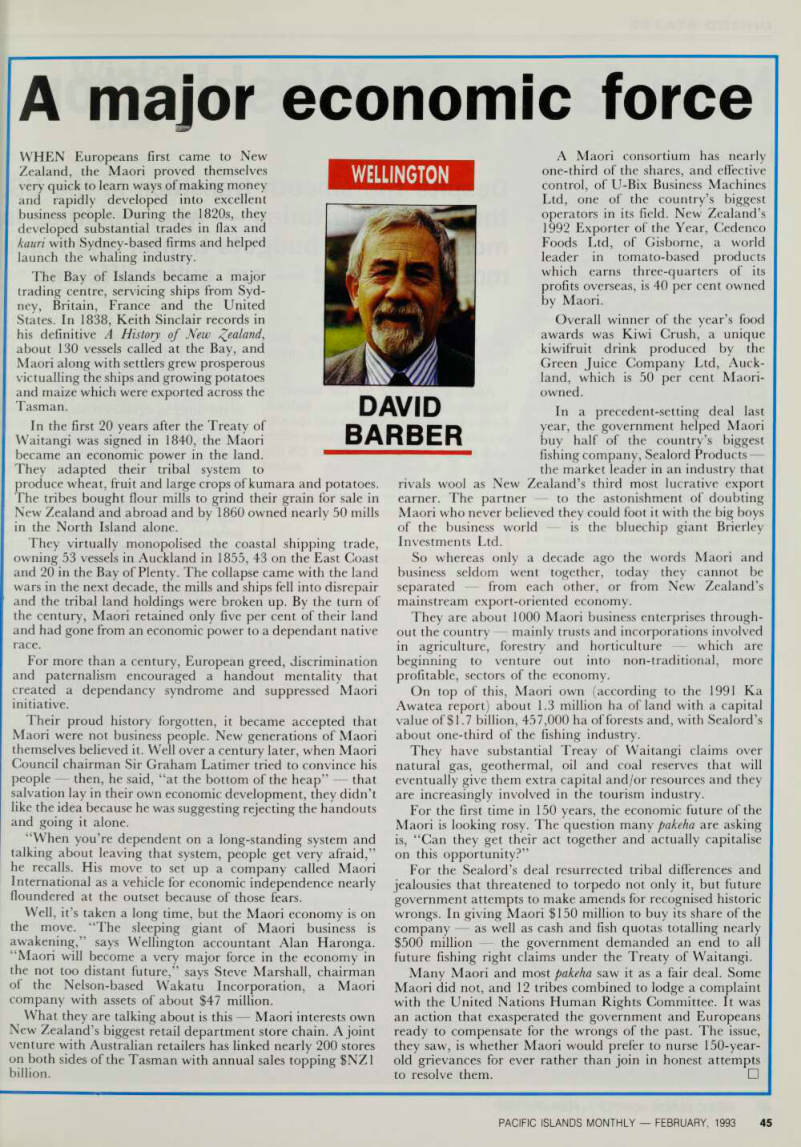
WHEN Europeans first came to New Zealand, the Maori proved themselves very quick to learn ways of making money and rapidly developed into excellent business people. During the 1820 s, they developed substantial trades in flax and kauri with Sydney-based firms and helped launch the whaling industry.
The Bay of Islands became a major trading centre, servicing ships from Syd ney, Britain, France and the United States. In 1838, Keith Sinclair records in his definitive A History of New Zjealmd, about 130 vessels called at the Bay, and Maori along with settlers grew prosperous victualling the ships and growing potatoes and maize which were exported across the Tasman.
In the first 20 years after the Treaty of Waitangi was signed in 1840, the Maori became an economic power in the land.
They adapted their tribal system to
produce wheat, fruit and large crops of kumara and potatoes.
The tribes bought flour mills to grind their grain for sale in New Zealand and abroad and by 1860 owned nearly 50 mills in the North Island alone.
They virtually monopolised the coastal shipping trade, owning 53 vessels in Auckland in 1855, 43 on the East Coast and 20 in the Bay of Plenty. The collapse came with the land wars in the next decade, the mills and ships fell into disrepair and the tribal land holdings were broken up. By the turn of the century, Maori retained only five per cent of their land and had gone from an economic power to a dependant native race.
For more than a century, European greed, discrimination and paternalism encouraged a handout mentality that created a dependancy syndrome and suppressed Maori initiative.
Their proud history forgotten, it became accepted that Maori were not business people. New generations of Maori themselves believed it. Well over a century later, when Maori Council chairman Sir Graham Latimer tried to convince his people then, he said, “at the bottom of the heap” that salvation lay in their own economic development, they didn’t like the idea because he was suggesting rejecting the handouts and going it alone.
“When you’re dependent on a long-standing system and talking about leaving that system, people get very afraid,” he recalls. His move to set up a company called Maori International as a vehicle for economic independence nearly floundered at the outset because of those fears.
Well, it’s taken a long time, but the Maori economy is on the move. “The sleeping giant of Maori business is awakening,” says Wellington accountant Alan Haronga.
“Maori will become a very major force in the economy in the not too distant future,” says Steve Marshall, chairman of the Nelson-based Wakatu Incorporation, a Maori company with assets of about $47 million.
What they are talking about is this Maori interests own New Zealand’s biggest retail department store chain. A joint venture with Australian retailers has linked nearly 200 stores on both sides of the Tasman with annual sales topping SNZI billion.
A Maori consortium has nearly one-third of the shares, and effective control, of U-Bix Business Machines Ltd, one of the country’s biggest operators in its field. New Zealand’s 1992 Exporter of the Year, Cedenco Foods Ltd, of Gisborne, a world leader in tomato-based products which earns three-quarters of its profits overseas, is 40 per cent owned by Maori.
Overall winner of the year’s food awards was Kiwi Crush, a unique kiwifruit drink produced by the Green Juice Company Ltd, Auck land, which is 50 per cent Maori owned.
In a precedent-setting deal last year, the government helped Maori buy half of the country’s biggest fishing company, Sealord Products the market leader in an industry that
rivals wool as New Zealand’s third most lucrative export earner. The partner to the astonishment of doubting Maori who never believed they could foot it with the big boys of the business world is the bluechip giant Brierley Investments Ltd.
So whereas only a decade ago the words Maori and business seldom went together, today they cannot be separated from each other, or from New Zealand’s mainstream export-oriented economy.
They are about 1000 Maori business enterprises through out the country mainly trusts and incorporations involved in agriculture, forestry and horticulture which are beginning to venture out into non-traditional, more profitable, sectors of the economy.
On top of this, Maori own (according to the 1991 Ka Awatea report) about 1.3 million ha of land with a capital value of $1.7 billion, 457,000 ha of forests and, with Sealord’s about one-third of the fishing industry.
They have substantial Treay of Waitangi claims over natural gas, geothermal, oil and coal reserves that will eventually give them extra capital and/or resources and they are increasingly involved in the tourism industry.
For the first time in 150 years, the economic future of the Maori is looking rosy. The question many pakeha are asking is, “Can they get their act together and actually capitalise on this opportunity?”
For the Sealord’s deal resurrected tribal differences and jealousies that threatened to torpedo not only it, but future government attempts to make amends for recognised historic wrongs. In giving Maori SISO million to buy its share of the company as well as cash and fish quotas totalling nearly S5OO million the government demanded an end to all future fishing right claims under the Treaty of Waitangi.
Many Maori and most pakeha saw it as a fair deal. Some Maori did not, and 12 tribes combined to lodge a complaint with the United Nations Human Rights Committee. It was an action that exasperated the government and Europeans ready to compensate for the wrongs of the past. The issue, they saw, is whether Maori would prefer to nurse 150-year old grievances for ever rather than join in honest attempts to resolve them. □