Those infernal constitutions
p. 43 · Read in the full issue
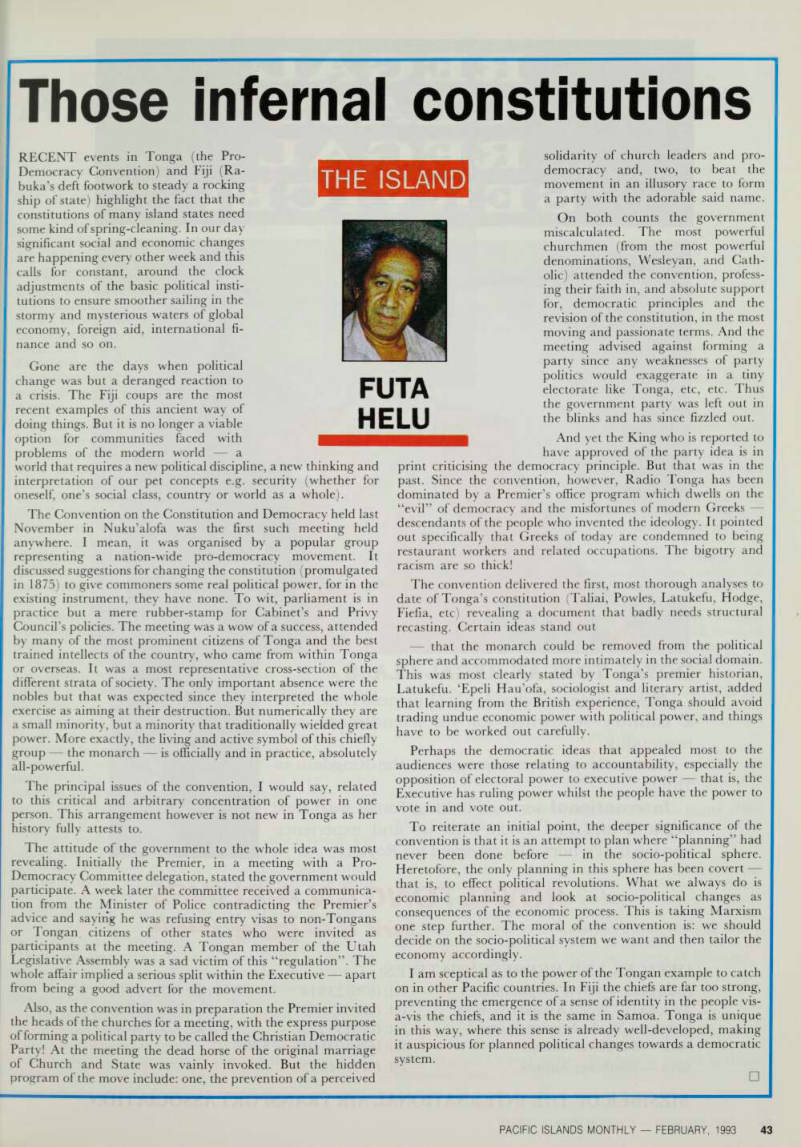
RECENT events in Tonga (the Pro- Democracy Convention) and Fiji (Ra buka’s deft footwork to steady a rocking ship of state) highlight the fact that the constitutions of many island states need some kind of spring-cleaning. In our day significant social and economic changes are happening every other week and this calls for constant, around the clock adjustments of the basic political insti tutions to ensure smoother sailing in the stormy and mysterious waters of global economy, foreign aid, international fi nance and so on.
Gone are the days when political change was but a deranged reaction to a crisis. The Fiji coups are the most recent examples of this ancient way of doing things. But it is no longer a viable option for communities faced with problems of the modern world a
world that requires a new political discipline, a new thinking and interpretation of our pet concepts e.g. security (whether for oneself, one’s social class, country or world as a whole).
The Convention on the Constitution and Democracy held last November in Nuku’alofa was the first such meeting held anywhere. I mean, it was organised by a popular group representing a nation-wide pro-democracy movement. It discussed suggestions for changing the constitution (promulgated in 1875) to give commoners some real political power, for in the existing instrument, they have none. To wit, parliament is in practice but a mere rubber-stamp for Cabinet’s and Privy Council’s policies. The meeting was a wow of a success, attended by many of the most prominent citizens of Tonga and the best trained intellects of the country, who came from within Tonga or overseas. It was a most representative cross-section of the different strata of society. The only important absence were the nobles but that was expected since they interpreted the whole exercise as aiming at their destruction. But numerically they are a small minority, but a minority that traditionally wielded great power. More exactly, the living and active symbol of this chiefly group the monarch is officially and in practice, absolutely all-powerful.
The principal issues of the convention, I would say, related to this critical and arbitrary concentration of power in one person. This arrangement however is not new in Tonga as her history fully attests to.
The attitude of the government to the whole idea was most revealing. Initially the Premier, in a meeting with a Pro- Democracy Committee delegation, stated the government would participate. A week later the committee received a communica tion from the Minister of Police contradicting the Premier’s advice and saying he was refusing entry visas to non-Tongans or Tongan citizens of other states who were invited as participants at the meeting. A Tongan member of the Utah Legislative Assembly was a sad victim of this “regulation”. The whole affair implied a serious split within the Executive apart from being a good advert for the movement.
Also, as the convention was in preparation the Premier invited the heads of the churches for a meeting, with the express purpose of forming a political party to be called the Christian Democratic Party! At the meeting the dead horse of the original marriage of Church and State was vainly invoked. But the hidden program of the move include: one, the prevention of a perceived
solidarity of church leaders and pro democracy and, two, to beat the movement in an illusory race to form a party with the adorable said name.
On both counts the government miscalculated. The most powerful churchmen (from the most powerful denominations, Wesleyan, and Cath olic) attended the convention, profess ing their faith in, and absolute support for, democratic principles and the revision of the constitution, in the most moving and passionate terms. And the meeting advised against forming a party since any weaknesses of party politics would exaggerate in a tiny electorate like Tonga, etc, etc. Thus the government party was left out in the blinks and has since fizzled out.
And yet the King who is reported to have approved of the party idea is in
print criticising the democracy principle. But that was in the past. Since the convention, however, Radio Tonga has been dominated by a Premier’s office program which dwells on the “evil” of democracy and the misfortunes of modern Greeks descendants of the people who invented the ideology. It pointed out specifically that Greeks of today are condemned to being restaurant workers and related occupations. The bigotry and racism are so thick!
The convention delivered the first, most thorough analyses to date of Tonga’s constitution (Taliai, Powles, Latukefu, Hodge, Fiefia, etc) revealing a document that badly needs structural recasting. Certain ideas stand out - that the monarch could be removed from the political sphere and accommodated more intimately in the social domain.
This was most clearly stated by Tonga’s premier historian, Latukefu. ‘Epeli Hau’ofa, sociologist and literary artist, added that learning from the British experience, Tonga should avoid trading undue economic power with political power, and things have to be worked out carefully.
Perhaps the democratic ideas that appealed most to the audiences were those relating to accountability, especially the opposition of electoral power to executive power that is, the Executive has ruling power whilst the people have the power to vote in and vote out.
To reiterate an initial point, the deeper significance of the convention is that it is an attempt to plan where “planning” had never been done before in the socio-political sphere.
Heretofore, the only planning in this sphere has been covert that is, to effect political revolutions. What we always do is economic planning and look at socio-political changes as consequences of the economic process. This is taking Marxism one step further. The moral of the convention is: we should decide on the socio-political system we want and then tailor the economy accordingly.
I am sceptical as to the power of the Tongan example to catch on in other Pacific countries. In Fiji the chiefs are far too strong, preventing the emergence of a sense of identity in the people vis a-vis the chiefs, and it is the same in Samoa. Tonga is unique in this way, where this sense is already well-developed, making it auspicious for planned political changes towards a democratic system.