Powerful Tabaran
p. 37 · Read in the full issue
Tabaran is a Kuanauan word spoken by the Tolais people who live around Rabaul in Papua New Guinea. A tabaran is a powerful spirit which has its own special dance and is honoured at local ceremonies. It is also the album title of a powerful collaboration between Australian-based band, Not Drowning Waving, and local Papua New Guinea musicians. Tabaran is truly the result of exchange and not exploitation. The powerful combination produces a new sound, the richness of which reflects the collaboration of two entirely different musical backgrounds and influences.
They seem to fit together with great harmony and a sense of enormous
creative potential.
Tabaran includes traditional songs and contemporary lyrics written around issues which concerned the musicians as a group. The tracks vary from traditional songs like Abebe in which Telek sings of the butterfly spirit and a funeral chant to political comment as in the Kiap song, taking its name from the local word for patrol officer,/^ pila , and describing the relations between Kiaps and native labourers, and Blackwater , a powerful comment on the plight of West Papuan refugees who have fled the Indonesian army to camps across the border.
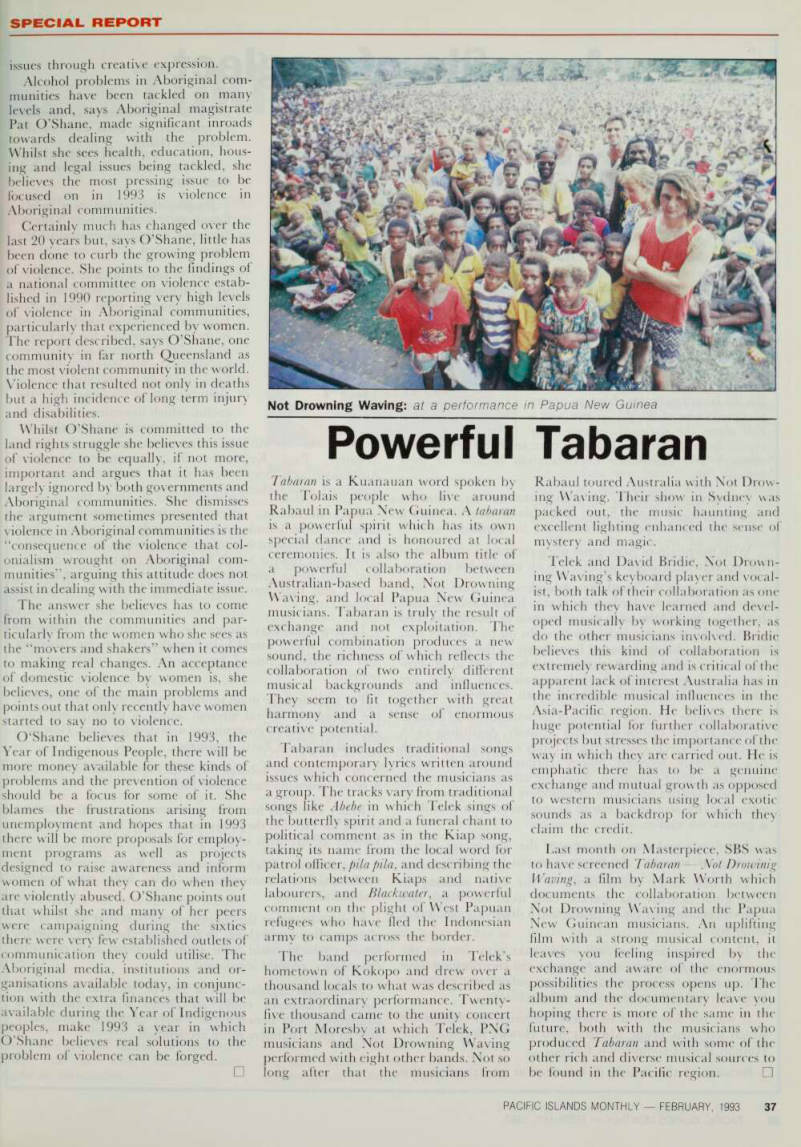
The band performed in Telek’s hometown of Kokopo and drew over a thousand locals to what was described as
an extraordinary performance. Twenty
five thousand came to the unity concert in Port Moresby at which Telek, PNG musicians and Not Drowning Waving performed with eight other bands. Not so long after that the musicians from
Rabaul toured Australia with Not Throw ing Waving, Their show in Sydney was packed out, the music haunting and excellent lighting enhanced the sense of mystery and magic, Telek and David Bridie, Not Drown
ing Waving’s keyboard player and vocal
ist, both talk of their collaboration as one in which they have learned and devel
oped musically by working together, as
do the other musicians involved. Bridie believes this kind of collaboration is extremely rewarding and is critical of the apparent lack of interest Australia has in the incredible musical influences in the Asia-Pacific region. He belivcs there is huge potential for further collaborative projects but stresses the importance of the way in which they are carried out. He is emphatic there has to be a genuine exchange and mutual growth as opposed to western musicians using local exotic sounds as a backdrop for which they claim the credit.
Last month on Masterpiece, SBS was to have screened Tabaran Not Drowinig Waving , a film by Mark Worth which documents the collaboration between
Not Drowning Waving and the Papua
New Guinean musicians. An uplifting film with a strong musical content, it
leaves you feeling inspired by the
exchange and aware of the enormous possibilities the process opens up. The album and the documentary leave you hoping there is more of the same in the future, both with the musicians who produced Tabaran and with some of the other rich and diverse musical sources to be found in the Pacific region. □
Not Drowning Waving: at a performance in Papua New Guinea