Forging real solutions
pp. 35-37 · Read in the full issue

IN early December in a small park in Redfern, a predominantly Aboriginal suburb of Sydney, Prime Minister Keat ing gave a speech to applauding crowds.
It was a scathing critique of colonialist behaviour in Australia. He talked of dispossession, genocide, lack of respect or understanding on the part of the non-
Aboriginal invaders.
Not since Gough Whitlam has a Prime Minister so openly condemned the activi ties of colonialists. The speech was followed the next day by numerous letters to the editor of national news papers describing two quite different responses. One congratulatory, applaud ing the Prime Minister’s outspoken comments as a step in the right direction, part of the process of reconciliation. The other, that this kind of speech was inflammatory, provoked racist attitudes and imposed guilt upon a generation who had nothing to do with the activities of their forefathers. An Aboriginal letter writer responded by suggesting that this kind of oppression and alienation con tinued to take place today in more subtle
forms. Whatever one believes, there can be little doubt that Keating is correct in his historical view, the debate is whether it is productive to discuss and acknowl edge these issues. It seems to me that it is essential to acknowledge, comfort and absorb this history in order to move forward, to develop any true sense of an Australian identity. Australian history has been built on myths which invariably sidestep the uglier aspects of colonialism and whilst many were angry at Keating’s comments, they are a necessary part of the evolution of Australia.
In the last 20 years there have been massive changes in relations between Aboriginal and non-Aboriginal Austra lia. Up to and after being given the vote in 1967 Aboriginal activists have fought to improve the conditions of their people.
Over the years Aboriginal legal services, health, education and housing have improved. Land rights claims have on occasions resulted in the handback of land and historical cases like Coronation Hill in which the Federal government respected Aboriginal claims that the
uranium mining site was in fact a sacred site and moved against the interests of big business and developers to prevent the mine going ahead.
Aboriginal media services have grown and expanded with numerous radio stations and television productions.
CAAMA, (Central Australian Aborigi nal Media Association) one of the best known, produces television programs which reach many of the more remote communities. CASM (Centre for Aborig inal Studies in Music) based in Adelaide is one of a number of musical centres around the country which promote the teaching of traditional music by Aborig inal elders alongside contemporary music. Bands like Yothu Yindi and their recent hit Treaty have brought contem porary Aboriginal music into the inter national arena, again often drawing on traditional influences they have been seen as producing an intrinsically “Aus tralian” sound. Numerous Aboriginal musical and theatre productions have addressed political, social and economic
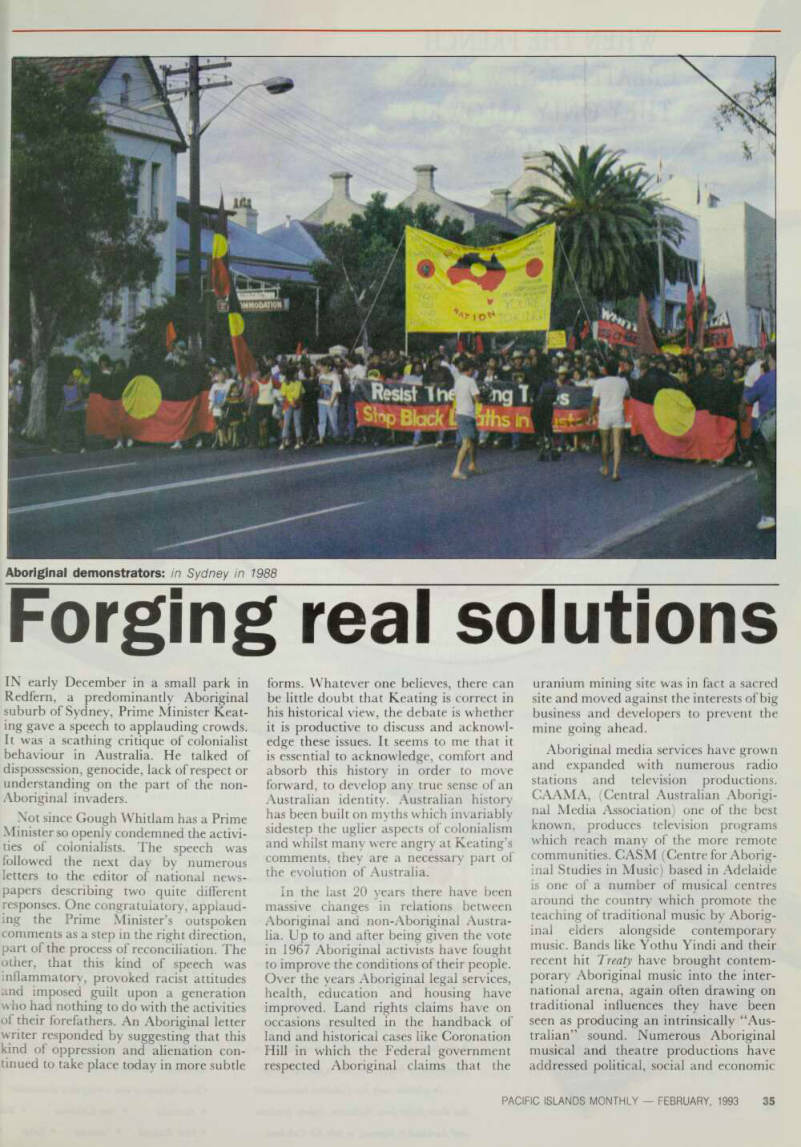
Aboriginal demonstrators: in Sydney in 1988
issues through creative expression.
Alcohol problems in Aboriginal com munities have been tackled on many levels and, says Aboriginal magistrate Pat O’Shane, made significant inroads towards dealing with the problem.
Whilst she sees health, education, hous ing and legal issues being tackled, she believes the most pressing issue to be focused on in 1993 is violence in
Aboriginal communities.
Certainly much has changed over the last 20 years but, says O’Shane, little has been done to curb the growing problem of violence. She points to the findings of a national committee on violence estab lished in 1990 reporting very high levels of violence in Aboriginal communities,
particularly that experienced by women.
The report described, says O’Shane, one community in far north Queensland as the most violent community in the world.
Violence that resulted not only in deaths but a high incidence of long term injury and disabilities.
Whilst O’Shane is committed to the land rights struggle she believes this issue of violence to be equally, if not more, important and argues that it has been largely ignored by both governments and Aboriginal communities. She dismisses the argument sometimes presented that violence in Aboriginal communities is the “consequence of the violence that col onialism wrought on Aboriginal com munities’*, arguing this attitude does not assist in dealing with the immediate issue.
The answer she believes has to come from within the communities and par ticularly from the women who she sees as the “movers and shakers” when it comes to making real changes. An acceptance of domestic violence by women is, she believes, one of the main problems and points out that only recently have women started to say no to violence. o‘Shane believes that in 1993, the Year of Indigenous People, there will be more money available for these kinds of problems and the prevention of violence should be a focus for some of it. She blames the frustrations arising from unemployment and hopes that in 1993 there will be more proposals for employ ment programs as well as projects designed to raise awareness and inform women of what they can do when they are violently abused. O’Shane points out that whilst she and many of her peers were campaigning during the sixties there were very few established outlets of communication they could utilise. The Aboriginal media, institutions and or
ganisations available today, in conjunc
tion with the extra finances that will be available during the Year of Indigenous peoples, make 1993 a year in which O’Shane believes real solutions to the problem of violence can be forged.