Winning Streak
pp. 51-52 · Read in the full issue
By Wainikiti Waqa
They came, they played, but they did not go home champs. A look at the performances of tthe regional teams at the World Youth Netball championsips.
COOK ISLANDS will remain South Pacific netball champs in the next decade if their performance at the recent World Youth Netball championship in Suva ( was anything to go by.
The small island nation again stamped its supremacy in the region and on the international scene when it came third at the championship. And if they continue in the same vein, the Cooks will rise to be one of the world’s best three in the years ahead. They were rated fifth in the last World Cup in Sydney.
The Cooks, newcomers to the youth championship, pipped the tournament’s second-rated English side 51-50, creating the major upset of the week-long tourna ment. The Margharet Matenga coached side also proved too strong for their South Pacific rivals. Although the Cooks did not play Fiji and Papua New Guinea, it is likely they would have easily beaten both teams.
The Cooks have a lot to thank the Kiwis for. New Zealand has been providing coaching and umpiring clinics for the Cook Islands Netball Association for some years and the New Zealand influence was evident throughout their games.
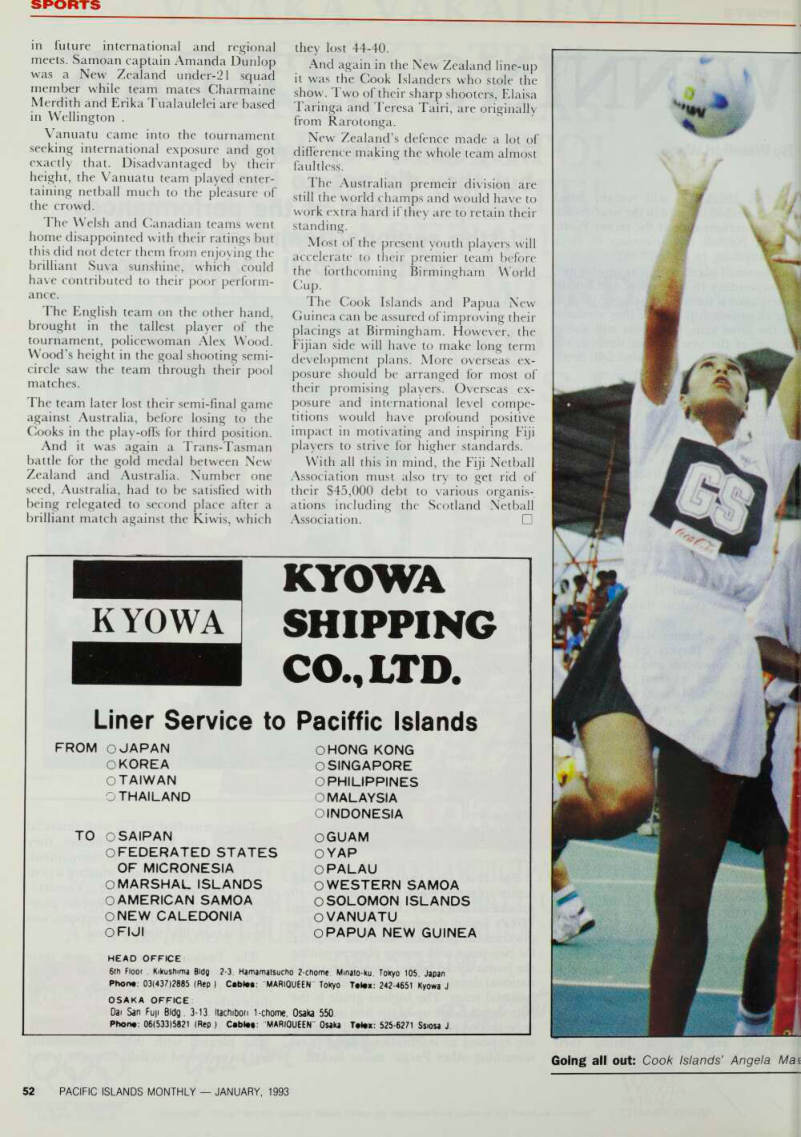
Matenga, a former Kiwi representa tive, and her players forced penalties onto their opponents and capitalised on them. She had a great asset in her shooter, Angela Maoate, who stood tall in her shooting position, leaving no doubts for her teammates once she received the ball inside the semi-circle.
Apart from Maoate, three other players have played for the Cooks national side.
The Cooks national side have been the South Pacific champs for the last decade after grabbing the title from Fiji in 1983’s Western Samoan South Pacific Games.
Since then, they have retained their form of play while Fiji have deteriorated, now being relegated to fourth position at the
1991 Spg In Png.
While other Pacific teams have shown :onsiderable progress in the past years, Fiji netball administrators have been breed to re-examine their development itrategies before the World Cup sched iled for Birmingham in 1995. The eight nonth training schedules put out for the Fiji youth side had little significance luring the tournament.
Fiji players lost concentration, seemed msettled and nervous during their James. The girls in white were penalised
constantly for stepping and obstruction, something missing in the other teams.
Both their games against Papua New Guinea proved to be a disap pointment for the large home crowd at the Laucala multi purpose courts. They lost 57-36 and 52-29.
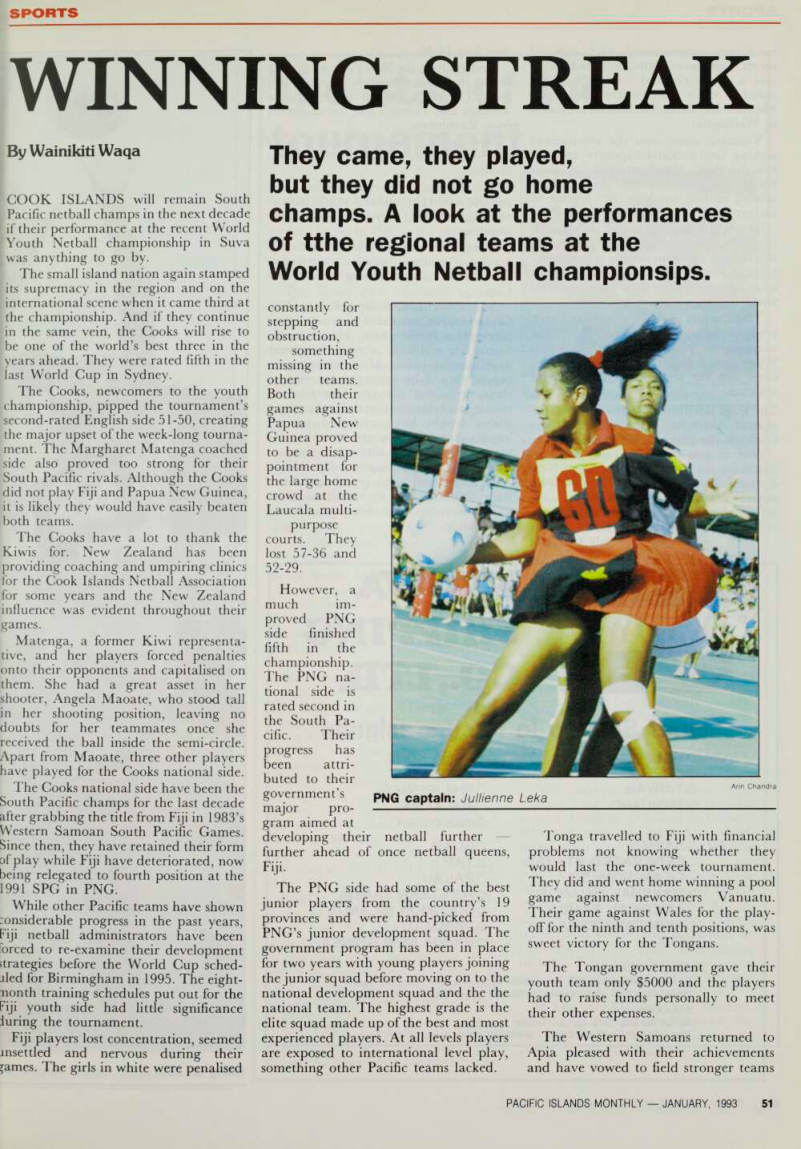
However, a much im proved PNG side finished fifth in the
championship.
The PNG na tional side is rated second in the South Pa cific. Their progress has been attri buted to their government’s
major pro
gram aimed at
developing their netball further further ahead of once netball queens, Fiji.
The PNG side had some of the best junior players from the country’s 19 provinces and were hand-picked from PNG’s junior development squad. The government program has been in place for two years with young players joining the junior squad before moving on to the national development squad and the the national team. The highest grade is the elite squad made up of the best and most
experienced players. At all levels players
are exposed to international level play, something other Pacific teams lacked.
Tonga travelled to Fiji with financial problems not knowing whether they would last the one-week tournament.
They did and went home winning a pool game against newcomers Vanuatu.
Their game against Wales for the play off for the ninth and tenth positions, was sweet victory for the Tongans.
The Tongan government gave their youth team only SSOOO and the players had to raise funds personally to meet their other expenses.
The Western Samoans returned to Apia pleased with their achievements and have vowed to field stronger teams
PNG captain: Jullienne Leka
Arin Chandra
in future international and regional meets. Samoan captain Amanda Dunlop was a New Zealand under-21 squad member while team mates Charmaine Merdith and Erika Tualaulelei are based in Wellington .
Vanuatu came into the tournament seeking international exposure and got exactly that. Disadvantaged by their height, the Vanuatu team played enter taining netball much to the pleasure of the crowd.
The Welsh and Canadian teams went home disappointed with their ratings but this did not deter them from enjoying the brilliant Suva sunshine, which could have contributed to their poor perform ance.
The English team on the other hand, brought in the tallest player of the tournament, policewoman Alex Wood.
Wood’s height in the goal shooting semi circle saw the team through their pool matches.
The team later lost their semi-final game against Australia, before losing to the Cooks in the play-offs for third position.
And it was again a Trans-Tasman battle for the gold medal between New Zealand and Australia. Number one seed, Australia, had to be satisfied with being relegated to second place after a brilliant match against the Kiwis, which
they lost 44-40.
And again in the New Zealand line-up it was the Cook Islanders who stole the show. Two of their sharp shooters, Elaisa Taringa and Teresa Tairi, are originally
from Rarotonga.
New Zealand’s defence made a lot of difference making the whole team almost faultless.
The Australian premeir division are still the world champs and would have to work extra hard if they are to retain their standing.
Most of the present youth players will accelerate to their premier team before the forthcoming Birmingham World
Cup.
The Cook Islands and Papua New Guinea can be assured of improving their placings at Birmingham. However, the Fijian side will have to make long term development plans. More overseas ex posure should be arranged for most of their promising players. Overseas ex posure and international level compe titions would have profound positive impact in motivating and inspiring Fiji players to strive for higher standards.
With all this in mind, the Fiji Netball Association must also try to get rid of their $45,000 debt to various organis ations including the Scotland Netball Association. □