Venturing into the past
pp. 48-49 · Read in the full issue
By Sally Andrew
Their dream to rediscover this ancient art and sail the islands of Fiji has now come true
“I HAD put all my heart into building my drua and now I wondered. How would it sail? We pulled it out of the shelter, rigged it, put it on the beach and raised the huge sail. Wow! It looked good. And when I sailed it across the lagoon it was far beyond my wildest expectations!”
The sparkle of satisfaction in his eyes made it apparent that Vince Beasley was pleased. The launching of his drua, Tabu Soro, marked the culmination of 18 months of hard work and the realization of a long-term goal. Vince first dreamed of building an ancient voyaging canoe in 1983 when he visited Fiji aboard his parents’ 60-foot yacht Severe nee, a 1951 Bermuda racer. During that visit, just one stop during a six-year circumnavi gation ol the world, the Fijian sailing drua captured this Californian’s imagination.
In 1990 Vince returned to Fiji with his Austrian wife Elfi and began building Tabu Soro “never give up”. He had not given up his dream.
The Fijian drua was a product of the late eighteenth century, blending Micro nesian and Tongan design and sailing features with classic Samoan construc tion techniques. Cook introduced the South Pacific boat-builders to iron and steel tools which in turn stimulated the use of Fijian timber vesi hardwood and the building of bigger and better canoes. According to Fergus Clunie, foremost authority on these ancient voyaging canoes, “the ancient, twin bulled Polynesian double canoe was forsaken for a fresh design in which a long, heavy hull bore the mast and sail,
a second and slimmer hull serving as its: outrigger. This gave the new canoe the essential sailing characteristics of a Micronesian outrigger without sacrific ing the strength and carrying capacity oil the old double canoe”. Like the smaller outrigger sailing canoes, the drua has nc fixed bow or stern. The smaller hull, on outrigger, is always kept to windward and when tacking, bow becomes stern and port becomes starboard. Unlike the old outriggers, however, which had a yard resting awkwardly over the fork ot a horned masthead, the drua had a sail which was raised and lowered by a halyard making it easier to sail. The biggest advantage of the drua concept was it could carry huge loads and it could saiD to winward. Unlike the old Polynesian! doubles that were helpless in all but the mildest weather, the drua could sail close to the wind.
Tabu Sara embraces both old and newj technology. Using the traditional desigm that was developed in Fiji (a modified! double-hulled canoe with a Micronesiani rig), Vince has taken advantage of modern fastenings and tools and has used!
opper nails and sikaflex in order to nake the hull watertight and low naintenance. Two thousand copper lails were used in the construction 600 hree-inch copper nails were used in the leek alone. Construction using tra litional lashings and breadfruit sap aulking would have been slow and edious and would have required a high egree of maintenance. The boat has •een solidly built with super fine joints.
Lccess hatches into the hulls for storage f food, clothes, books and spares have een made waterproof by using a raised p and a bicycle inner tube the steam omes through the top with a piece of rood protecting it. A few pumps with a icycle pump . . . presto! The hull is watertight. Inner tubes in the ends of the ulls, plus empty jerry cans, and poured )am in the cama provide emergency oatation. Not traditional, but if the drua ips over it won’t sink.
Druas were originally powered by huge lils of woven pandanus that had to be used and lowered by several men. “We ad the ladies of the village make eight jecially sized pandanus mats, then we nt and sewed them all together. We lade the sail a little smaller to allow for
stretch. But it’s
very impracti
cal. It’s heavy,
especially when
wet, and prone to mildew and mould. Instead I made a traditionally shaped sail of modern ma terials suitable for the kind of double-handed cruising we will do. You have to remember, the Tongans and Fijians were not “cruising” in these boats.
They used them as war ma chines, sailed to an island or two and then re turned back home.”
When Elfi and Vince first arrived in Fiji they studied the drua on display at the museum in Suva and talked to Fergus Clunie, former
curator.
Providentially, they were invited to Fulaga in the Lau Group to observe the installation of the high chief. Only three islands in the Lau have the special vesi hardwood needed for the drua’s hulls, and only two of these Fulaga and Ogea still make and sail outrigger canoes. With the permission of the high chief of Fulaga, Vince and Elfi moved to nearby Ogea where a suitable hardwood vesi tree was growing. Here, the two hulls were roughly hewn and hollowed-out in the bush and then brought to the village where they were shaped. Instead of leaving the roundness of the bottom of the tree, Vince peaked the hulls a little bit, faired them super smooth and kept the underwater lines perfectly parallel for top performance. Side boards 18 feet long, 21 inches high and one inch thick were cut and fitted on the top edge of the hull. Inside the hull he fitted 36 frames each one individually shaped.
Vince and his wife Elfi brought boat building and practical skills of their own to the project and learned other skills as work progressed. When they first arrived in the Lau Group, they had to build a Robinson Crusoe-type house and learned to weave mats and sew thatch. “My wife
had some hard times in the beginning, (especially with) the isolation. She never dreamed of what we were getting into.
Neither did I. She has since come to learn the value and the experience”.
After the hulls were shaped, Vince and Elfi relocated to nearby Fulaga where they finished the deck, the deck-hut and fine-tuned the rig. The villagers helped when they could but many construction
problems were solved only by invention.
Often Vince and Elfi worked with the materials until they found something that was practical and looked good. Elfi did all the weaving on the deck-hut (vale ni-drua) and the thatching of the roof, creating the design on the side and tying it all together with magimagi. Nearly 3000 feet of magimagi or coconut twine was used in the deck-hut alone.
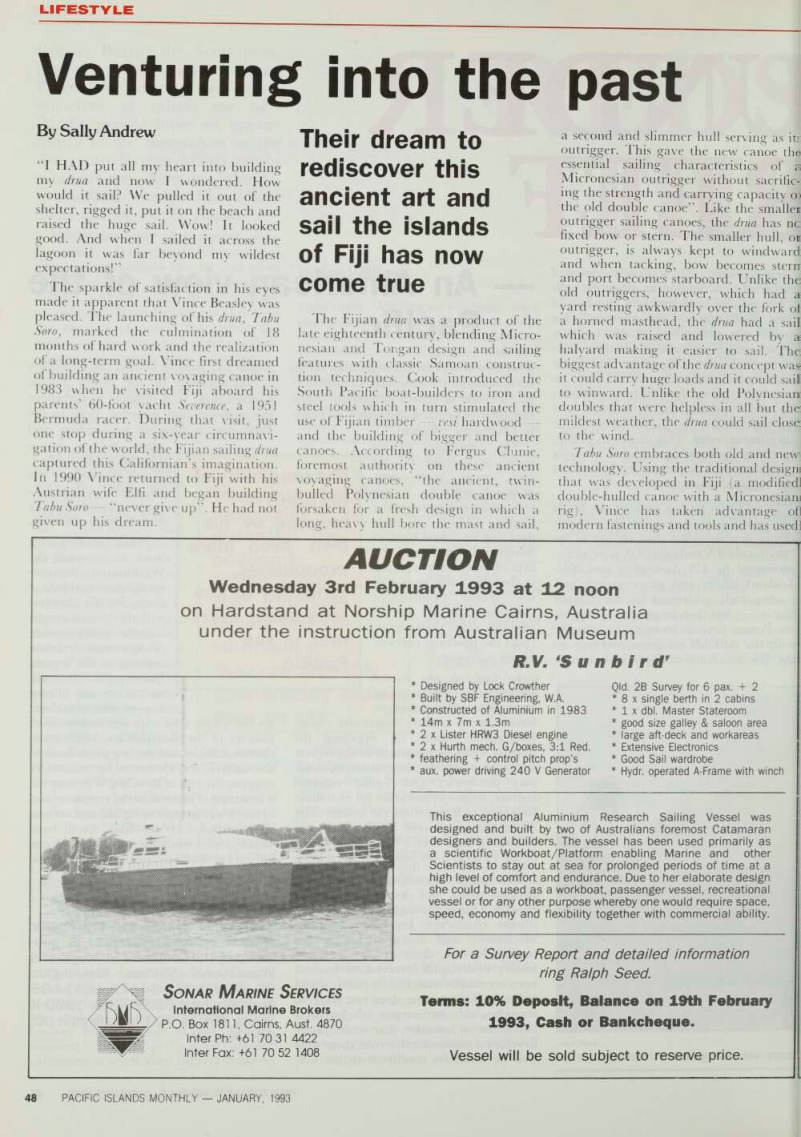
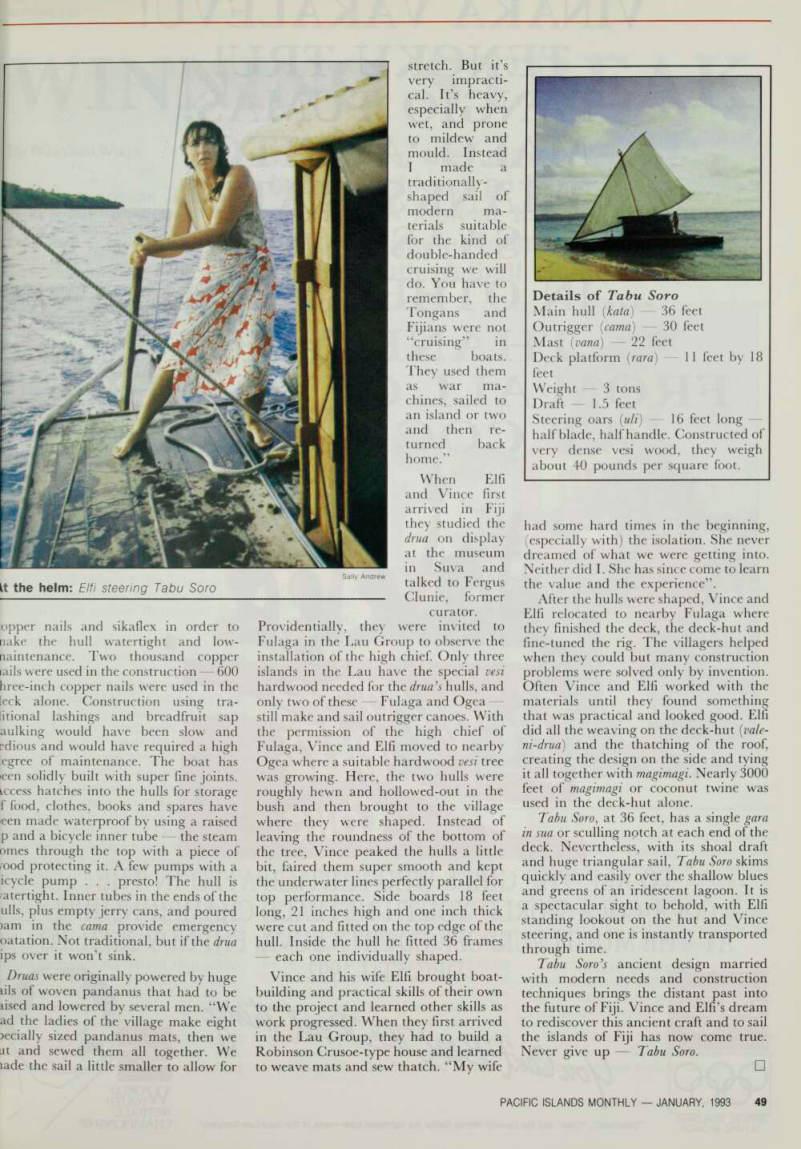
Tabu Soro, at 36 feet, has a single gara in sua or sculling notch at each end of the deck. Nevertheless, with its shoal draft and huge triangular sail, Tabu Soro skims quickly and easily over the shallow blues and greens of an iridescent lagoon. It is a spectacular sight to behold, with Elfi standing lookout on the hut and Vince steering, and one is instantly transported through time.
Tabu Sow’s ancient design married with modern needs and construction techniques brings the distant past into the future of Fiji. Vince and Elfi’s dream to rediscover this ancient craft and to sail the islands of Fiji has now come true.
Never give up
Tabu Soro.
At the helm: Elfi steering Tabu Soro
Sally Andrew
Details of Tabu Soro Main hull (kata)-36 feet Outrigger ( cama )-30 feet Mast ( vana )-22 feet Deck platform ( rara) -11 feet by 18 feet Weight-3 tons Draft-1.5 feet Steering oars (uli) - 16 feet long half blade, half handle. Constructed of very dense vesi wood, they weigh about 40 pounds per square foot.