Fundamental Differences
pp. 42-43 · Read in the full issue
By David North
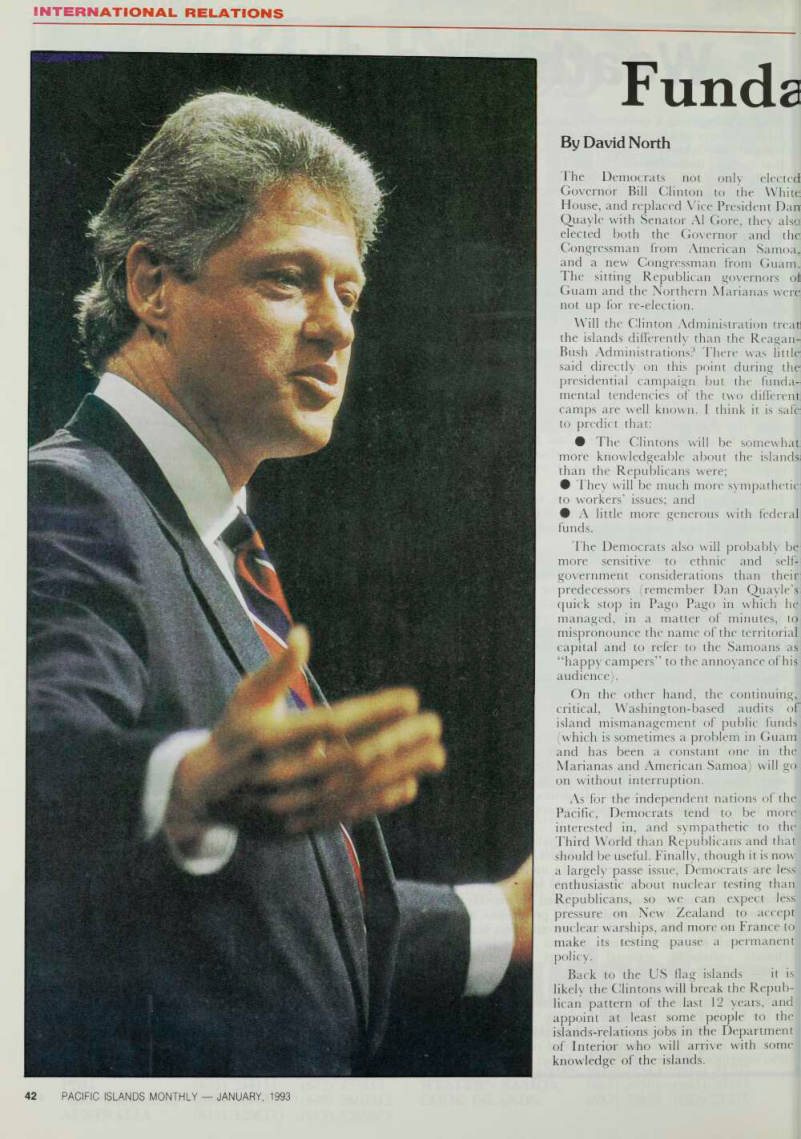
The Democrats not only elected Governor Bill Clinton to the White House, and replaced Vice President Dan Quayle with Senator A 1 Gore, they also elected both the Governor and the Congressman from American Samoa, and a new Congressman from Guam.
The sitting Republican governors oft Guam and the Northern Marianas were not up for re-election.
Will the Clinton Administration treat! the islands differently than the Reagan- Bush Administrations? There was little said directly on this point during the presidential campaign but the funda mental tendencies of the two different] camps are well known. I think it is safe: to predict that: • The Clintons will be somewhat; more knowledgeable about the islands! than the Republicans were; • They will be much more sympathetic: to workers’ issues; and • A little more generous with federal, funds.
The Democrats also will probably be; more sensitive to ethnic and self government considerations than their
predecessors (remember Dan Quayle’s;
quick stop in Pago Pago in which he; managed, in a matter of minutes, to mispronounce the name of the territorial capital and to refer to the Samoans as “happy campers” to the annoyance of his; audience).
On the other hand, the continuing, critical, Washington-based audits of island mismanagement of public funds (which is sometimes a problem in Guam and has been a constant one in the Marianas and American Samoa) will go on without interruption.
As for the independent nations of the Pacific, Democrats tend to be more interested in, and sympathetic to the- Third World than Republicans and that should be useful. Finally, though it is now a largely passe issue, Democrats are less I; enthusiastic about nuclear testing than Republicans, so we can expect less pressure on New Zealand to accept nuclear warships, and more on France to make its testing pause a permanent
policy.
Back to the US flag islands it is likely the Clintons will break the Repub lican pattern of the last 12 years, and appoint at least some people to the ■' islands-relations jobs in the Department of Interior who will arrive with some knowledge of the islands.
Further, a Democratic Congress and a Democratic Labor Department will insist I on higher wages for the garment workers [ on Saipan if the "Made in L T SA” label Icontinues to be attached to the clothing [ made there. Stateside unions will see to 1 that. Further, the two Congressmen most interested in this issue, Lewis Payne (D Virginia) and George Miller (D ICalifornia), chair of the Interior and [ Insular Affairs Committee were re- I elected in the recent election, while the I House member most likely to speak up for CNMFs establishment, Robert Lagomarsino (R California) was [defeated by a Republican who spent money like water in the primary.
Similarly, the Clintons will approach social issues with more sympathy. It will be easier to introduce food stamps, and maybe there will be a totally different stance no appointments will be made of any judges or lawyers who would agree with the tough anti-abortion position taken by Guam.
How will the new Democratic ap pointee handle the continuing desire of the Marianas for more freedom, and of Guam for Commonwealth status? That is hard to say; it depends on who is appointed to what position. While Main land Democrats routinely have a range of predictable views on the status of women and of ethnic minorities, on workers’ rights, and on the need to be supportive of the poor, they do not come with a predictable view about self government-short-of-statehood within the US system.
One thing is sure, however securing statehood for the heavily Democratic (and Black) District of Columbia, and for the Hispanic island of Puerto Rico, will be much more pressing issues to the Clinton White House than concerns regarding levels of self-government in any of the Pacific territories.
Here are some specifics about the US-
Elag islands:
American Samoa With the Presi dent (Clinton) and the new Governor [A. P. Lutali) and the Congressman (Eni F. H. Faleomavaega) all allied to one mother, there should be relatively imooth sailing in Mainland-Amcrican Samoa relations. Samoa (unlike Guam md CNMI) is not seeking to change its )asic relations with Washington, so those horny problems arc avoided.
While in the past there had been a cries of battles between Faleomavaega md former Governor Peter Tali Dolcman, often over who was to get redit for certain federal-island pro
grams, these differences presumably will disappear. The Congressman, the Governor and the Clintons can now move ahead together on such bread-and butter issues as getting food stamps a specialized welfare program) for older and disabled Samoans; similarly there will be no barriers to the introduction of a Mainland-subsidised housing program for military veterans. (Many Samoans enlist in the US armed services, retire after 20 years while still relatively young, and then return to the islands with nice
How will the Demo cratic victories affect relations between Washington and the Pacific Islands?
pensions.) Guam Things will be a little more complicated in the Guam-Mainland scene, as there is a Republican Governor, Joe Ada, along with the newly-elected Democratic Congressman, Robert Un derwood. They probably will wrestle with each other. It is expected Under wood will be far more vigorous in his pursuit of Chamorro rights than his predecessor, Ben Blaz.
But, in contrast to American Samoa, Guam is largely self-sufficient financially (thanks to all those Japanese tourists) and no Mainland interests arc trying to attack a major Guam industry, as is the case with the Marianas. So relations between the island and the Mainland should rock along easily, except for the persisting dispute about Commonwealth status.
The Marianas The outcome of the 1992 elections left the political leadership of the Commonwealth of the Northern Marianas in even worse shape than before.
While both American Samoa and Guam have delegates to the House of Representatives, with large federally funded staffs busily promoting the inter ests of their islands (though no vote on
the floor of the House; CWII’s able envoy to W ashington, Juan N. Babauta, is little more than an elected lobbyist. A Republican, Babauta has one more year to serve of his four-year term as CNMI’s
Washington Representative.
CNMI, for reasons that arc hard to understand, has not opted for the seat in the House of Representatives that it could have for the asking. The scat would give CNMI a place at the table where decisions are made, but apparently the
Republican leadership views asking for a
seat in the House as committing itself too closely to Washington, Meanwhile, in addition to this struc tural problem, the CNMI Governor, Larry Guerrero, has little credibility in Washington. First there was his listless performance last summer at a rare House Committee hearing devoted to his islands, and to the scandalous wages paid to the foreign workers brought into Saipan's garment factories. The Governor show ed no signs of appreciat ing the extent to which his territory was in serious trouble with the Congress over this issue. The clothes, with "Made in USA” labels are brought to the Main land, while the jobs in question have moved from the Mainland to the islands, irking many Stateside Congressmen who formerly had the jobs in their districts
PIM July, 1992 .
Then, in a manoeuver that left Washington heads shaking in disbelief, his press office said Governor Guerrero had held a very fruitful, one-on-one meeting, after the hearing, with the Committee chair. Congressman Miller.
But the meeting never happened.
Apparently believing that things said
to the media in the islands would never get back to Washington, the Governor's office basked in favourable local press for a couple of days. Then all hell broke loose when the strong-minded Chairman found out about the story; his office issued a furious press release and lie immediately sent a team of investigators to find out what was happening on the islands, in the garment factories, and in the barbed-wire enclosed camps where many of the workers live.
So the next time the Marianas w ant to make their case to the Congress thev will not have a Congressman to help them as Samoa and Guam do), will have a Governor whose word means little to the chairman of the all-powerful House Interior and Insular Affairs Committee, and will find the White House is no longer in the hands of their political party.