Where
pp. 24-26 · Read in the full issue
Special Report
Where are we headed?
The Pacific region, with its unique circumstances, finds itself ill-prepared for the century ahead.
By Martin Tiffany
PELL away the glossy tourist-brochure image from the Pacific islands and you will find island economies in trouble.
With problems that arc unique to the region, all Pacific island nations are facing constraints to development of varying magnitudes.
On top of this there is the apparent volatility of Pacific island economies, made worse by the countries’ relatively small size where the results of almost every event, good or bad, are quickly transmitted throughout the entire na tion. This last observation is made by Rodney Cole from the Research School of Pacific Studies at the Australian National University in Canberra.
Cole, research director of the Islands/ Australia Program at the National Centre for Development Studies (NCOS), is part of an ambitious project looking at the future of the region and the difficulties that may emerge as a result of high lev els of population growth.
He said governments are so immersed in the problems that confront them day to-day that they have been unable to devote time to thinking ahead, seeking to establish plans and programs now which, while accommodating the problems of the present, would look at least easing difficulties which can expect to emerge in the future.
These difficulties involve a range of
issues, including relatively high popu
lation growth and a possibility that available resources from land and sea
will diminish over time. In order to highlight these problems the NCDS has initiated a program called Pacific 2010, based on demographic projections for the major island stales of the Pacific to about the year 2010, which seeks to identify problems likely to emerge as a direct result of population growth.
Projects under Pacific 2010 are not concerned with population control or family planning but with the economic implications of an expanding number of people, particularly young people, at a time when employment opportunities, if not decreasing arc at least not to be
expanding.
According to Cole, over the last decade, on average, the island econom ies, as measured by GNP, have failed to
perform satisfactorily, with some
countries in fact going backwards in terms of per capita income.
Failure to perform can be attributed to a wide range of factors, some of which can be controlled while others are beyond the influence of island govern ments.
Hurricanes, cyclones, drought, frost, and flood are features of some or all Pacific islands.
While the international community is generous in response to these disasters, support is usually of a humanitarian variety and has little long term effect on the national product.
Some countries have a restricted range of exports, usually the legacy of poverty in the country’s resource base. Most of the regional countries have small, frag mented domestic markets and are remote
from foreign markets, access to which is made more difficult by high transport costs.
Most island nations have high levels of population growth and problems with skills development. Young people move to the greener pastures of developed countries overseas. This influences the efforts of government to encourage foreign investment although remittances from Pacific islanders working abroad can play a major role in supporting the balance of payments of some countries.
Land tenure can sometimes prove a difficult issue in the negotiation of agreements affecting investment, par ticularly in the mining sector. Especially in countries where traditional bound aries have not been clearly defined. Law and order problems in some countries have serious implications for investment decisions.
Also as Cole points out, “being price takers for most of their domestic pro duction, particularly in the agricultural sector, the islands are inevitably subject to the vagaries of international market
and the often savage price shifts.”
Despite the relief offered by such devices as STABEX, some governments have been forced, for political and social reasons, to provide price support schemes involving resources which could under other circumstances be better used else where.
These are serious problems which need to be addressed to promote island development. But it is not all doom and gloom.
Since gaining independence the re gional governments have enjoyed the generosity of an increasing range of aid donors. Generous levels of aid have, however, often masked real structural problems and caused governments to defer or avoid decisions necessary to meet their shifting social and economic needs.
It has been argued that aid might give way to trade and become a more positive feature of donor/recipient relations. In creasingly the islands seek improved options for their activities and have argued that aid funds should be div erted to support trading operations.
Trade treaties like SPARTECA and PATCRA have been put in place by
Australia and New Zealand to foster Pacific trading ventures and help island entrepreneurs enter their markets. In addition, the Lome Convention of the European Community, the Market Ac
cess and Regional Competitiveness
Scheme of the USAID program and a number of other bi-lateral and multi lateral agreements exist to provide opportunities for the islands to develop trading links with the rest of the world.
But, with the possible exception of Fiji’s garment industry, there has been little to show for the opportunities available. The global nature of the world’s trading operations makes it imperative these small economies recog nise their limitations and advantages and act accordingly. Cole suggests they must seek to use the labour they possess, their often unique climatic and geographic locations, the treaties which provide special advantages and the natural attractions of their environment.
Some countries have made the break.
Fiji took advantage of the 1987 military coups to de-regulate labour practices, de value its currency and introduce incen tives for foreign investors. All positive
steps which have led to substantial growth in the manufacturing sector, particularly in the field of garments.
Tonga has identified a niche market in Japan for a particular variety of squash pumpkin and developed an important, short-season export industry. Western Samoa took advantage of cheap, skilled labour to have a Japanese firm begin manufacturing electrical harnesses for motor vehicles. One thousand jobs are expected to be created.
While island leaders seek to develop
policies which provide an improved way
of life for their people, the manner in which this might be achieved does not become any easier, despite increasing aid flows and improved trading opportunities. The accepted measure of growth, GNP per capita, continues either to fall or grow only slowly over time.
According to Cole the reason is clear.
Populations continue to grow despite efforts by some countries to support family planning in the interests of higher living standards. In some instances there is a “safety net” in the form of emigration and this is evident in the population growth rate figures for Tonga and Western Samoa. Other countries which do not have the same opportunities for emigration have had access to land which has helped absorb population
growth.
Cole says the question to be addressed is whether these options for absorbing population increases will always be open.
If the countries to which Polynesian emigrants have moved should become less accommodating, what will the results then be? In those countries where land has been the “safety net” can this
position continue?
Some suggest that in future the only option open to many Pacific islanders will be subsistence agriculture. But with much of the available arable land in most Pacific countries already being used, will this option be available in the future?
Traditional unprocessed commodity exports are the prime feature of most South Pacific economies copper and timber in PNG, phosphate in Nauru, copra in Kiribati, sugar in Fiji and coconut oil in Western Samoa presently share declining terms of trade.
These exports are extremely vulnerable to world market fluctuations.
Semi-subsistence agriculture and fisheries are the backbone of many Pacific economies. According to Suva based Forum Secretariat these have not sustained growth in the 1980 s basically because of the sharp decline in prices for traditional primary export commodities.
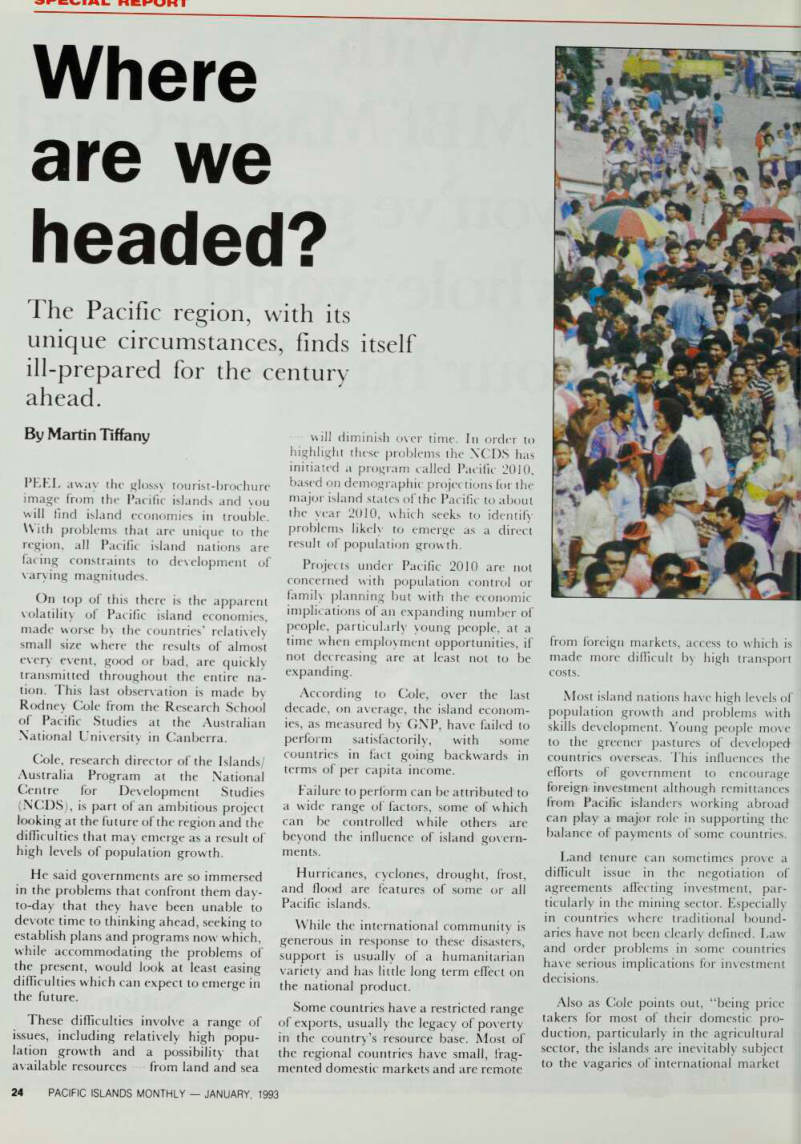
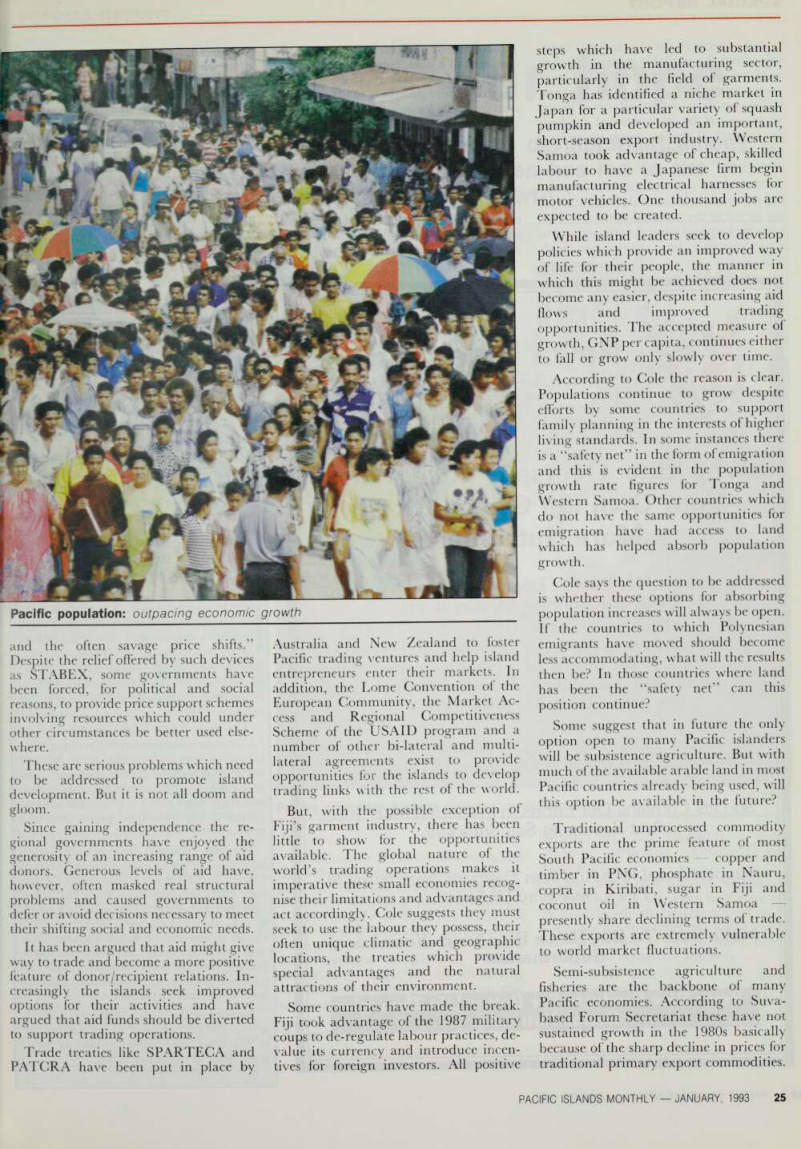
Pacific population: outpacing economic growth
As Cole sees it, the conclusion, “inevi table from the available evidence, is that, as of now, the islands of the Pacific Ocean arc coping with existing levels of popu lation, but only just. Standards of living, as measured by conventional methods are in gradual decline; pressures on land and thus the subsistence sector, are
increasing.”
There are opportunities for improv ing the contributions of the manufactur ing sector to the national economy. This however requires careful management to avoid entering into competition with
those countries better able to meet the demands of a fickle international market than small isolated states. Niche markets appear to offer prospects of success. This scenario calls for careful examination of policies towards the future.”
The National Centre for Development Studies through the program Pacific 2010 will seek to present to governments and those involved in resource manage ment. an indication of likely implications of population growth in various sectors of national economies. It will also seek to identify possible options which might be
considered, at least to minimize the effects of population growth. The first book from the program ‘Pacific 2010- Challenging the future?’ is due for publication soon. It should provide some sobering thoughts to governments and private sectors alike.
As Cole says, the leaders of today should take heed of the ‘dooms-day’ scenario the population projections of Pacific 2010 imply. After all, they are responsible for the consequences for the next generation. He is confident that national leadership and the international community want to face up to the question of tomorrow and steps can be taken to meet the challenge population growth implies. □