Guam’s abortion ban reversed
pp. 20-21 · Read in the full issue
L Aw
By David North
GUAM’S law banning abortions has been overturned by the United States Supreme Court. Guam thus remains the only place in Micronesia where a woman can obtain a legal abortion.
While the Supreme Court only rarely rules on Pacific island matters, the decision did not come as a complete surprise as the court had indicated last June it was opposed (by a slim 5-4 majority) to sweeping laws against abortion. The Guam law was sweeping no abortions would be legal unless two doctors asserted the woman’s life was in danger, or unless the pregnancy was outside the woman’s womb.
An even more sweeping provision of the Guam law, later made moot, would have made it a crime to give advice about abortion to a pregnant woman. After that provision came under heavy fire for
apparently violating the constitutional
guarantee of freedom of speech, Guam’s Attorney-General (a woman who had a dim view of the legislation anyway) decided not to try to implement it. The entire anti-abortion law was never en forced, anyway, as the Federal District Court tor Guam suspended it until the higher courts could rule on it. As a result, abortions continued to be performed on the island.
Meanwhile, the nearby Common wealth of the Northern Marianas, which has a different relationship to Washing ton, has a territorial constitutional pro vision against abortion, which, however, lacks legislatively-set penalties and has not been tested in court. The few women resident in FSM and the Marshalls seeking abortions typically leave those islands and fly to cither Guam or Honolulu.
The battle over abortion in Guam goes back a couple of years when the ranking Catholic clergyman in highly Catholic Guam launched a crusade against abortion. Soon the 21-member, one house Territorial Legislature includ ing both Democrats and Republicans voted unanimously for the legislation.
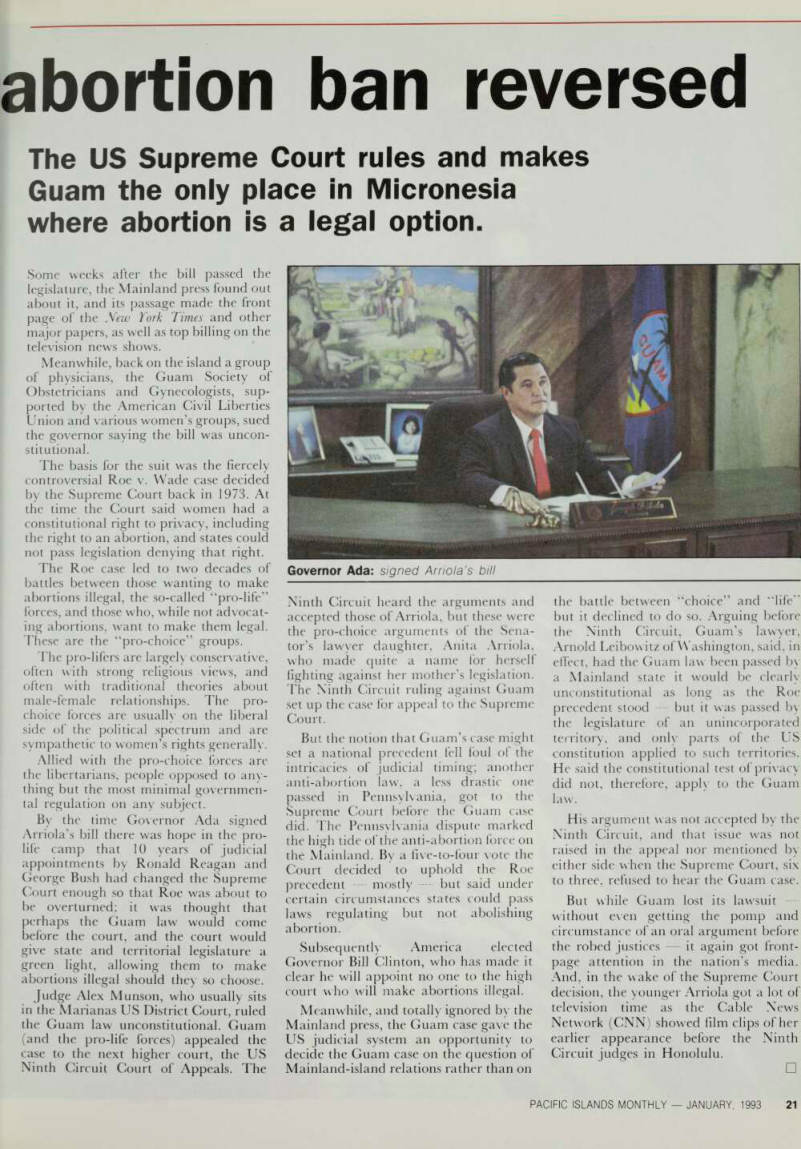
Democratic Senator Elizabeth Arriola pushed the bill through the Legislature, and Republican Governor Joe Ada soon signed it (despite his Attorney-General’s advice).
The US Supreme Court rules and makes Guam the only place in Micronesia where abortion is a legal option.
Some weeks after the bill passed the legislature, the Mainland press found out about it, and its passage made the front page of the New York Times and other major papers, as well as top billing on the television news shows.
Meanwhile, back on the island a group of physicians, the Guam Society of Obstetricians and Gynecologists, sup ported by the American Civil Liberties Union and various women’s groups, sued the governor saying the bill was uncon stitutional.
The basis for the suit was the fiercely controversial Roe v. Wade case decided by the Supreme Court back in 1973. At the time the Court said women had a constitutional right to privacy, including the right to an abortion, and states could not pass legislation denying that right.
The Roe case led to two decades of battles between those wanting to make abortions illegal, the so-called “pro-life” forces, and those who, while not advocat ing abortions, want to make them legal.
These are the “pro-choice” groups.
The pro-lifers are largely conservative, often with strong religious views, and often with traditional theories about male-female relationships. The pro choice forces are usually on the liberal side of the political spectrum and arc sympathetic to women’s rights generally.
Allied with the pro-choice forces are the libertarians, people opposed to any thing but the most minimal governmen tal regulation on any subject.
By the time Governor Ada signed Arriola’s bill there was hope in the pro life camp that 10 years of judicial appointments by Ronald Reagan and George Bush had changed the Supreme Court enough so that Roc was about to be overturned; it was thought that perhaps the Guam law would come before the court, and the court would give state and territorial legislature a green light, allowing them to make abortions illegal should they so choose.
Judge Alex Munson, who usually sits in the Marianas US District Court, ruled the Guam law unconstitutional. Guam (and the pro-life forces) appealed the case to the next higher court, the US Ninth Circuit Court of Appeals. The
Ninth Circuit heard the arguments and accepted those of Arriola, but these were the pro-choice arguments of the Sena tor’s lawyer daughter, Anita Arriola, who made quite a name for herself fighting against her mother’s legislation.
The Ninth Circuit ruling against Guam set up the case for appeal to the Supreme Court.
But the notion that Guam’s case might set a national precedent fell foul of the intricacies of judicial timing; another anti-abortion law, a less drastic one passed in Pennsylvania, got to the Supreme Court before the Guam case did. The Pennsylvania dispute marked the high tide of the anti-abortion force on the Mainland. By a five-to-four vote the Court decided to uphold the Roe precedent mostly but said under certain circumstances states could pass laws regulating but not abolishing abortion.
Subsequently America elected Governor Bill Clinton, who has made it clear he will appoint no one to the high court who will make abortions illegal.
Meanwhile, and totally ignored by the Mainland press, the Guam case gave the US judicial system an opportunity to decide the Guam case on the question of Mainland-island relations rather than on
the battle between “choice” and "life" but it declined to do so. Arguing before the Ninth Circuit, Guam’s lawyer, Arnold Leibowitz of Washington, said, in effect, had the Guam law been passed by a Mainland state it would be clearly unconstitutional as long as the Roe precedent stood but it was passed by the legislature of an unincorporated territory, and only parts of the US constitution applied to such territories.
He said the constitutional test of privacy did not, therefore, apply to the Guam law.
His argument was not accepted by the Ninth Circuit, and that issue was not raised in the appeal nor mentioned by either side when the Supreme Court, six to three, refused to hear the Guam case.
But while Guam lost its lawsuit without even getting the pomp and circumstance of an oral argument before the robed justices it again got front page attention in the nation’s media.
And, in the wake of the Supreme Court decision, the younger Arriola got a lot of television time as the Cable News Network (CNN) showed film clips of her earlier appearance before the Ninth Circuit judges in Honolulu.
Governor Ada: signed Arriola’s bill