origin
pp. 35-36 · Read in the full issue
Advertising Feature
Pafco-
and its origin
PAFCO was established in 1964, with shareholdings divided between the large Japanese trading concern. C Itoh. an ather Japanese company. Nichiryo Ltd, the Fiji government and a few individ jals.
Initially the venture operated as a tuna transhipment depot, based on a 2000-tonne freezer. It serviced a fleet of Faiwanese and Korean fishing vessels /vhose catch was stored prior to ship nent to Japan for canning.
Local employment then was mainly for nen who unloaded and loaded ships, oaded bait, and stacked the fish. The government then began to envisage development of an integrated tuna :atching and processing industry.
A pilot cannery was opened in 1970, with a larger canner coming into oper ation in 1975. Two more canning lines were commissioned in 1980 and 1981.
Can needs were supplied by the Fiji
Can Co Ltd , subsidiary of a Japanese packaging equipment manufacturer. The government held 20 per cent of the shares. Pacific Packaging Ltd, a subsidi ary adjacent to the main PAFCO can nery, has replaced Fiji Can Company as the supplier of cans.
Guests from overseas and Fiji gathered at Levuka in November, 1989 for the
inauguration of Pacific Packaging Ltd and to celebrate the 25th anniversary of
Pafco.
Nichiryo Ltd sold its shares in PAFCO to C Itoh in 1982. After trading profitably for a number of years, PAFCO was hit by an international price decline. It made losses from 1982 to the end of 1986.
In 1986 after lengthy negotiations, C Itoh decided to relinquish its shares in
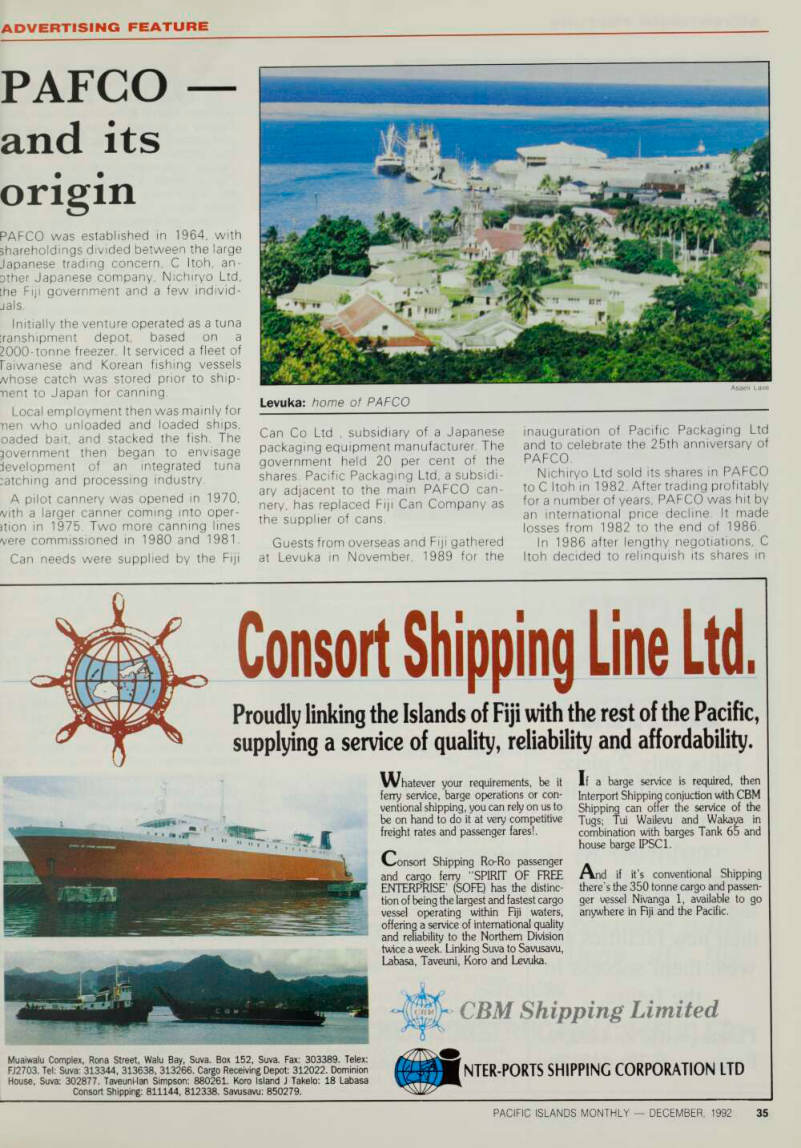
Levuka: home of PAFCO
PAFCO to government. The government became the majority owner about 98 per cent and a financial restructuring created a sound base to continue and expand operations.
In the 1990 and 1991 annual reports, the directors reported a total turnover in excess of $5O million, four per cent higher than 1989. Sales for the last five years totalled $230 million.
The company today has shareholders' funds of $l2 million compared to about $500,000 in January, 1987. Current assets exceed current liabilities by $5.7 million.
The company initiated major capital improvements, particularly in canning equipment, to enhance profitability. Pa cific Packaging Limited, a subsidiary of PAFCO opened in 1989, has created additional reductions in production costs.
The PAFCO extension commissioned on September 26 this year by Prime Minister Sitiveni Rabuka, is funded by the Australian government. The $l7 million package has special significance as the largest single aid project ever undertaken by that government in this part of the Pacific.
The expansion, funded under the auspices of the Australian International Development Assistance Bureau (AIDAB), includes major wharf develop ment, a new 3000-tonne capacity freezer, batch processing facilities, roll on-roll-off loading facilities, container
storage, office complex, forklifts andl 3000 special aluminium fish bins.
AIDAB appointed a joint venture: between Riedel & Byrne and Irwin Alsop Pacific as project managers, engineers! and architects, after an exhaustive selec-1 tion process. Both joint venture comJ panies have extensive experience in the Pacific. Riedel & Byrne were responsible for the marine engineering activities.l Irwin Alsop were responsible for the! building and associated works.
Head contractor for the land recla mation and wharves was McConnell Dowell (Fiji). Head contractor for the] building and paving work was Fletcher) Construction Co (Fiji) Ltd.
The implementation of the project] involved a number of separate contracts! including ★ The land reclamation and wharves] and roll-on-roll-off facility. ★ The construction of three very large] freezer rooms, offices and site services] including hydraulic works to collect all] waste. ★ The fish unloading, loading, sorting,] binning and weighing system. ★ The supply of 3000 one-tonne] aluminium fish bins. ★ The supply of special forklifts tol operate in the freezer rooms. ★ The provision of navigation equip-] ment for shipping.
The extensions have provided PAFCO] with increased capacity and efficiency in] all aspects of unloading, storage, pro-1 cessing, canning and shipping.
They also allow the company to] supply its markets consistently year-] round, provide better stock control and reduced handling costs, and lower port] and berthing charges.
PAFCO tuna is regarded as among the] best in the world. It is sold mainly to| customers in Britain and Canada.
The company has a "no nets", "dol-l phin friendly" policy.
The cannery annually processes about] 15,000 metric tonnes of tuna supplied by boats from the government-owned Ika Corporation, and vessels fishing in Kiri- bati and Solomon Islands waters.
A fleet of 16 vessels chartered to ] PAFCO from F.C.F. Fishery Co. Ltd of] Taiwan also supplies the cannery.
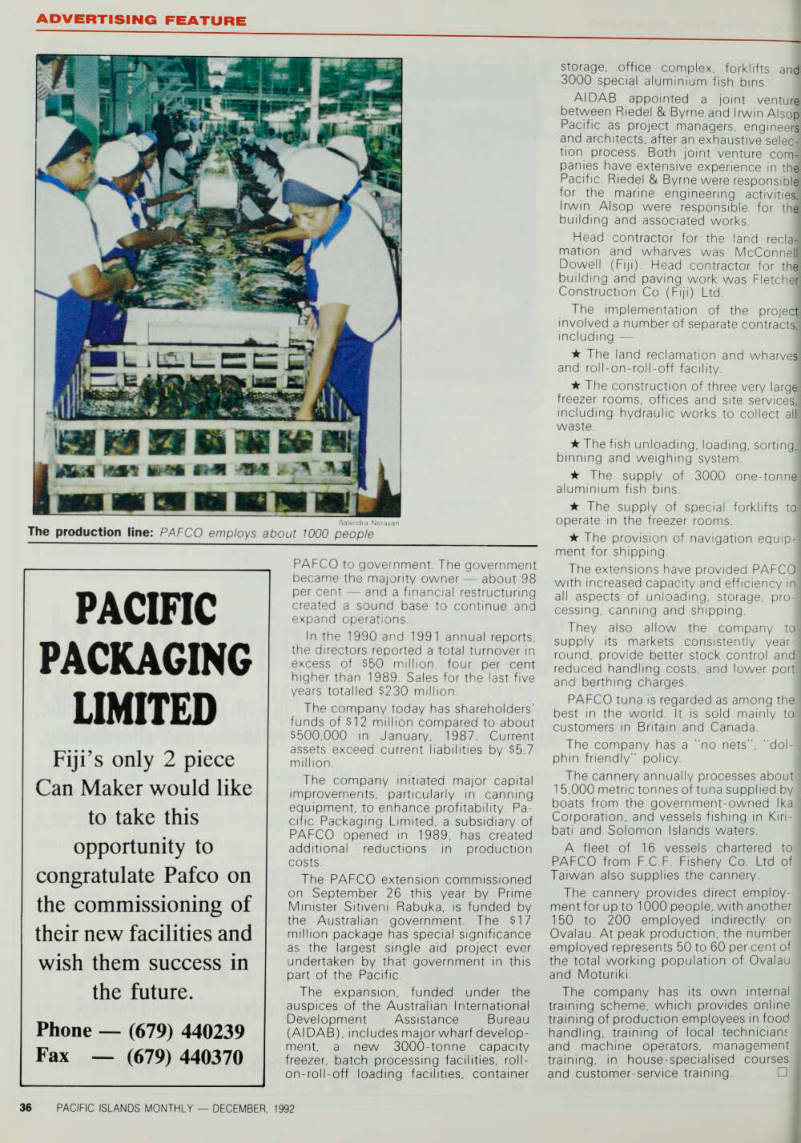
The cannery provides direct employ ment for up to 1000 people, with another 150 to 200 employed indirectly on Ovalau. At peak production, the number employed represents 50 to 60 per cent of 1 the total working population of Ovalau ( and Moturiki.
The company has its own internal training scheme, which provides online training of production employees in food i handling, training of local technicians I and machine operators, management I training, in house-specialised courses I and customer-service training.
Salendra Narayan The production line: PAFCO employs about 1000 people