Anglophone and Francophone’
pp. 32-33 · Read in the full issue
Profile
‘No difference between Anglophone and Francophone’
By lan Williams
AS PIM interviewed the Prime Minister in his New York Hotel room, in English, he alternated between French and Bislama in talking to his colleagues. When asked if the
change of government implied a change
of Foreign Policy from its independent
and non-aligned position, he emphasised continuity. “At the moment, we are not changing everything but there has been a change of government, so of course, there will be some changes of
policy.
“For example, we will give priority in our foreign affairs to external trade. In the past we have done lots on the political and human rights level and we will continue to do so, but we will add to that a concern for internal and external trade.
We have established relationships with some countries and we will maintain them, but others we will build strong commercial relations with”.
When asked if he was referring to Taiwan, he replied, “Well not only that we first moved to Grafton in Austra lia. We have relationships with business people, and we are trying to build commercial relations between Australia and Vanuatu. It is not easy but at the moment we are trying to negotiate for direct shipping. And we have started talks with the New Caledonia provinces and New Zealand.”
But does having trade relations with Taiwan imply diplomatic relations? “No, we already have relations with the mainland of China, and we will continue those. They give a lot of help to Vanuatu and they are very important in our grouping in, for example, the United Nations. Our ties with Taiwan are only at the commercial level.”
Vanuatu is the only Forum country which joined the Non-Aligned Move ment but you were not represented in Djakarta at the recent NAM summit why? “It is simply that we were a new government, just come in, and we faced many decisions, we had a lot to do in internal affairs. It was too early for us, so we decided not to go this time.”
New Zealand had apparently hoped Vanuatu would be canvassing on its behalf for the Security Council seat among the non-aligned, but Carlot says,
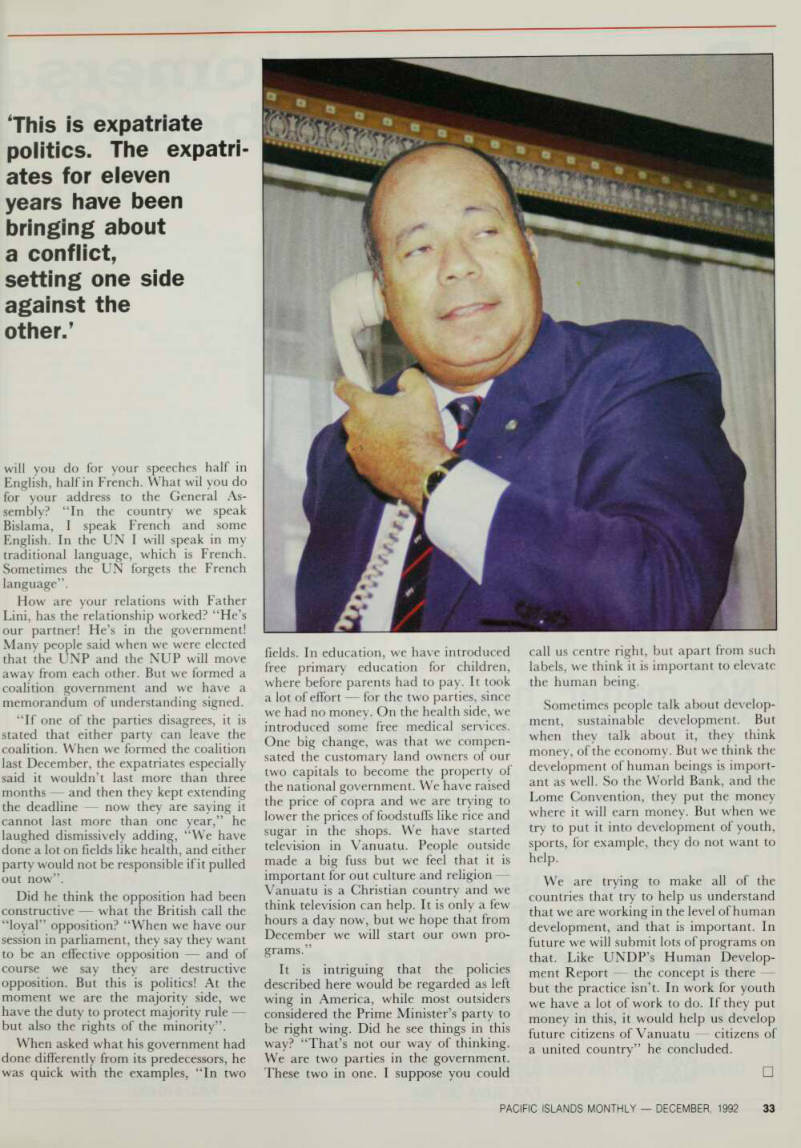
VANUATU S new Prime Minister, Maxime Carlot, is sending mixed signals to the world. He attended a World Anti-Communist League meeting in Hungary but denied rumours he would antagonize China by recognising Taiwan. He siganlled clearly Vanuatu’s foreign policy would follow the bottom hne more than any political line in future. He also told PIM the Francophone/ Anglophone divide was an artificial creation of expatriates but insisted his first speech to the United Nations General Assembly should be in French
“We have not been informed about that.
But we will take it as trade we will trade with them for votes. If they support us, we will support them. We have candidates in our regional organizations - and we will look for New Zealand support.”
And why did he go to the World Anti- Communist League conference? “When we were in opposition, our party, and myself, were members of this body, so I was invited to go, and I took the chance to visit Hungary to see what it was like following the collapse of communism there”.
Will there be any change in the attitude of Vanuatu to the Kanaks in New Caledonia. “It depends on what you are talking about. Our links with the New Caledonia people are stronger than ever. Our Foreign Minister works closely with the French government and of course also closely with the two prov inces.
“We have strong ties now, and the provinces are ready to make investments in agriculture in Vanuatu. This is our priority, and we are not interested in talk, about more Kanak, more Melanesian, and so on. That’s not our priority. And I think we are gaining the support of island leaders, because they can see how important it is to build up our economies which are worsening throughout the Pacific islands.
“If I can make a comparison, the previous government was doing well in production in Vanuatu, but less so in selling our products. That is why we are giving priority to looking for partners.
For example, we have near 100 per cent imports form Australia, but now we are sitting down and talking and there are Australian businessmen interested in buying products from us. There are problems about customs and so on, but we hope to resolve them.”
Has the new government changed its attitude to French nuclear testing if they were to resume? “We signed the letter at
the Forum, not just about the testing but about nuclear fuel shipments and war material. Automatically, the people in Vanuatu do not want these things. We sent that message not just to France, but Japan, Britain, China and Russia”.
On the environmental field, Vanuatu has achieved a high standing inter nationally, particularly because of the role played by Robert Van Lierop, your UN ambassador as chairman of the body. Are you going to maintain the same stand? “Well we support the environment we are for development without spoiling the environment. We will continue to support it and we will do more in that field. Vanuatu wants the UN to be serious and quick about setting up the commission on sustainable devel opment. We think the UN has been a little bit slow in this sphere”.
On domestic policies, you have mem bers of both Anglophone and Francophone parties in your govern ment. Do you think you will be able to take politics in Vanuatu away from the
linguistic divide?
“Yes, this is expatriate politics in Vanuatu. There is no problem between Anglophone and Francophone. The ex patriates for 11 years have been bringing about a conflict, setting one side against the other. When we came into power, both communities took their place in the government. Before, the Anglophones would not promote Francophones in the government.
“When we came to power the expatri ates, from Australia, France and else where, said it was impossible to do what we did. But it is normal in Vanuatu. Even in the former government the Minister of Health for example was a Francophone, but they never mentioned it”.
So what compromise did you reach about languages? “There is no compro mise necessary. The languages are our Droperty, they are put in our consti ution. The expatriates never got that.
There is no difference between francophones and Anglophones for local
people.”
Boutros Boutros Ghali gives his
‘This is expatriate politics. The expatri ates for eleven years have been bringing about a conflict, setting one side against the other.’
will you do for your speeches half in English, half in French. What wil you do for your address to the General As sembly? “In the country we speak Bislama, I speak French and some English. In the UN I will speak in my traditional language, which is French.
Sometimes the UN forgets the French
language”.
How are your relations with Father Lini, has the relationship worked? “He’s our partner! He’s in the government!
Many people said when we were elected that the UNP and the NUP will move away from each other. But we formed a coalition government and we have a memorandum of understanding signed.
“If one of the parties disagrees, it is stated that either party can leave the coalition. When we formed the coalition last December, the expatriates especially said it wouldn’t last more than three months and then they kept extending the deadline now they are saying it cannot last more than one year,” he laughed dismissively adding, “We have done a lot on fields like health, and either party would not be responsible if it pulled out now”.
Did he think the opposition had been constructive what the British call the “loyal” opposition? “When we have our session in parliament, they say they want to be an effective opposition and of course we say they are destructive opposition. But this is politics! At the moment we are the majority side, we have the duty to protect majority rule but also the rights of the minority”.
When asked what his government had done differently from its predecessors, he was quick with the examples, “In two
fields. In education, we have introduced free primary education for children, where before parents had to pay. It took a lot of effort for the two parties, since we had no money. On the health side, we introduced some free medical sendees.
One big change, was that we compensated the customary land owners of our two capitals to become the property of the national government. We have raised the price of copra and we are trying to lower the prices of foodstuffs like rice and sugar in the shops. We have started television in Vanuatu. People outside made a big fuss but we feel that it is important for out culture and religion- Vanuatu is a Christian country and we think television can help. It is only a few hours a day now, but we hope that from I-. , 7 r December we will start our own pro- r
gram S... . .
11 is intriguing that the policies described here would be regarded as left wing in America, while most outsiders considered the Prime Minister s party to be right wing. Did he see things m this way? That s not our way of thinking.
We are two parties m the government.
These two in one. I suppose you could
call us centre right, but apart from such labels, we think it is important to elevate the human being, e , , Somet.mes people talk about develop ™nt - sustainable development. But whe " ,h O' talk about it, they hmk money, of the economy. But we think the development of human beings is import ant as S° the World Bank, and the Lome Convention, they put the money where it will earn money. But when we tr Y t° put it into development of youth, sports, for example, they do not want to help.
We are • tQ make all of the countries that t to he i p us understand we are WQrki in the level of human , , . ,• . . T development, and that is important. In r r ,• , . r future we will submit lots of programs on that. Like UNDP’s Human Develop ment Report the concept is there b u t p rac tice isn’t. In work for youth we kave a i Q t of work to do. If they put mo ney in this, it would help us develop f u t ure citizens of Vanuatu citizens of a united country » he concluded.