The charter that spell disillusionment
pp. 12-15 · Read in the full issue

Politics
By Karin von Strokirch
THE conclusions presented at the end of July by the Development Charter in Tahiti were indicative of the profound social and economic malaise pervading the territory. The reports were the result of a week-long conference by over 30 groups comprising 350 leading members of the community. The participants came from diverse professional back grounds ranging from public servants and businessmen to religious leaders.
Their task was to identify the 10 main obstacles to development in the territory and to propose 10 priority areas for reform. The groups, independently of each other, produced a damning indict ment of politicians as a group, regardless of party affiliation. But other sectors, such as the public service, trade unions and churches were also subject to heavy criticism for their part in putting the brakes on development.
It is no coincidence that this comprehen sive reflection on the territory’s present and future directions came only three months after the announcement of the nuclear test moratorium. The decision sent shock waves through the territory.
The temporary, and what must eventu ally be a permanent, suspension of the tests, has driven home the need for an urgent examination of ways in which the Pacific Test Centre’s (CEP) dominant role in the economy for the last 30 years can be replaced.
The concept of a Development Charter was initiated by President Gaston Flosse and agreed to in Paris under a protocol signed by the state and the territory on May 14, 1992. This meeting was to a large extent designed to reassure the territory France would not simply desert it in the wake of the CEP. The first phase of the charter was based in Papeete. Now the charter co-ordinators are consulting with rural districts and outer islands. On the basis of the charter’s conclusions and proposals the territorial government will attempt to produce a long term develop ment strategy. The French state, in turn, is committed to assist in the implement ation of the new development strategy, entitled Pact for Progress, the terms of which will be negotiated by January 1993.
Although France has signalled its pre paredness to participate, the onus is clearly being placed on French Polynesia
to take responsibility for its future. The reports of the Development Charter in late July expressed the utter disillusion ment of the population with their political leaders. To quote but one such view: “There can be no real reforms with a political class composed, by a large majority, of incompetent and immature men driven by personal, pecuniary, electoralist and nepotistic motivations.”
The attack on politicians did not end there, they were also accused of wasting public funds, promoting a climate of instability as a result of their continual factionalism, and failing to provide a long-term vision for development of the territory. After hearing two days of reports in this vein, President Flosse remarked, with a begrudging sense of humour, that in their critique of the territory’s leaders the charter groups must have drawn on every abusive word in the French dictionary! On a more serious note, he added, that if they were right there was little hope for the future.
The high degree of disenchantment with local politicians is not surprising given the political mayhem witnessed over the past year. Last September the fragile governing coalition between Flosse’s Tahoeraa party and Emile Vernaudon’s Ai’a Api collapsed only five months after the elections which brought them to power. The new coalition government of Tahoeraa and Jean Juventin’s Here Ai’a was then virtually paralysed until April this year due to a lock-out at the Territorial Assembly, organised by the indignant outgoing assembly president, Vernaudon. The comedy assumed tragic proportions when, as a result of the lock out, the assembly was unable to vote on funds for the victims of Cyclone Wasa, which had hit several outer islands at Christmas. This complete dysfunction of the territory’s highest democratic insti tution was severely criticized by the charter. Industrial disputes, featuring prolonged strikes and blockades, in July 1991 and the beginning of 1992, have also contributed to perceptions of a government losing control.
The image of President Flosse personally was tarnished by the decision of a Paris court on April 1 to convict him of abuse of office, for which he received a fine and a six-month suspended sentence. The conviction led to calls for his resignation and for new elections by the opposition parties. The President did not have to resign as he has appealed the court’s decision; the appeal was to have been
heard on October 23. The final straw foi the government came even as the chartei groups were reaching their conclusions, when the French High Commissioner seized control of the territorial budget.j France also came under fire for being “lax” in not having fulfilled its responsi bilities in the territory, in terms ol promoting economic development and ensuring the legal and democratic func tioning of the territory’s institutions. The statute of autonomy was regarded by many charter groups as being a failure, due to the poor performance of both state and territorial authorities.
The second major area to come under the Development Charter’s scrutiny was the economy. It noted that, “The Polynesian economy, based as it has been on atomic rent since 1963, is artificially sustained by external transfers and now exhibits several principal forms of unbal anced and negative development; includ ing high prices, an excessive trade deficit and dependence on imported foods.”
Another serious constraint on develop ment is the “hypertrophy and low productivity” of the public service, as well as the high salaries and fringe benefits enjoyed by public servants and
politicians alike.
Further, it was felt that the territory’s j
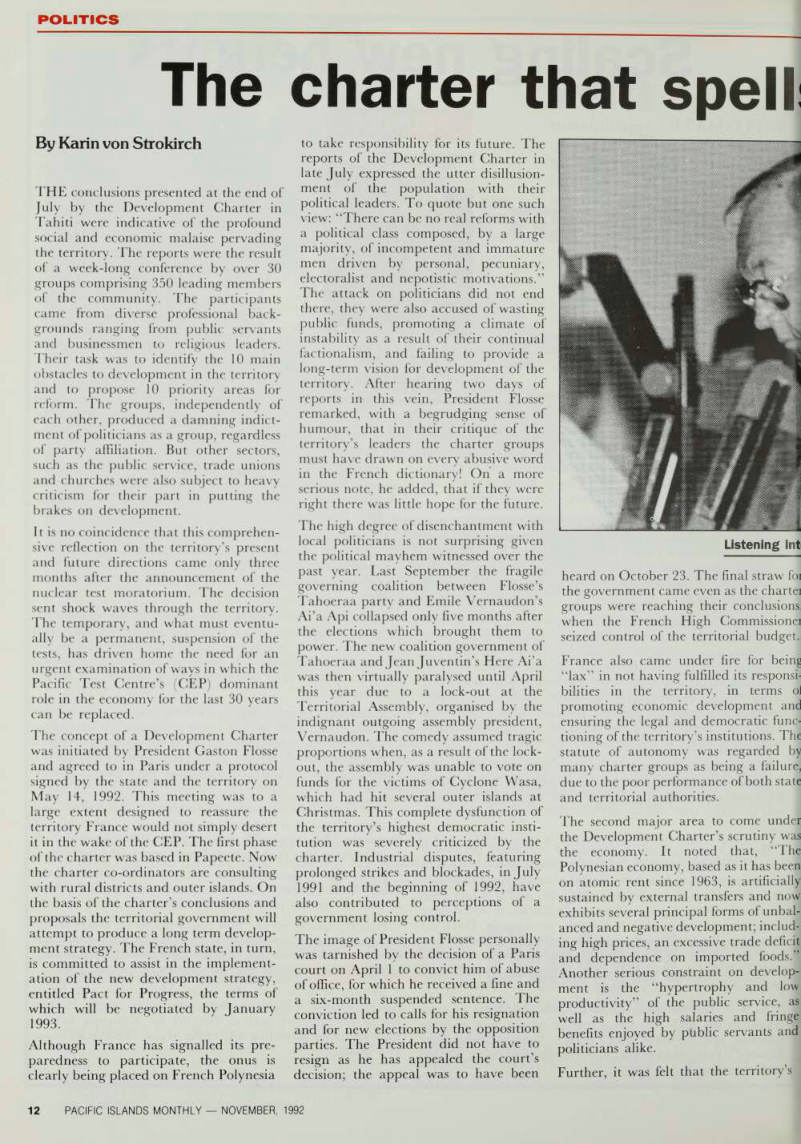
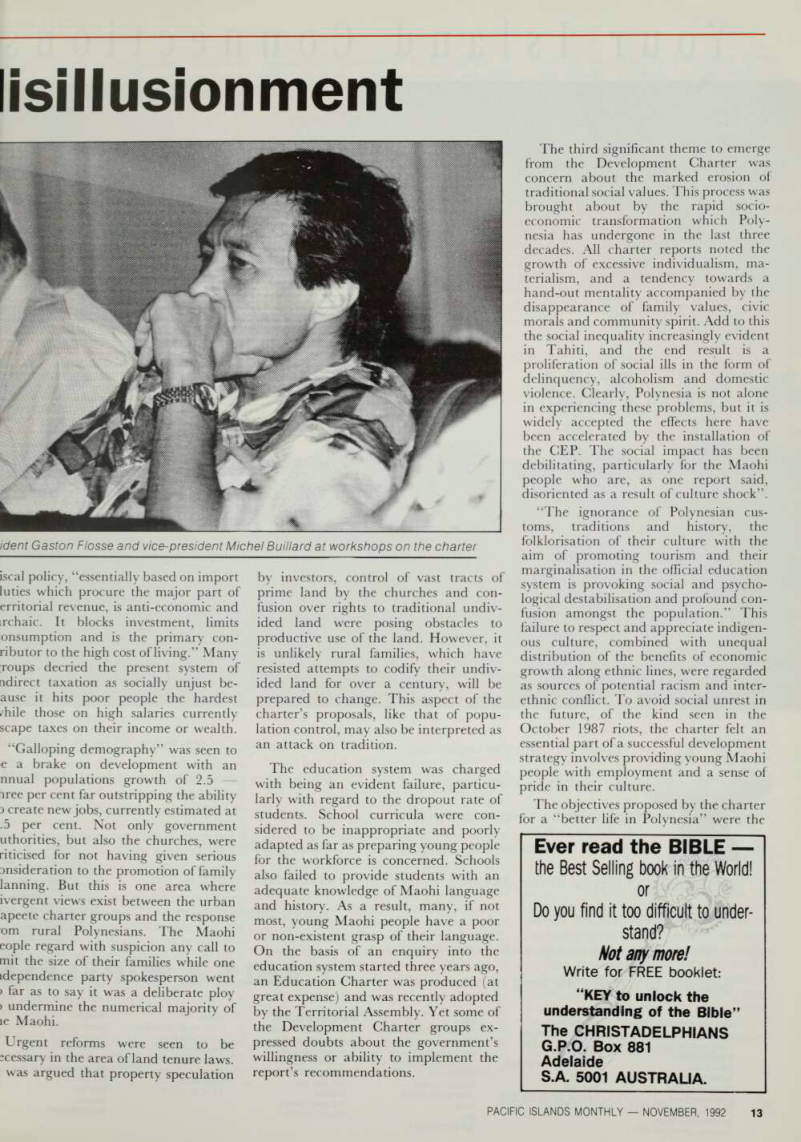
Listening in[?]
iscal policy, “essentially based on import luties which procure the major part of erritorial revenue, is anti-economic and trchaic. It blocks investment, limits onsumption and is the primary con ributor to the high cost of living.” Many roups decried the present system of ndirect taxation as socially unjust be ause it hits poor people the hardest /hile those on high salaries currently scape taxes on their income or wealth.
“Galloping demography” was seen to e a brake on development with an nnual populations growth of 2.5 iree per cent far outstripping the ability create new jobs, currently estimated at .5 per cent. Not only government uthorities, but also the churches, were riticised for not having given serious Dnsideration to the promotion of family lanning. But this is one area where ivergent views exist between the urban apeete charter groups and the response om rural Polynesians. The Maohi eople regard with suspicion any call to mit the size of their families while one
(dependence party spokesperson went
> far as to say it was a deliberate ploy > undermine the numerical majority of le Maohi.
Urgent reforms were seen to be in the area of land tenure laws. was argued that property speculation
by investors, control of vast tracts of prime land by the churches and con fusion over rights to traditional undiv ided land were posing obstacles to productive use of the land. However, it is unlikely rural families, which have resisted attempts to codify their undiv ided land for over a century, will be prepared to change. This aspect of the charter’s proposals, like that of popu lation control, may also be interpreted as an attack on tradition.
The education system was charged with being an evident failure, particu larly with regard to the dropout rate of students. School curricula were con sidered to be inappropriate and poorly adapted as far as preparing young people for the workforce is concerned. Schools also failed to provide students with an adequate knowledge of Maohi language and history. As a result, many, if not most, young Maohi people have a poor or non-existent grasp of their language.
On the basis of an enquiry into the education system started three years ago, an Education Charter was produced (at great expense) and was recently adopted by the Territorial Assembly. Yet some of the Development Charter groups ex pressed doubts about the government’s willingness or ability to implement the report’s recommendations.
The third significant theme to emerge from the Development Charter was concern about the marked erosion of traditional social values. This process was brought about by the rapid socio economic transformation which Poly nesia has undergone in the last three decades. All charter reports noted the growth of excessive individualism, ma terialism, and a tendency towards a hand-out mentality accompanied by the disappearance of family values, civic morals and community spirit. Add to this the social inequality increasingly evident in Tahiti, and the end result is a proliferation of social ills in the form of delinquency, alcoholism and domestic violence. Clearly, Polynesia is not alone in experiencing these problems, but it is widely accepted the effects here have been accelerated by the installation of the CEP. The social impact has been debilitating, particularly for the Maohi people who are, as one report said, disoriented as a result of culture shock”.
“The ignorance of Polynesian cus toms, traditions and history, the folklorisation of their culture with the aim of promoting tourism and their marginalisation in the official education system is provoking social and psycho logical destabilisation and profound con fusion amongst the population.” This failure to respect and appreciate indigen ous culture, combined with unequal distribution of the benefits of economic growth along ethnic lines, were regarded as sources of potential racism and inter ethnic conflict. To avoid social unrest in the future, of the kind seen in the October 1987 riots, the charter felt an essential part of a successful development strategy involves providing young Maohi people with employment and a sense of pride in their culture.
The objectives proposed by the charter for a “better life in Polynesia” were the
[?]dent Gaston Flosse and vice-president Michel Buillard at workshops on the charter
inverse of the problems they identified.
They emphasized the compelling need to reduce economic dependence on France and particularly the nuclear test pro gram.
The Development Charter has been rigorous in diagnosing French Poly nesia’s ills and has provided vision for the future. Yet, as President Flosse pointed out, it is one thing to make criticisms and recommendations and another to realise them.
Intransigence on the part of politicians and public servants, based on a desire to protect their existing privileges, poses a major obstacle to numerous recommen
dations. For example, it will be an up-hill battle to reduce the size and cost of the territorial bureaucracy, as this sector has a lot of political clout, and a strong trade union. The govern ment tried to begin this process in August by freez ing the salaries of the public service but the re sponse has been one of outrage and outright re fusal by the public service trade union, which has moreover attacked the charter as being a “mas querade”. Similarly, there would be resistance to the idea mooted by the charter of prohibiting accumu lation of political offices.
The extent to which offices can be accumulated was illustrated last year whereby Emile Vernaudon simultaneously acted as
municipal mayor, deputy to the French National Assembly and President of the Territorial Assembly.
A dilemma, which the Development Charter has far from resolved, is determining what kind of development and for whom. A prominent example of differing perceptions is in tourism. The government, private sector and foreign investors are keen to promote large hotel projects with a view to injecting much needed capital and providing employ ment.
Many Polynesians are not convinced of the employment benefits of such projects, arguing that the majority of jobs for them will be in the form of cleaners and gardeners. One result of this conflict ing perception of development is that several major hotel projects have had to be abandoned in recent years in the face of popular opposition. The most notable cases being the construction of a 2000-room hotel on the island of Tupai in the Australs which was opposed by traditional landowners, and the pro
posed golf-course-hotel condominium at
Opunohu on Moorea, which was de feated in a local referendum last year.
Now a new controversy has emerged over the Meridien Hotel project in Punaauia, Tahiti. For nearly two months local residents have been camped at the hotel site, preventing construction, in defiance of heavy fines and a court order for them to move. Their position is that there have been irregularities in the granting of construction permits and a failure to consult with the population or to under take an environmental impact study.
Yet, fundamentally, the protestors would be opposed to the project regardless of
the processes which led to it because the hotel is to be built on a public park and access to the beach which they want to maintain. The logic of building new hotels has also been questioned given the present inability to fill existing ones in Tahiti, and the number of hotels which have recently been shut down as a result.
A similar deadlock exists over the phosphate mine planned for the island of Mataiva. Locals are all too aware of the environmental damage caused by a previous phosphate mine on the island of Makatea, not to mention the experience of Nauru. It is partly due to the failure of the above projects to proceed, that President Flosse saw the need for a comprehensive debate to determine what people actually want and how their aspirations can be realised.
The wildcard factor in French Poly nesia’s development is the role to be played by France. On the one hand the nuclear tests have constituted an import ant form of revenue for the territory, on the other, they are widely recognised as
blocking incentives for productive econ omic activity. In order to make realistic plans for the future, territorial authorities need to know whether the test mora torium will continue. Moreover, French Polynesia has no guarantees as to whether the present high level of civil aid from France will be maintained if the CEP shuts down.
The French Socialist government has indicated its commitment to the Devel opment Charter in the form of its contribution to this plan, but the size and quality of its contribution to this plan, which would be crucial to its success, is as yet unknown. The plan has been
linked to the Matignon Ac cords in New Caledonia, with a major difference be ing that, at this stage, no referendum on indepen dence is envisaged at the end of it. Finally, all the agree ments with Paris, including the Pact which will be signed in January 1993, may be renegotiated from scratch if Jacques Chirac’s RPR wins the national legislative elec tions in March 1993.
Local reactions to the De velopment Charter have been mixed. Cynics argue that the charter is just one in a parade of public debates, conferences and round tables on development in recent years, all of which were soon forgotten. This reference to past forums is inaccurate but optimistic observers believe the charter has presented
possibly the most systematic
and honest assessment of the territory’s political and socio-economic life seen to date. The importance placed on the charter was evident in the fact that no high-ranking members of government attended the recent regional meeting in Noumea for French diplomats and terri torial heads of government; they chose to stay in Tahiti and hear the conclusions of the charter.
One commentator said President Flosse had exhibited a poor sense of timing in holding the debate now as opposed to just after the elections last year when he could have laid the blame for the charter’s bleak prognosis on the outgoing government. Instead, the pres ent leadership should be commended for having the courage to initiate such a reflection, at its own peril in political terms, in order to define a sound strategy for Polynesia’s future. Now the question remains, does the political will exist, in both Paris and Papeete, to implement the charter’s recommendations?
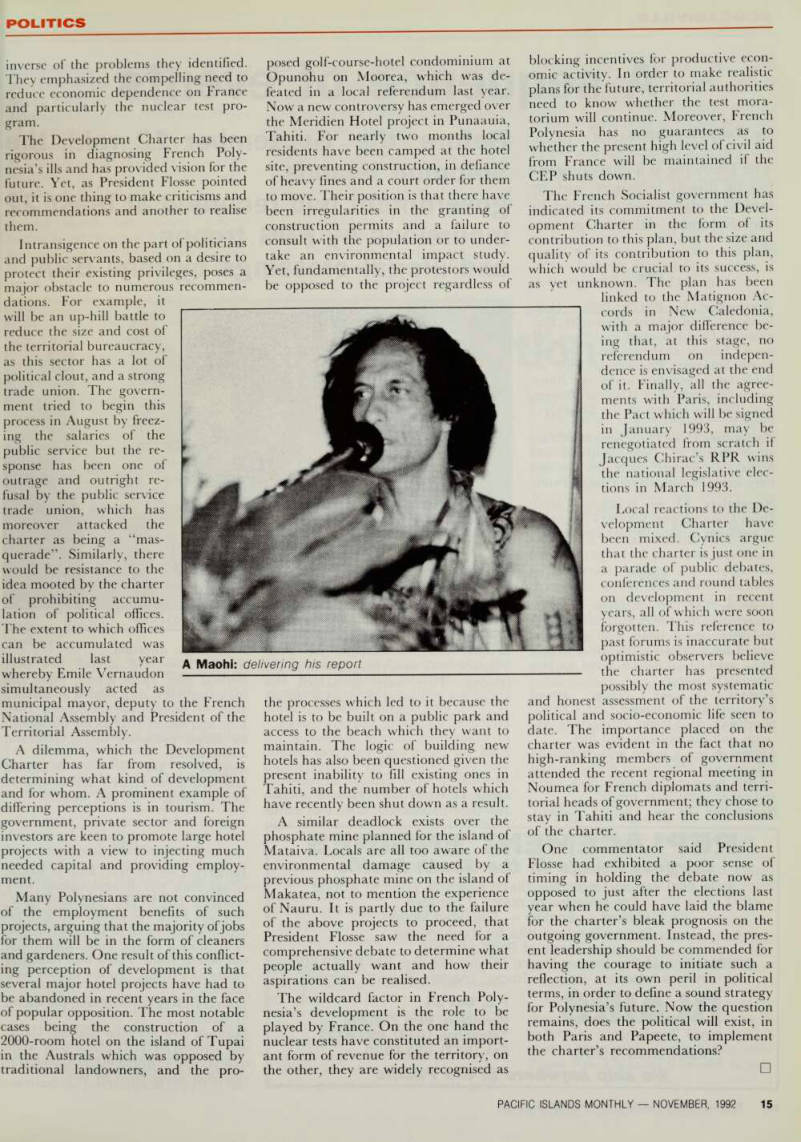
A Maohi: delivering his report