Scaling new heights
p. 11 · Read in the full issue
DIPLOMATIC appointments
are not always hugely signifi
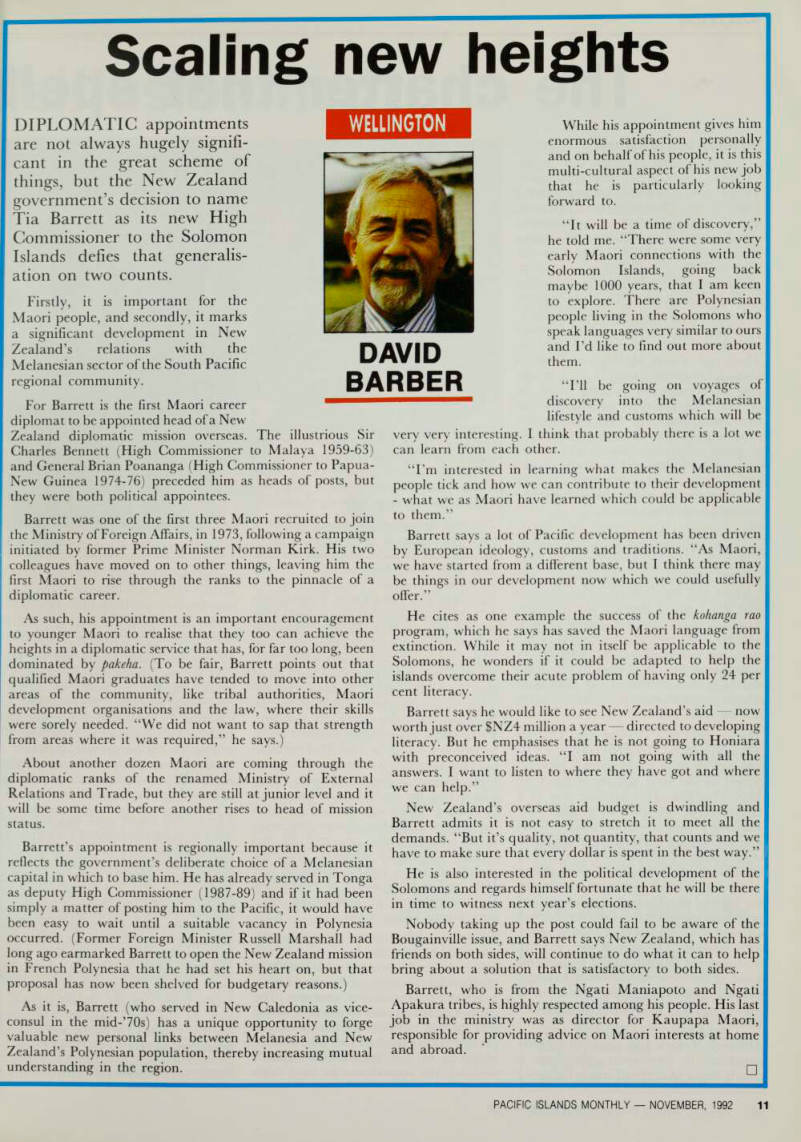
cant in the great scheme of things, but the New Zealand government’s decision to name Tia Barrett as its new High Commissioner to the Solomon Islands defies that generalis ation on two counts.
Firstly, it is important for the Maori people, and secondly, it marks a significant development in New Zealand’s relations with the Melanesian sector of the South Pacific regional community.
For Barrett is the first Maori career diplomat to be appointed head of a New
Zealand diplomatic mission overseas. The illustrious Sir Charles Bennett (High Commissioner to Malaya 1959-63) and General Brian Poananga (High Commissioner to Papua- New Guinea 1974-76) preceded him as heads of posts, but they were both political appointees.
Barrett was one of the first three Maori recruited to join the Ministry of Foreign Affairs, in 1973, following a campaign initiated by former Prime Minister Norman Kirk. His two colleagues have moved on to other things, leaving him the first Maori to rise through the ranks to the pinnacle of a diplomatic career.
As such, his appointment is an important encouragement to younger Maori to realise that they too can achieve the heights in a diplomatic service that has, for far too long, been dominated by pakeha. (To be fair, Barrett points out that qualified Maori graduates have tended to move into other areas of the community, like tribal authorities, Maori development organisations and the law, where their skills were sorely needed. “We did not want to sap that strength from areas where it was required,” he says.) About another dozen Maori are coming through the diplomatic ranks of the renamed Ministry of External Relations and Trade, but they are still at junior level and it will be some time before another rises to head of mission status.
Barrett’s appointment is regionally important because it reflects the government’s deliberate choice of a Melanesian capital in which to base him. He has already served in Tonga as deputy High Commissioner (1987-89) and if it had been simply a matter of posting him to the Pacific, it would have been easy to wait until a suitable vacancy in Polynesia occurred. (Former Foreign Minister Russell Marshall had long ago earmarked Barrett to open the New Zealand mission in French Polynesia that he had set his heart on, but that proposal has now been shelved for budgetary reasons.) As it is, Barrett (who served in New Caledonia as vice consul in the mid-’7os) has a unique opportunity to forge valuable new personal links between Melanesia and New Zealand’s Polynesian population, thereby increasing mutual understanding in the region.
While his appointment gives him enormous satisfaction personally and on behalf of his people, it is this multi-cultural aspect of his new job that he is particularly looking forward to.
“It will be a time of discovery,” he told me. “There were some very early Maori connections with the Solomon Islands, going back maybe 1000 years, that I am keen to explore. There are Polynesian people living in the Solomons who speak languages very similar to ours and I’d like to find out more about them.
“I’ll be going on voyages of discovery into the Melanesian lifestyle and customs which will be
very very interesting. I think that probably there is a lot we can learn from each other.
“I’m interested in learning what makes the Melanesian people tick and how we can contribute to their development - what we as Maori have learned which could be applicable to them.”
Barrett says a lot of Pacific development has been driven by European ideology, customs and traditions. “As Maori, we have started from a different base, but I think there may be things in our development now which we could usefully offer.”
He cites as one example the success of the kohanga rao program, which he says has saved the Maori language from extinction. While it may not in itself be applicable to the Solomons, he wonders if it could be adapted to help the islands overcome their acute problem of having only 24 per cent literacy.
Barrett says he would like to see New Zealand’s aid now worth just over SNZ4 million a year directed to developing literacy. But he emphasises that he is not going to Honiara with preconceived ideas. “I am not going with all the answers. I want to listen to where they have got and where we can help.”
New Zealand’s overseas aid budget is dwindling and Barrett admits it is not easy to stretch it to meet all the demands. “But it’s quality, not quantity, that counts and we have to make sure that every dollar is spent in the best way.”
He is also interested in the political development of the Solomons and regards himself fortunate that he will be there in time to witness next year’s elections.
Nobody taking up the post could fail to be aware of the Bougainville issue, and Barrett says New Zealand, which has friends on both sides, will continue to do what it can to help bring about a solution that is satisfactory to both sides.
Barrett, who is from the Ngati Maniapoto and Ngati Apakura tribes, is highly respected among his people. His last job in the ministry was as director for Kaupapa Maori, responsible for providing advice on Maori interests at home and abroad.