A spectacular cultura[?]event in the making
pp. 40-41 · Read in the full issue
Festival
By Christine Hatcher
THE sixth festival of Pacific Arts to be held on Rarotonga in the Cook Islands has a promise. It will be the largest, most spectacular and
exciting culturally sharing
event to date.
Ancient vaka (canoe) building skills have been especially revived around the Pacific, with Polynesians, Melanesians and Micro nesians individually crafting magnificent vaka for sailing to Rarotonga for this event.
Epic sea voyages will be in part reconstructed by Hawaii’s Hokule’a. Ocean go ing vaka from other Pacific island countries will also arrive from their home lands after long journeys. All will use the ancient art of navi gation by the stars.
In reality, the Festival begins in Aitutaki - a pictur esque island 140 nautical miles from Rarotonga. It is from there that a cer emonial, traditional depar ture will bid those, and the Aitutaki Ngapuariki vaka fare well on the last leg of their voyage, about four days be fore the festival.
Meanwhile, hand carved canoes from the islands of Atiu, Mangaia, Mitiaro and Mauke in the Cook Islands will also be charting their course,
Rarotonga bound.
A traditional turou (of ficial welcome) exchannge
will take place at the reefs edge. The vaka Takitumu, a one-third size twin hull replica of the original Takitumu Kaila built in Samoa in 1000 AD and rebuilt by former Prime Minister Sir Thomas Davis for this occasion, will pilot. The Uritaua, Tautai, Oe and Akateretere and various other vaka will escort.
Their combined entrance into Ngatangiia Harbour, the site from where, according to legend, migrations to New Zealand took place, sets the special theme for this maire nui (festival) —“Seafaring Pacific Islanders.”
This moment of historical and contemporary awareness is to be marked and officiated by HRH Prince Edward
on the October 16. The idea was sewn by Sir Thomas as far back as 1985, when, as member for the South Pacific Com mission, he suggested holding the festival here. The festival office began operating in October 1990 and in December last year Tamarii Tutangeta became festival director. “I suppose it’s the biggest such undertaking ever to happen in the Cook Islands,” he says.
Preparations have been relentless from installing extra toilets to beautifying the entire island with $500,000 worth of plants and trees to building a splendid SNZII.6 million cultural centre, the core venue for the festivities.
The participation of 27 countries is
confirmed - fron] American Samod and Western Samoa] Easter Islands, and the Federated State of Micronesia people will come.
Australia is sending a large ethnic contin gent and Guam, Ha waii, and Kiribati will also send their best. Fiji promises fire walking demon strations and the Marshall Islands.
Nauru and New Caledonia will be represented. New Zealand will bring one ocean-going, one war vaka as well as many people. Niue, Norfolk Island, Northern Mariana Island and Palau will attend. Papua New
Guinea promises
many spectacular
dances and tiny, re mote Pitcairn Islands, famous for its carvings, will prove their craft. Ta hiti is known for its graceful dancers and Tonga will perform its war dances.
Tokelau, Tonga, Tu valu, Vanuatu and Wallis and Futuna
complete the picture.
They will bring with them unique traditional theatre,
crafts, their special drum sounds and dances. But the programs are a secret.
“If you want to see, you will have to come,” is the answer from the festival office.
On a reasonably small island with a population of 10,000 and onlyj approximately 4500 commercial beds, accommodation has been a problem for some hoping to attend.
A cry has gone out for “home stays”! and 100 extra beds have been found, says Melynnda Morrissette, manager of the Accommodation Bureau for the Chamber of Commerce.
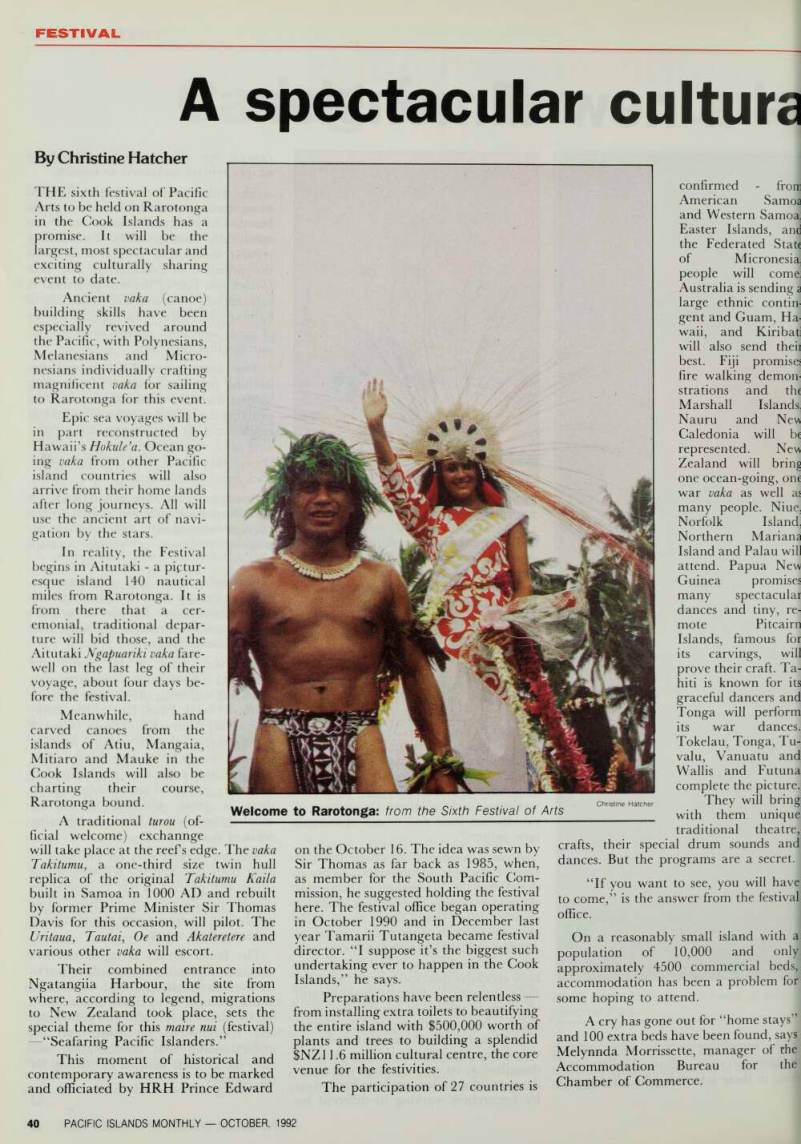
Christine Hatcher Welcome to Rarotonga: from the Sixth Festival of Arts
‘But we could do with a hundred more,” she laughs. To house the 2100 partici pants, mattresses have been bought, schools and halls upgraded and a special >aka village built to house the navigators md their crew.
Food planning for the large contin gents, including a patai ceremony raditional umukai (food cooked in an ;arth oven) and entertainment for up to 1000 after the opening pageant has
nvolved much forethought.
The traditional generosity and hos )itality for which Cook Islanders are well ;nown however, brings a five-star guarantee that no-one will go hungry!
Time, money and energy have been iven in abundance. Dedication has been acreasing daily as time draws the festival loser.
A combined school choir has been ehearsing for months. A specially omposed song has been written by ;acher Thomas Samuel of St. Josephs chool. This will be featured in the pening ceremony and become the fficial festival song. Its catchy tune will nsure its survival long after the festival over.
The CINAT (Cook Islands National rts Theatre) has been revived. To atch their rehearsals, even with dancers isually dressed in tee-shirts, shorts and ireu , the excellence of Cook Islands’ ancing is apparent. For the first time, rong emphasis will be on visual arts, alike other festivals which have
nphasized performance.
A huge variety of arts and crafts will be shown and exhibited. As another first, workshops will be held in weaving, carving, traditional medicine, tatooing, shell making and fabric painting. These articles will be for sale in the 17 kikau huts now under construction on the edge of Avarua township.
A highlight will be the major Arts Festival Fashion Show. Depicting “Cos tumes and Rituals” the show will take the audience through the ages of fashion from yester-year to the present. Six of the 27 countries will also take part in this event.
Lynnsay Francis, an organiser says, “The clothes featured will mirror a marriage between old cultural traditions
and modern design techniques.”
Literature also features strongly with poetry and story readings planned in a
special “poet’s corner”.
Several books have been published.
The most recent being a glossy pictorial called Tivaevae - Portraits of Cook Islands Quilting. Cook Islands Drums , Tipani, a pot pourri of poetry and art, the practical guide Learning Rarotongan Maori and Manakonako - Reflections were published earlier this year. Books on Cook Islands dance and oral history transcripts are close to completion.
Traditional sports and games, such as the throwing of spears into a coconut on a long stick and vaka racing will provide fun and competition.
Gospel Day on the 26th will be marked with a Biblical Pageant and the grande
finale, a day later, will take the form of a mardi gras.
These are some of the many treats in store for the participants, spectators, 500 VIPs and visitors who will fill this island
to capacity.
As Queen’s representative, Apenera
Short said at the ceremonial opening of parliament on August 14, “It will be something that everyone will remember all their lives”.
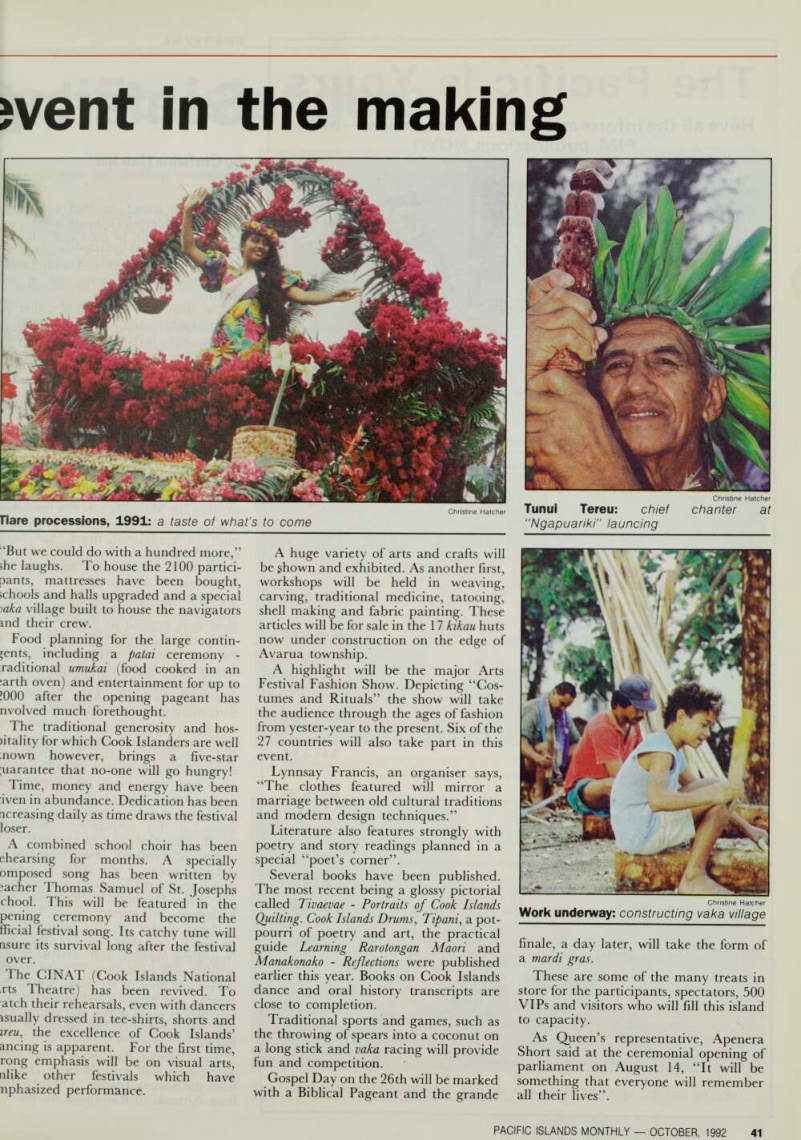
[?]lare processions, 1991: a taste of what's to come
Christine Hatcher
Christine Hatcher Tunul Tereu: chief chanter at “Ngapuariki" launcing
Christine Hatcher Work underway: constructing vaka village