Caring for the country - a new dimension
pp. 38-39 · Read in the full issue
Environment
By Liz Thompson
Innovative things have been happen ing at Ayers Rock, now reclaiming its traditional name, Uluru. The landmark remains Australias’ most prominent natural icon. The red rock, the purple rock, the dusty blue rock, depending on the time of day, its many faces have graced a thousand magazines. But, since the handback of Uluru-Kata Tjuta National Park to the traditional land owners in 1985, (the Anangu people of the Mutitjulu community), and the establishment of joint management with Australian National Parks and Wildlife, (ANPWS) the publication of visual images has been better controlled.
Uluru, like numerous other natural features in the landscape, has deep religious significance for the Aboriginal community which care for it. For this reason it is deemed inappropriate by Anangu that images showing particu larly sacred areas are published commer cially. As a result clear guide-lines have been established for photographers.
Ownership and joint management have inspired a very different and very successful approach both to the visitor experience and to land management in general. A recently completed fauna survey adds another new dimension to this process of sharing responsibility for, as Anangu say, “caring for the country”.
A three-year collaboration between CSIRO scientists, traditional land owners and non-Aboriginal park staff, the survey married traditional and scientific knowledge. Its major objective was to arrest the rapid demise of the area’s fauna. According to Arid Zone Research Centre scientist Dr Steve Mor ton, in Alice Springs, Uluru has already lost approximately 50 per cent of its native ground dwelling mammals a result of changing fire practices and an ever increasing number of tourists.
Working together Anangu and scientists collected a comprehensive data base documenting the fauna within the park,
including information concerning their
habitat preferences, behaviour and whether or not their numbers are threatened.
Clearly in a cross-cultural process such as this there will be significant differences in approach, not only to the landscape but in the way research is undertaken and knowledge is controlled. The Tjukurpa forms, for Anangu, a funda mentally different approach to the land scape than that of science. Inappropri ately interpreted by non-Aboriginals as
Marrying traditional and scientific knowledge has inspired a successful and very different approach to land management
the “Dreamtime”, the Tjukurpa is the time of creation, when ancestral spirits in the form of animals and humans trav elled across the continent. As they travelled they brought the natural fea tures of the landscape into existence.
Certain animal behaviours described within the Tjukurpa determined the ways in which they were classified by Anangu. A process substantially different to the scientific approach in which classification is determined by evolution ary history. Due to the often secret and sacred nature of this information or knowledge, very little of it was available to scientists. Throughout the period of working, Anangu helped scientists un derstand what were appropriate and
inappropriate kinds of questions.
Though there were often differences in classification, there were many areas in which knowledge was compatible. When the sites were selected for observation it was found that Anangu and scientists both dissect the landscape into similar habitat types. Eight main survey sites representing these different habitat types were studied seven times over a period of three years. Scientists set up traditional survey methods of traps and observational transects whilst Anganu brought a very different process to life.
Observing tracks and scats they recorded the activities of numerous animals not caught in traps.
Anangu readily showed scientists where to find endangered species and taught them tracking skills which helped them locate animals they had been struggling to record. Ecologist Julian Reid, one of the researchers involved in theTlurvey, remarks on Anangu’s extra ordinarily developed observational skills.
Out in the field, “they were,” he explains, “able to describe tracks very specifically, such as, “that’s a female goanna going off to dig its nesting chamber”, as opposed to “that’s a female goanna going off to hunt for a small mouse or spider”. As Anangu move across the land they constantly point out tracks and describe events which have taken place in various areas according to
marks, which to the untrained eye, are barely visible. With them, this appar ently dry piece of scrubland is filled with life and movement.
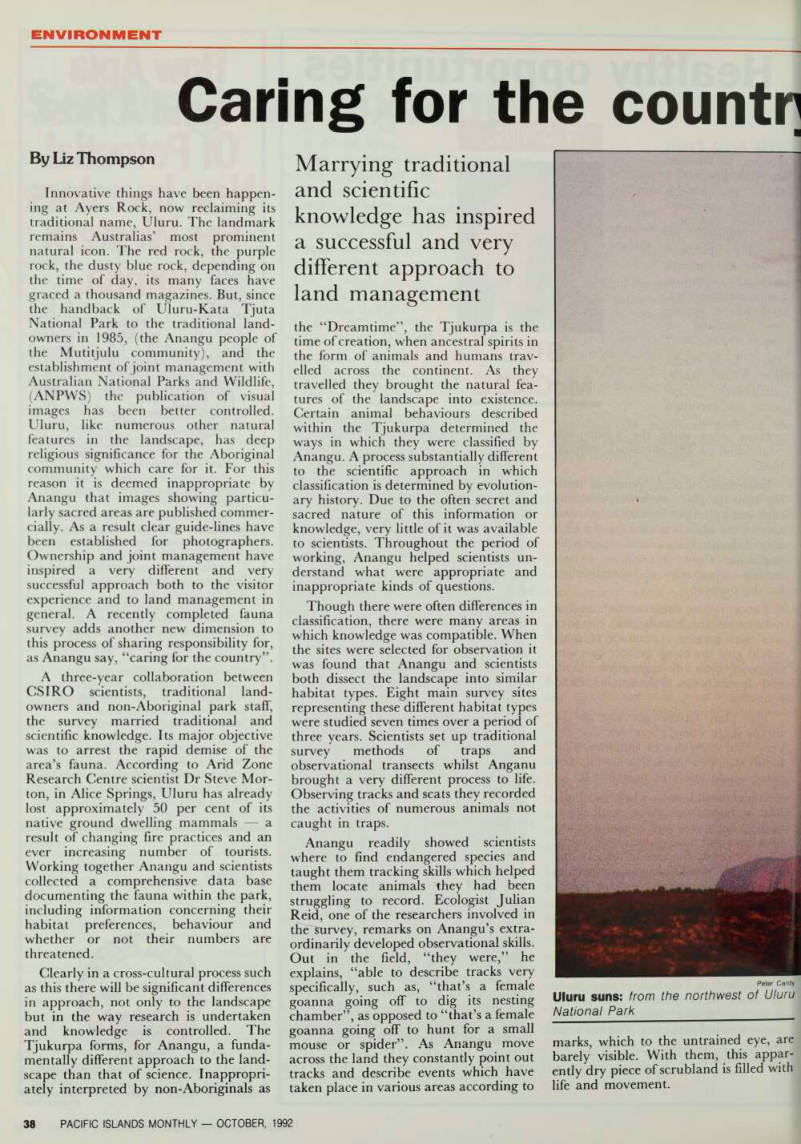
Peter Canty Uluru suns: from the northwest of Uluru National Park
is something which may appear traordinary to urban dwellers and en to those scientists who often spend
many months in the field, but is an accepted and natural skill among people who live and breathe the land, spend their lives walking across it and pace accumulated information across the eyes.
Their broad knowledge and understand ing allowed for a far more wholistic view of the dynamics of a highly changeable system.
Anangu experience provided, says Lynn Baker, one of the projects principal researchers, a better context for the findings of the survey. While the survey itself was conducted during a predominantly wet period, Anangu, she explains, “were able to talk about years and years of such processes, drought to wet, large scale wildfires, the coming of rabbits and foxes and details of animals now extinct”.
Anangu were able to create detailed sand drawings of animals’ burrows, describing the placement of particular chambers some for breeding, some for resting, how some were lined with chewed spinifex. On many occasions Anangu told of animal behaviour pre viously unknown to science. One particu larly evocative description was that of the Patiny patinypa or Burtons snake lizard, climbing to the top of spinifex humps at
night and whistling or vocalising.
Though not observed by scientists during the survey, they did hear what Anangu described as its cry. On some occasions Anangu information was later backed up by researchers working in different lo
cations, on others their observations simply remain unknown to science.
The subsequent report put forward numerous recommendations some based on combined data, some on
specifically Anangu data. Establishing
regular monitoring programs to assess the presence of endangered and rare species was one of the top priorities. A substantially increased understanding of habitat preferences of rare species will be of great assistance during proposed re introduction programs.
The importance of traditional fire
burning practices in terms of providing
habitat diversity within small areas and avoiding the spread of huge wildfires was emphasized. It was suggested the plan ning and management of fires should always take place with the appropriate traditional landowners.
Anangu stressed they would like to see the information collected passed to the younger community, particularly in creasing numbers of young Anangu rangers.
Certainly there are, on occasions, differing perspectives, as in feral animals seen as both a pest but also as a major food source for Anangu, replacing now extinct native fauna.
However, there is no doubt the
combined knowledge, appropriately
managed, will bring the greatest benefits.
“I think” says Yami Lester, the chair man of the Uluru-Kata Tjuta board of management, “they’re working together well to come to terms with things”. As a cross-cultural process it was ultimately extremely successful and clearly suggests there is great potential for further collaboration both at Uluru and in other areas of Australia.
Anangu suggest that on the basis of what both they and the scientists learnt about the process, a list of guidelines should be drawn up to help those involved in future projects of information collection and transfer.
The fauna survey is significant not only in fulfilling its required objectives in terms of data collection and recommen dations, but in recognizing and respect ing the richness of traditional knowledge and relations to the land, and, in understanding that collaboration will reap the greatest benefits in “caring for the country”.
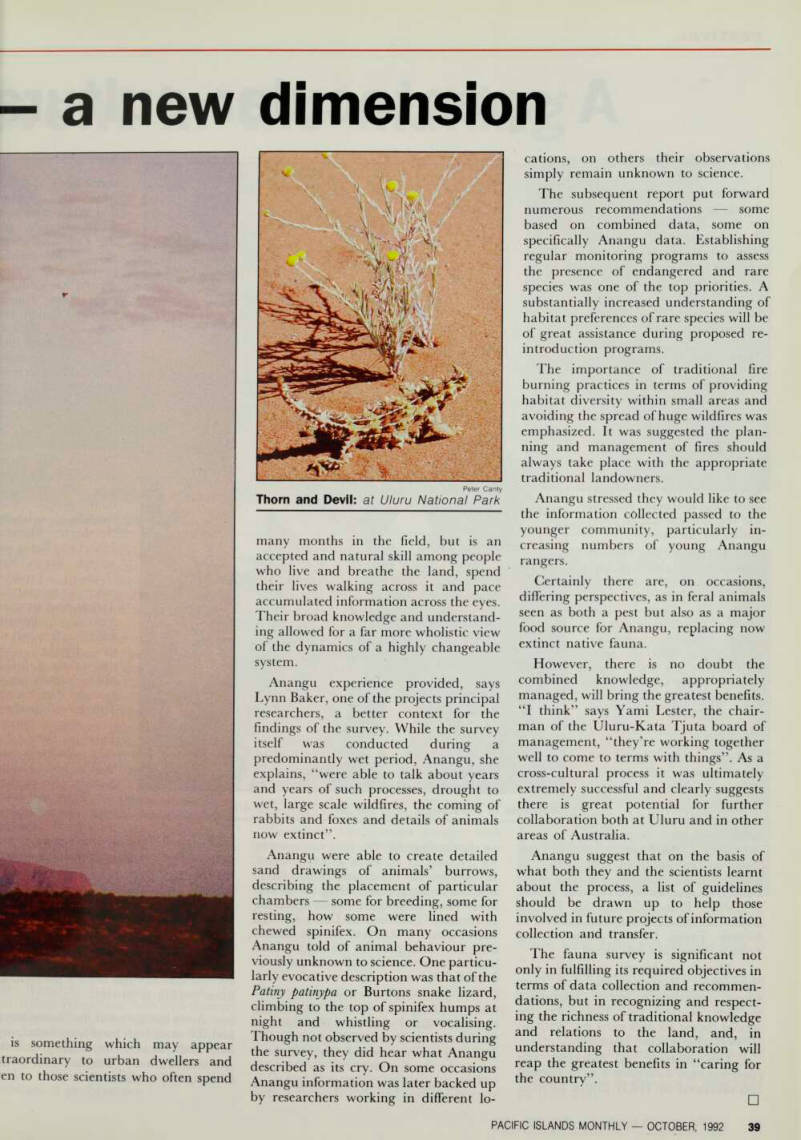
Peter Canty Thorn and Devil: at Uluru National Park