Seafaring pacific islanders
pp. 42-43 · Read in the full issue
By Christine Hatcher
A haunting sound, muffled by dense, fringed woods echoes through a forest on the island of Atiu in the Cook Islands.
The morning sun scatters shadows as prayers go out to Tane, god of the forest, for permission to release one of his children.
The chain-saw bites. Birds scatter in alarmed white and brown patterns. A mango tree falls, releasing a musty fragrance as the hefty trunk indents the earth. There is much laughter, chanting and calling to the gods, to the ancestors for help with this heavy work. Many willing hands aid as another vaka (canoe) is born.
Similar ceremonies on Rarotonga have seen the birth of pilot vaka for the festival, the Takitumu and the 240-man war canoe, the Uritaua , the Ngapuariki from Aitutaki and vaka from Mauke, Mitiaro and Mangnia’s Te Uru Ote Rangi.
This life-force, poured into every vaka built in traditional times, has been revived here in the Pacific for the sixth Festival of Pacific Arts beginning in Rarotonga on October 16.
According to the Prime Minister of the Cook Islands, Sir Geoffrey Henry, the ideas were kindled in 1972.
“At that time, the then leaders of the Pacific decided something had to be done for the survival of their culture. They sensed an erosion taking place; Western philosophy began to have an impact.
Something had to be done. Then there was Fiji,” he said.
There have been five festivals since.
But, for the first time, participating countries have been challenged to build vaka and sail them to Rarotonga, navigating by the stars. In following the traditions of their ancestors the special theme of this festival “Seafaring Pacific Islanders” will be created.
And so, across the Moana-nui-o-kiva the great ocean of blue space a hand of welcome to the 27 countries participat ing from Polynesia, Micronesia and Melanesia, will extend.
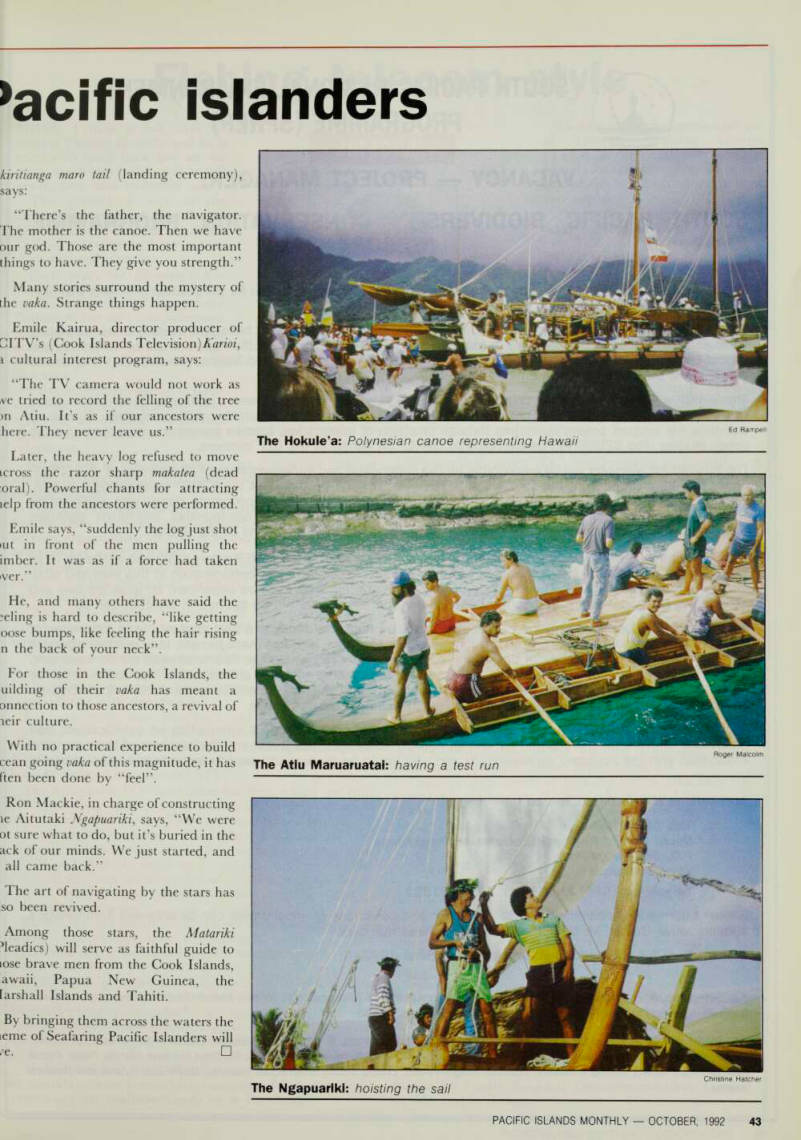
Here, stories of the vaka will be recreated, as they tell of the nuku (travelling parties), and survival at sea, arrivals and departures. These are the stories not only of the past, but of the present and future which make up the mixtures of mythologies and genealogies that bind together the people of the Pacific. . , Toua Pitman, Rarotonga’s chief navi gator, who will sail Hawaii s Hokule a from the Society Islands to Mauke then from Aitutaki to Rarotonga for the
kiritianga maro tail (landing ceremony), says: “There’s the father, the navigator.
The mother is the canoe. Then we have our god. Those are the most important things to have. They give you strength.”
Many stories surround the mystery of the vaka. Strange things happen.
Emile Kairua, director producer of CITV’s (Cook Islands Television) Karioi, i cultural interest program, says: “The TV camera would not work as ve tried to record the felling of the tree )n Atiu. It’s as if our ancestors were here. They never leave us.”
Later, the heavy log refused to move icross the razor sharp makatea (dead oral). Powerful chants for attracting iclp from the ancestors were performed.
Emile says, “suddenly the log just shot iut in front of the men pulling the imber. It was as if a force had taken ver.”
He, and many others have said the deling is hard to describe, “like getting oose bumps, like feeling the hair rising n the back of your neck”.
For those in the Cook Islands, the uilding of their vaka has meant a onnection to those ancestors, a revival of leir culture.
With no practical experience to build cean going vaka of this magnitude, it has ften been done by “feel”.
Ron Mackie, in charge of constructing le Aitutaki Ngapuariki , says, “We were ot sure what to do, but it’s buried in the ack of our minds. We just started, and all came back.”
The art of navigating by the stars has so been revived.
Among those stars, the Matariki Readies) will serve as faithful guide to lose brave men from the Cook Islands, awaii, Papua New Guinea, the larshall Islands and Tahiti.
By bringing them across the waters the icrne of Seafaring Pacific Islanders will /e. □
Ed Rampell
Roger Malcolm
Christine Hatcher
The Hokule’a: Polynesian canoe representing Hawaii
The Atiu Maruaruatai: having a test run
The Ngapuariki: hoisting the sail