Are we eating ourselves to death?
pp. 24-25 · Read in the full issue
Health
The right to health, which is taken for granted in so many parts of the world, still appears elusive in the Pacific region. As we move towards the 21st century and believe we are advancing into a new age, basic health needs are being overlooked. For instance, there is a shortage of primary health workers to educate the population on prevention, there is a shortage of facilities to provide care and treatment to those who are ill and there is a shortage of skilled medical personnel, making expensive overseas care which few can afford a necessity. Bureaucracy, shortage offunds and planning have been blamed for the deteriorating health standards.
By Martin Tiffany
IF THE human body can be compared to a motor vehicle then health services in the South Pacific can be compared to a
body repair shop. This comparison is
perhaps a bit unfair, regional health services are better than this assembly line analogy. However, what is generally true is people are treated when they get sick rather then preventative measures being taken to keep them well. A bit like
running a car engine with no oil and then trying to repair it when it seizes up.
Dr Sitaleki Finau, the health coordi nator at Noumea’s South Pacific Com mission, says rather than running a pro active service which helpS prevent disease most Pacific island nations have “repair service” type health care. He even sug gested health depart ments and health ministries be re labelled disease de partments and dis ease ministries as these are directed mainly towards dis eases.
Dr Finau, a Ton gan, has worked in many Pacific
countries including
Fiji, Tonga, Feder ated States of Micro nesia, New Cale donia, Tokelau and New Zealand. The problem, as he sees it, is people only look at the end of the line where a person has a
disease and then go about trying to cure it. Dr Finau said health services must look right up to the beginning of that line and work out how disease can be prevented.
He said everything from environ mental degradation -like deforestation to basic sanitation had an impact on health and must be taken into consider ation when looking at the overall health picture. Logging activities, for example, cause heavy erosion which can lead to the destruction of food gardens - directly
affecting diet.
While Dr Finau and others agree on the problem, the cause is a different story.
One drawback faced by most Pacific countries is the priority, or lack of it, their governments give to health. Junior ministers are often given the health portfolios and allocations for health services are usually way down the bottom of the priority list.
What is needed is more money for training especially to develop primary health care. This will deal with basic sanitation and hygiene but, as Dr Finau, points out there have to be long term
plans.
For many of the developing island nations infectious diseases are the main cause of death. However, the trend now is a move away from infectious to non communicable diseases (NCD). This catches many countries Fiji for example in the middle where they are still trying to eradicate infectious diseases and at the same time trying to counter the life-style diseases.
This in effect will see the health service of countries adjust to try and balance looking after the two disease categories making the job of the health worker doubly hard.
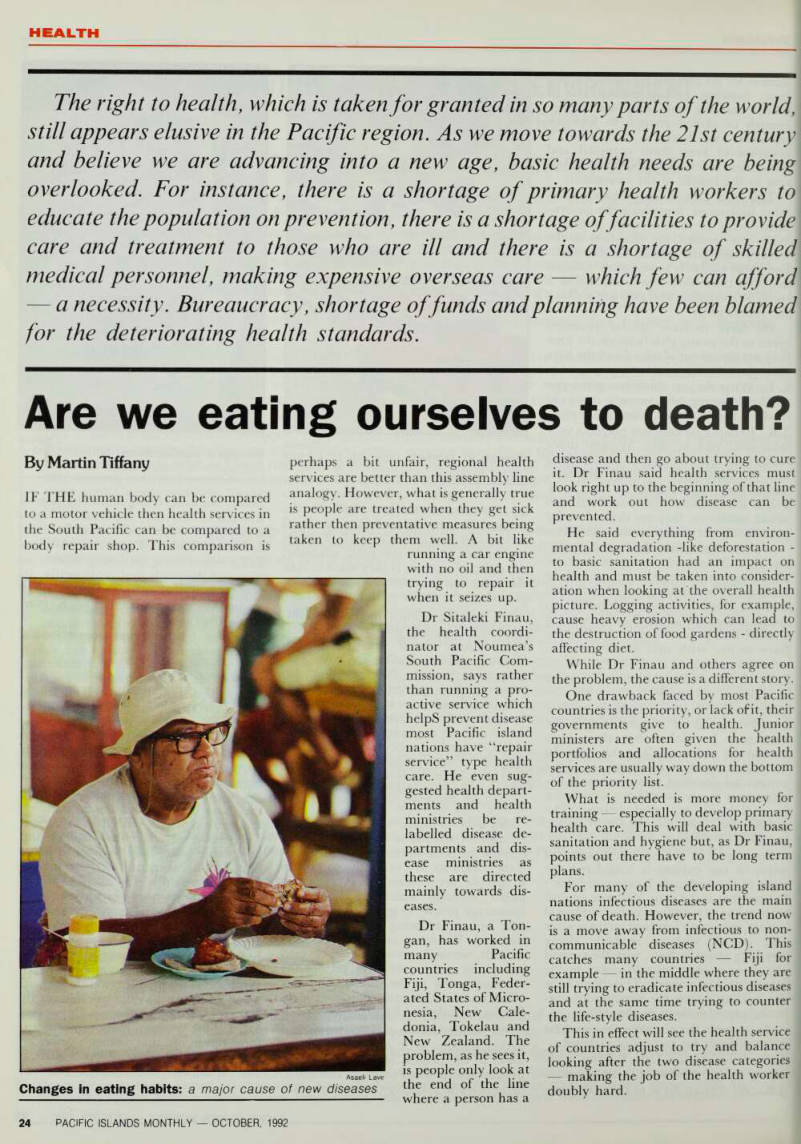
Changes in eating habits: a major cause of new diseases
While there have been many successes in combating infectious diseases, trying to fight non-communicable diseases is more difficult as one is faced with the task of changing the way a person lives.
What is needed is something which will sharply bring home the message that we are eating and drinking (and smok ing) ourselves to death.
What needs to be driven home is that just like tuberculosis and malaria, poor diet, lack of exercise and obesity can kill.
The increased instances of NCDs such as heart diseases, diabetes and high blood pressure are directly related to lack of exercise, excessive alcohol consumption, smoking and eating too much processed foods (despite an adequate and often
cheaper supply of fresh vegetables, fruit
and meat). There is the story of the fisherman who sells his catch and then buys tinned fish for his family’s dinner.
While you may smile at this story, it exemplifies a situation of countries sur rounded by the sea, many with lush tropical vegetation, yet a lot of the inhabitants survive on a staple of tinned fish, meat, sugar, flour and rice. This reliance on processed and imported food is the result of a developing cash economy, the expansion of cash cropping and increased urbanisation.
Because the Pacific has imitated foreign development approaches and life styles these new diseases have been called Western diseases. This term is mostly applied to diseases such as diabetes, hypertension, heart attacks, stroke, gout, and similar ailments caused by overeat ing, lack of exercise and stress.
However, as Dr Finau points out, the Pacific seems to be leading the world, with the highest prevalence of diabetes in Nauru and possibly the Marshall Islands.
“In other words, these diseases have migrated and made their homes among the Pacificans. The latter in turn have received them with a Pacific welcome. So it is unreasonable to call them Western diseases anymore, they are new Pacific diseases.”
While tobacco and alcohol are blamed as a cause of NCDs they also create what Dr Finau calls a “false economy”. He said Fiji, for example, manufactured both cigarettes and beer which provided many millions of dollars for the economy (the revenue from liquor sales in Fiji in 1988 was 5F14,126,000). But this gain is offset by the health costs of treating patients with tobacco and alcohol related sicknesses. Fiji, Tonga and Samoa are spending scarce health resources on anti alcohol and anti-smoking campaigns but
are simultaneously producing these dis
ease agents.
Treating patients with NCDs is also very expensive as the specialised treat ment needed is usually not available locally.
One of the most prevalent NCDs in the region is diabetes. It is the most common NCD in Fiji and hospital admission has increased seven fold in the last 40 years from 170 in 1952 to 1400 in 1990. A national diabetes seminar in Suva last year predicted another 1000 adults would develop diabetes every year unless extensive preventative measures were introduced.
Medical authorities in Western Samoa estimate 15 per cent of the population suffer from the disease five times the level in Australia and New Zealand.
A recent study in New Zealand showed Pacific Islanders, Maori and Asians are three times more likely to develop diabetes than Europeans. The study shows the likelihood of becoming diabetic appears to be related to income, obesity and racial group.
The study says some of the difference rates in disease rates could be explained by different diets, rates of obesity and
level of physical activity.
The study also says the relative risk of developing diabetes was highest among the poorly paid and decreased as income rose.
It should not, however, be assumed from this last finding that the more money you have the healthier you will be.
Nauru for example has the highest GNP per capita (SA20,000) in the region but has one of the lowest life expectancies (55). This can be compared with Niue which has a GNP per capita of only 5A957 and a life expectancy of 67.
So while the path to eradicate infec tious diseases seems pretty clear-cut, what path do we take to combat non communicable ones?
While there are many arguments and
suggestions on how to do this, it will definitely be no easy task. Apart from those dedicated health “freaks” most of us are guilty guilty of over-eating, eating the wrong foods, drinking alcohol, smoking and so on.
As Dr Finau points out, many individ uals are indulging themselves as a means of displaying their affluence and end up suffering from these diseases. “I know of some civil servants who wear their gouts as their badges of achievement.”
So unlike infectious diseases the power to make an improvement is in our hands.
But as we know all too well the flesh is weak.
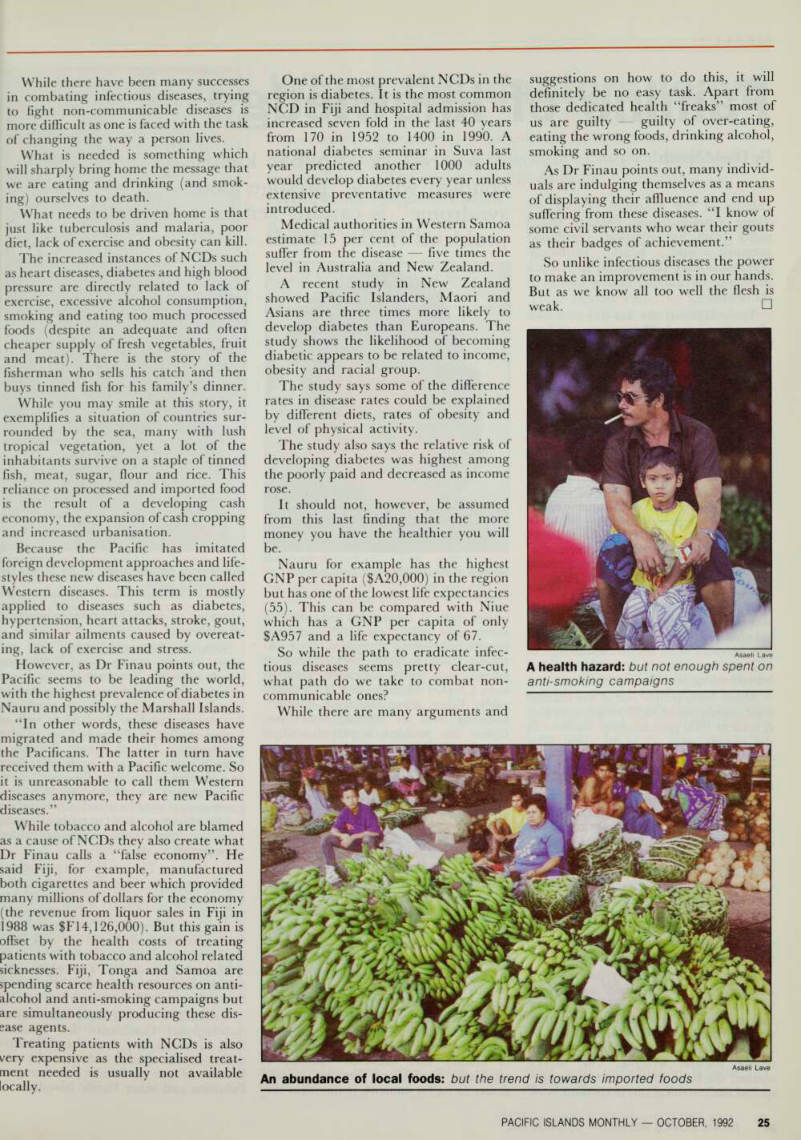
A health hazard: but not enough spent on anti-smoking campaigns
An abundance of local foods: but the trend is towards imported foods