A new kind of violence
pp. 21-23 · Read in the full issue
As social structures in the Pacific change they affect all elements of the community, me of the most common and most negative developments has been the increase in the Kcurrence of violence against women, Domestic violence, as a manifestation of apid cultural transition in the Pacific, nvolves a new set of circumstances for the ommunity. “We see”, says Josepha Kanawi, secretary of Papua New Guineas’
Law Reform Commission, “a new kind of iolence emerging in the country.” While ustomary law has been effective and highly espected, a new kind of violence necessi-
tales a new kind of law. The Law Reform Commission stresses the importance of
recognising, combining and valuing the
importance of customary law, while accept ing the changing situation and the need to develop appropriate laws to assist women in the face of increased violence against them.
Josepha Kanawi talks here to Liz Thompson about what she sees as reasons for the increasing violence and the
accompanying, supposed, lower status of
women in urban environments. She cites, among other things, the growing number of
unemployed, dissatisfied young people, the
adverse effects of alcohol on the male
population, the infuence of violent, sexist
films from developed countries, changes to
a monetary economy, and the anthropologi cal accounts which claim women’s inferi ority in Melanesian culture. She talks also of strategies being developed, not only to help women deal with problems of violence, but to assist in empowering them. By changing attitudes negative to women’s development there will of course be a corresponding growth in their involvement in the development of the Pacific region.
i.T.: What do you think has given rise 3 the increase in the law and order roblem over the last few years? .K.: It’s very difficult to pinpoint xactly, but from my own point of view ’s a question of the haves and the have ots despair people help themselves to
hat they think is jus fied, that seems to be ne way of looking at ic problem. On this ime issue you come to le question of women nd their rights in the immunity.
We have been told,
srhaps indoctrinated
hat we in Papua New uinea suffer very idly; that we are the west in terms of hav g any status in the unmunity.
It’s time for us to icstion that too,
hether the anthropo
gical assessment of us correct or not. For ample, the question bride price we
ive been told that this is one factor lich makes us appear as second class izens, not having the same rights as en because we are purchasable items if u like.
Therefore whoever purchases us owns and so we don’t have any right in termining our own events or future, lat is changing now, because we Papua *vv Guinean women are now viewing ide price as the recognition of the value the women in the community. There “ now two views appearing on the issue bride price. I remember when I was the university studying and the ninist movement was fighting to do
away with bride price. I’m beginning to change my view. I’m starting to believe that bride price is the community’s way of putting a value on the women their sons marry.
We need to recognise that their contribution need not be the same as the
man’s but that they have the same worth as the men in the development of the nation. I’m not sure who to blame for the fact that we’ve been taught that in our Melanesian traditional role-play women are inferior.
It’s a time of development for the nation where everything is being ques tioned and we have to question current attitudes towards women.
L.T.: Do you think Western input, in the form of violent or sexist films and television, contributes to some of the problems of attitude towards women in Papua New Guinea?
J.K.: Yes, I think there are so many idle
people around, people who can’t get jobs and have nothing to do, who occupy themselves with films and cinemas. I think for many of our young people there is an attraction in going to see what the developed world is doing and then trying to copy it.
We, or maybe the government, have not been able to come up with a plan to occupy
these people,
so they spend a lot of time watching these films and try ing to 'imitate them. It’s playing on the idleness of the majority of our youth, with nothing to oc cupy them
selves, they
must copy at leisure what
they see.
L.T.: What kind of programs do you think would be most advantageous in terms of curbing this rise in crime?
J.K.; We need to occupy our youth, engage them in worthwhile projects. I think the government has made a start, we have the National Youth Program, how it is being handled is probably not getting the best out of it, but the idea is good.
Perhaps our education system is forc ing out youth who are not yet mature enough to get straight into the workforce and so, during that time they get involved in activities that are not pro
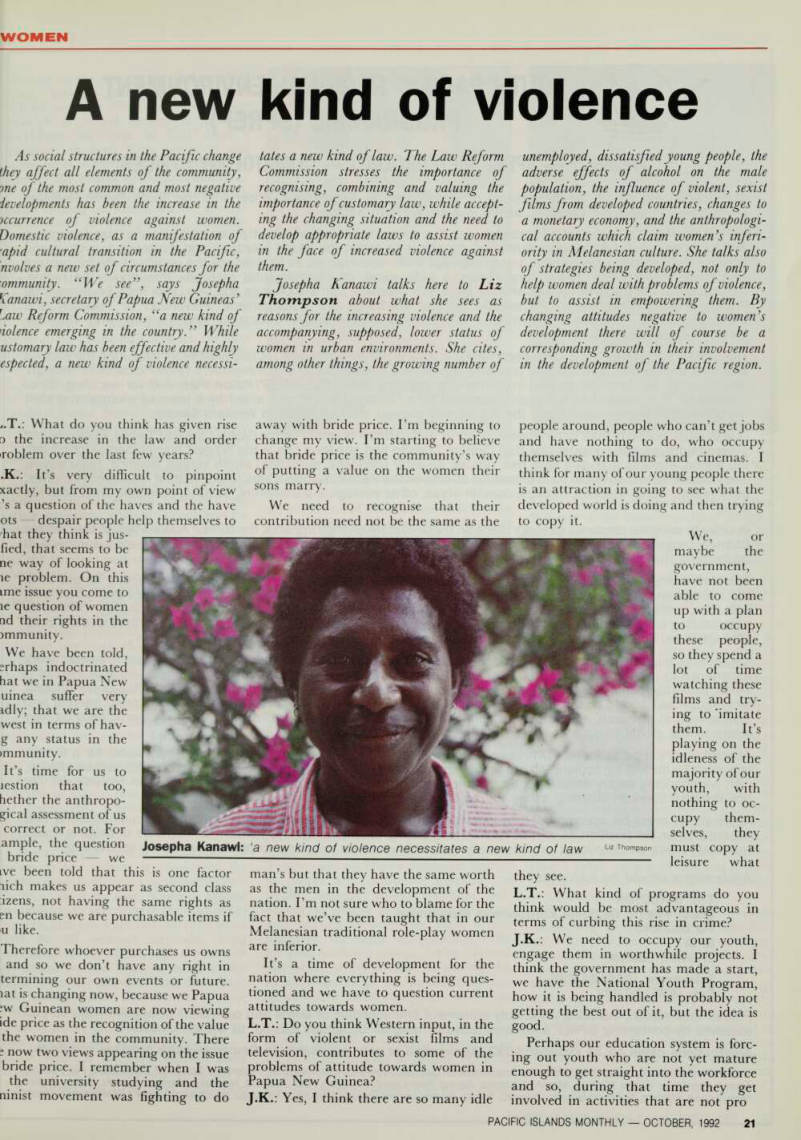
Josepha Kanawi: ‘a new kind of violence necessitates a new kind of law nz Thompson
ductive for the community. Between that time, between getting pushed out of school and the time they are mature enough or skilled enough to join the workforce we have to find them a program to keep them occupied and allow them to feel that they are contribu ting to the benefit of the community.
This is an area which probably needs more looking at, something the govern ment needs to look at more seriously.
With our women the situation is the same, young girls looking for jobs don’t find them easily. It’s even more difficult for them than boys. I’m worried that a trend is developing and girls are walking the streets now.
We have to have special attention given to the young girls between the time they are forced out of school and the time they get into the workforce.
L.T.: What do you think has given rise to the lowering of women’s status in modern Papua New Guinea society?
J.K.: Reliance on cash has played a very influential role in that. Women don’t really need the man to provide for them and the children in a village situation, and so they’re not reliant on their men.
When wives follow their husbands into urban situations, they are dependent for just about everything on that partner.
Women need money for housekeeping, for the children and they cannot escape the violence they have to put up with in the house. Women have to compete with alcohol, when their partner prefers to spend money on alcohol it produces a conflict that promotes violence. Women have to live with that all the time in urban situations, L.T.: How has what you call “the nature of violence” changed?
J.K.: In the villages any fighting is public knowledge and so it’s sanctioned, the men may be violent but they don’t overdo the violence, it’s in the open. In the urban situation the break up of the communal situation, the communal en vironment means people are now living in individual, scattered houses. The public don’t get to impose a public sanction on violence.
Some people believe the beating of wives in our culture is considered the right of the husband. I personally don’t believe that is the case. Violence against women has its sanctions in the traditional society, men can’t just beat up their wives and go off without anybody doing anything about it. Now, with the current situation, women have to resort to the legal system for answers. They don’t have the backup which the community nor mally provides them in the village.
As a result the situation becomes far more difficult for victims of violence.
L.T.: What is the Law Reform body trying to do to relieve this situation?
J.K.: All we can do is to try and create
an awareness of what is available for the women. That is, what assistance the legal system can provide them with. Produc ing leaflets, stating the basic situation, the rights of women. If they want to take the case up in court we outline the procedure for them.
We started a women and law commit tee which is outside the government set up, voluntary and non-government.
We’ve produced leaflets in three lan guages English, Pidgin and Motu,
very simple, providing information
which will start to help women help themselves. One of the reasons women find it difficult to get legal help and legal aid is the public solicitor’s office is too busy defending criminals. They don’t deal with issues relating to women, like domestic violence, maintenance, custody or anything like that.
We aim to make the leaflet simple enough for women to understand, clear enough for them to make their own case if they want to. We’ve produced posters so people are confronted everyday, a public message which we hope will encourage people to rethink the issue of wife beating as being the right of the husband. We carry out seminars, talks for kids, women’s groups, we’ve covered just about every avenue of getting the message across to the public. Our last effort was a video campaign we did in Pidgin, subtitled in Eglish.
We made 700 copies and ran out within months of it being released, so we’re in the process of getting funds to produce more. The campaign continues, helping women, taking them to the court
house, showing them summons papers.
But one of the most important things is a change of attitude, our main focus has to be the whole of Papua New Guinea.
L.T.: Women are becoming more con scious of their role and more active, do you think that a greater involvement of women would contribute to a more stable situation?
J.K.; Yes. I believe that women look at things more simply, women are able to look after their own homes, make sure their children have enough to eat, they are clothed, that they go off to school.
These are small things. Looking at the smaller unit and, I believe, if women can handle that,women have the potential to handle a bigger house, if you like. In Papua New Guinea we have the house of parliament, while men don’t look after the home, I don’t know why they think they have better credentials for handling a bigger home, the national parliament.
I believe women have that instinct, and, on a large scale, may be able to follow that. I think women in decision making situations would be less likely to submit to the temptations of corruption.
Women are beginning to re-assess themselves, to reconsider the role they have to play within the community.
Everybody agrees that in Melanesia women have been the symbol of peace.
With social norms breaking down, sup posed rules of behaviour are all over the place and we don’t know what’s happen ing. I think it’s even more important in these conditions that women’s voices are heard, that they take an equal share in our “democratic” system of government. □
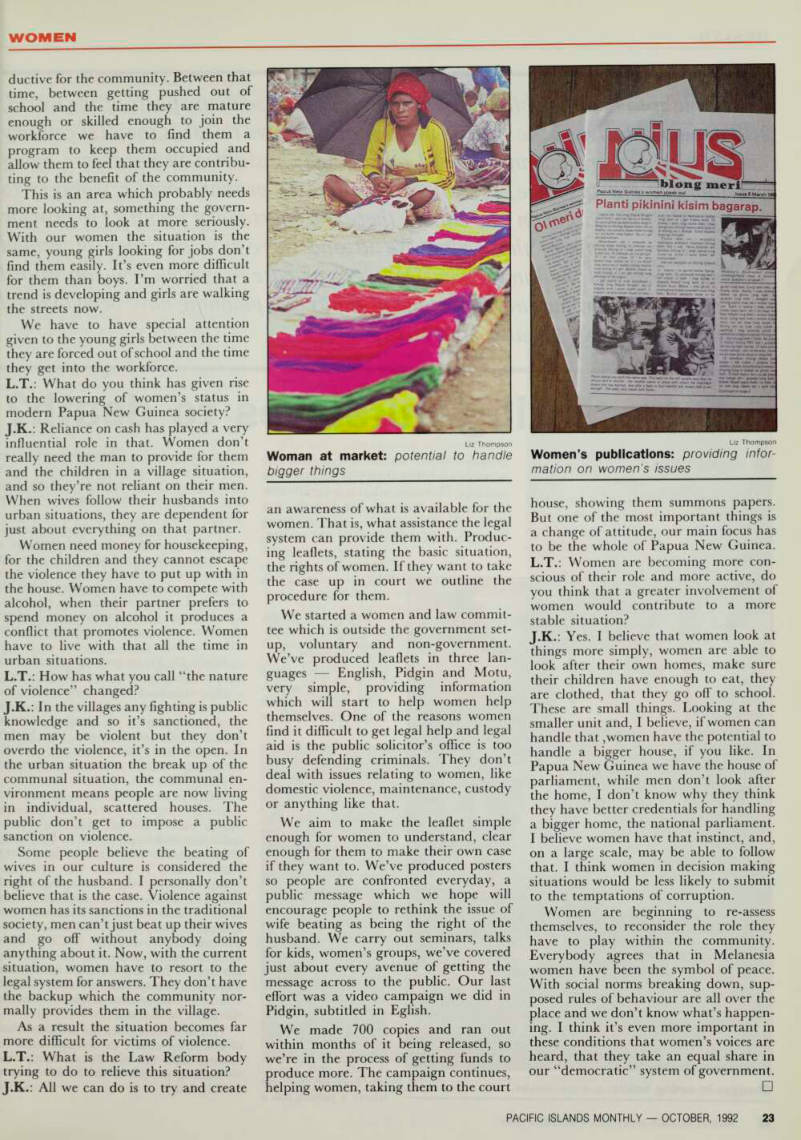
Liz Thompson Woman at market: potential to handle
bigger things
Liz Thompson Women’s publications: providing infor mation on women's issues