It’s a woman’s life
pp. 19-20 · Read in the full issue
Women
By Debbie Singh
“HE BEAT me like the devil . . . when he came home drunk, he broke down the door, I had been sleeping with my three children and he forced himself on me. He had some problem on the street and he came to reciprocate with me ... I hit him hard but didn’t leave a mark. He stabbed me but didn’t kill me”.
The words come from a Dominican woman who has survived domestic violence in one of its higher forms. But the problem of gender violence is not just confined to one particular class or society.
Violence against women is a pattern, a reign of force and terror, not just one physical attack. It involves a number of other tactics such as intimidation, threats, economic deprivation and re peated physical and psychological abuse.
In over 95 per cent of domestic assaults, the man is the assailant. There are rare cases where a woman batters a man and women have been known to kill their attacker after prolonged years of battering. But violence in the home is largely against women in all societies, cultures and ethnic groupings.
Many excuses such as alcohol, jeal ousy, work pressure and anger are used as reasons for wife-battery and violence.
And many myths cloud the reality of the issue as well.
Religion and culture have been used - more than any other reason to defend practices oppressive to women, both in the Pacific and the rest of the world.
While women realise religion and :ulture are necessary to maintain the identity of their societies, they are now beginning to question their destructive aspects.
In the Pacific, the issue of violence was lever publicly debated or questioned mtil recently with the convening of the irst regional workshop on women and /iolence, in Suva, Fiji.
The three-week, Fiji Women’s Crisis
Centre-organised workshop brought
ogether over 30 women from 10 Pacific sland countries which included Kanaky, Pallid, Irian Jaya, Papua New Guinea, Vanuatu, the Cook Islands, Solomons, he Federated States of Micronesia and dji.
A woman from the GABRIELA fem nist lobby group in the Philippines also )articipated in the workshop and gave m outline of the situation of women in icr country, as well.
The workshop discussed and analysed
For the first time in the Pacific the issue of violence against women
is being publicly debated and questioned
forms of violence against women; cam paigns and actions against violence; the women’s movement in the Pacific and Pacific culture in the changing social and political context.
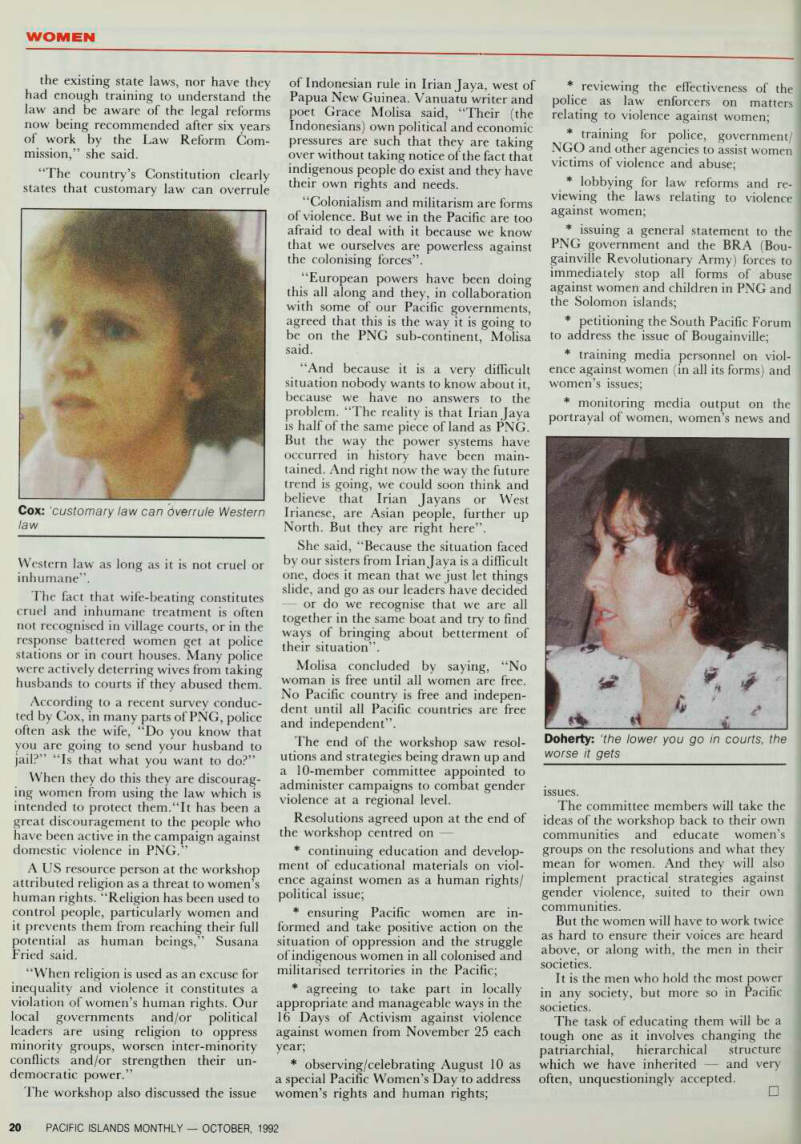
Laws of Pacific countries were also analysed and discussed. Fiji lawyer Imrana Jalal said,“Courts of law are not working for women in many Pacific island nations as they do not recognise women’s special situations.
“Although Fiji’s laws state that all men and women are equal before the law, this does not happen in practice”, Jalal said.
Under the current laws, happenings in the home, such as violence against women is not considered a criminal offence, while what happens outside the home is.
On the related topic of whether the justice system works for women, Papua New Guinea’s first and only woman judge, Theresa Doherty, said, “In our courts women and young people and the less educated are not as well treated by the courts as the better educated mem bers of the society.”
This was especially so in the lower courts. “The lower you go in courts, the worst it gets for women. “When it comes to bride price or compensation payments there is no limit to the amount that the village court will set,” Judge Doherty said.
Elizabeth Cox, a PNG development worker, told the workshop over 60 per cent of women are beaten by their partners, and wife and girlfriend beating is commonly accepted by both men and women in PNG communities.
She discussed studies of hospital, court and welfare records by the PNG Law Reform Commission, as well as case studies which showed 66 percent of rural and 100 percent of highland wives are beaten in the country. Cox also cited an example of gender violence from Bou gainville and said, “The government hoped to end the war (on Bougainville) by sending in the army, but the soldiers could not find any of the Bougainville Revolutionary Army rebels and so they turned on the women raping and beating them.
“Then they began using women to get back at the men. They would collect women, stand them in a circle, strip them
and make them perform sexual acts. Now gang rapes are more prevalent and all these contribute to violence against women”, Cox said.
She also criticised the type of custom ary law being practised in PNG, particu larly by male village court magistrates.
She said the laws were heavily biased and discriminatory against women and many women were being wrongfully and il legally imprisoned as a result.
“This is because village court magis trates do not understand the relationship between customary laws as opposed to
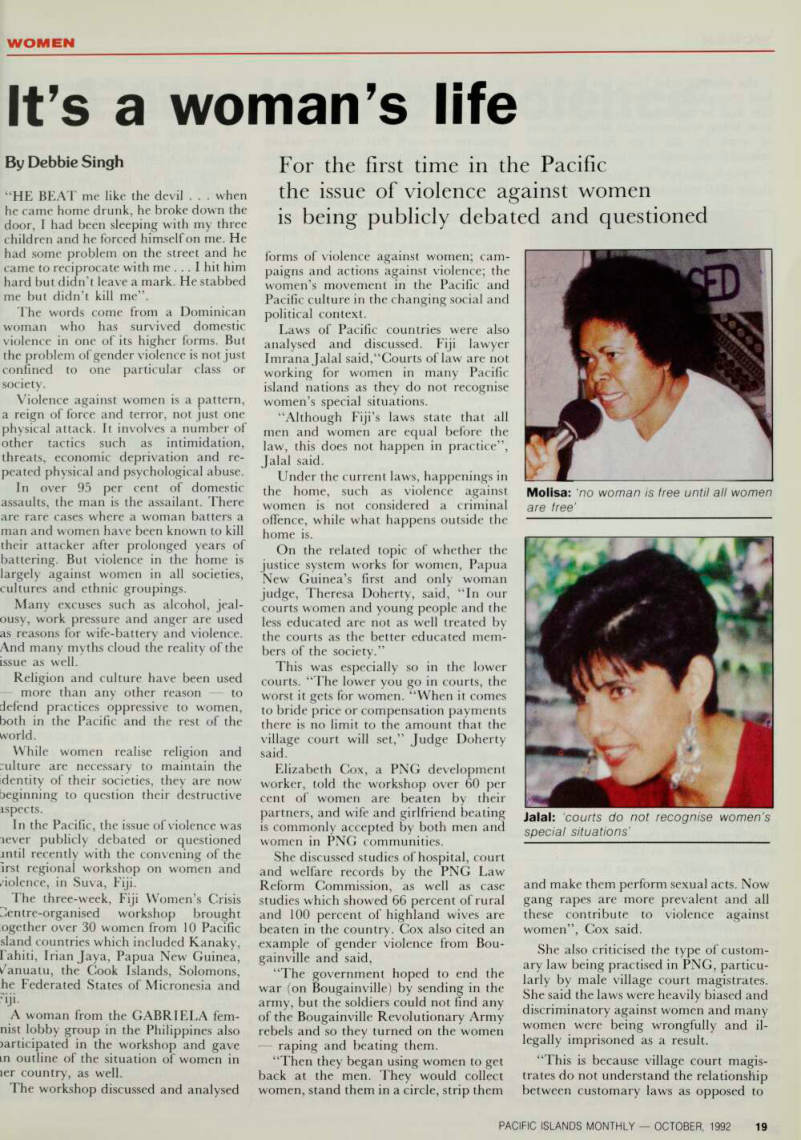
Molisa: no woman is free until all women are free’
Jalal: courts do not recognise women's special situations’
the existing state laws, nor have they had enough training to understand the law and be aware of the legal reforms now being recommended after six years of work by the Law Reform Com mission,” she said.
“The country’s Constitution clearly states that customary law can overrule
Western law as long as it is not cruel or inhumane”.
The fact that wife-beating constitutes cruel and inhumane treatment is often not recognised in village courts, or in the response battered women get at police stations or in court houses. Many police were actively deterring wives from taking husbands to courts if they abused them.
According to a recent survey conduc ted by Cox, in many parts of PNG, police often ask the wife, “Do you know that you are going to send your husband to jail?” “Is that what you want to do?”
When they do this they are discourag ing women from using the law which is intended to protect them.“lt has been a great discouragement to the people who have been active in the campaign against domestic violence in PNG.”
A US resource person at the workshop attributed religion as a threat to women’s human rights. “Religion has been used to control people, particularly women and it prevents them from reaching their full potential as human beings,” Susana Fried said.
“When religion is used as an excuse for inequality and violence it constitutes a violation of women’s human rights. Our local governments and/or political leaders are using religion to oppress minority groups, worsen inter-minority conflicts and/or strengthen their un democratic power.”
The workshop also discussed the issue
of Indonesian rule in Irian Jaya, west of Papua New Guinea. Vanuatu writer and poet Grace Molisa said, “Their (the Indonesians) own political and economic pressures are such that they are taking over without taking notice of the fact that indigenous people do exist and they have their own rights and needs.
“Colonialism and militarism are forms of violence. But we in the Pacific are too afraid to deal with it because we know that we ourselves are powerless against the colonising forces”.
“European powers have been doing this all along and they, in collaboration with some of our Pacific governments, agreed that this is the way it is going to be on the PNG sub-continent, Molisa said.
“And because it is a very difficult situation nobody wants to know about it, because we have no answers to the problem. “The reality is that Irian Jaya is half of the same piece of land as PNG.
But the way the power systems have occurred in history have been main tained. And right now the way the future trend is going, we could soon think and believe that Irian Jayans or West Irianese, are Asian people, further up North. But they are right here”.
She said, “Because the situation faced by our sisters from Irian Jaya is a difficult one, does it mean that we just let things slide, and go as our leaders have decided or do we recognise that we are all together in the same boat and try to find ways of bringing about betterment of their situation”.
Molisa concluded by saying, “No woman is free until all women are free.
No Pacific country is free and indepen dent until all Pacific countries are free
and independent”.
The end of the workshop saw resol utions and strategies being drawn up and a 10-member committee appointed to administer campaigns to combat gender violence at a regional level.
Resolutions agreed upon at the end of the workshop centred on * continuing education and develop ment of educational materials on viol ence against women as a human rights/ political issue; * ensuring Pacific women are in formed and take positive action on the situation of oppression and the struggle of indigenous women in all colonised and militarised territories in the Pacific; * agreeing to take part in locally appropriate and manageable ways in the 16 Days of Activism against violence against women from November 25 each year; * observing/celebrating August 10 as a special Pacific Women’s Day to address women’s rights and human rights;
* reviewing the effectiveness of the police as law enforcers on matters relating to violence against women; * training for police, government/ NGO and other agencies to assist women victims of violence and abuse; * lobbying for law reforms and re viewing the laws relating to violence against women; * issuing a general statement to the PNG government and the BRA (Bou gainville Revolutionary Army) forces to immediately stop all forms of abuse against women and children in PNG and the Solomon islands; * petitioning the South Pacific Forum to address the issue of Bougainville; * training media personnel on viol ence against women (in all its forms) and women’s issues; * monitoring media output on the portrayal of women, women’s news and
issues.
The committee members will take the ideas of the workshop back to their own communities and educate women’s groups on the resolutions and what they mean for women. And they will also
implement practical strategies against
gender violence, suited to their own communities.
But the women will have to work twice as hard to ensure their voices are heard above, or along with, the men in their societies.
It is the men who hold the most power in any society, but more so in Pacific societies.
The task of educating them will be a tough one as it involves changing the patriarchial, hierarchical structure which we have inherited and very often, unquestioningly accepted.
Cox: ‘customary law can Overrule Western law
Doherty: ‘the lower you go in courts, the worse it gets