Famine of knowledge
pp. 26-27 · Read in the full issue
By David North
Infants in the Marshall Islands are dying of malnutrition. Palauan adults
suffer from hypertension, highblood
pressure and heart problems.
Nauruans have the highest per capita incidence of diabetes of any nation in the world.
These ailments are not due to a lack of nutritious food. They are caused by a famine of knowledge - a severe lack of public education about the nutritional value of foods, coupled with a “prestige food syndrome” left over from the colonial past.
According to a United Nations study of nutrition for the Republic of the Marshall Islands, in one month of 1990, 14 children died in Majuro - the capital island - of illnesses related to malnutriton. Overall, about 65 percent of the children surveyed were under nourished, many being severely malnourished. The UNICEF survey, done with the Marshall’s government, also found serious nutritional problems in youths seven to 14, young men 15 to 18, and women in the 30 to 34 and 45 to 49 age ranges. The most severe malnutrition was found among the one to two-year old children. Children under one year of age showed the lowest incidence of malnutrition, the survey stated, because
breastfeeding is still prevalent.
About 5000 people out of the islands’ total population 0f46,000 were surveyed.
A total of 1700 preschool-age children in the islands were found to suffer from moderate to severe malnutrition and 3000 others were underweight. Neither money, standards of living, nor urbanization are the chief causes of the problem, according to the authors of the report, Dr. Neal Palafox, Marshalls medical director for preventive health, and Dr. Emilie Flores, a UNICEF physician. Flores attributed the major cause to ignorance parents are feeding their children junk food. In both urban and rural settings, parents buy sodas, cereals, candy and cakes - food heavy in sugar and fat content for their children, instead of more nutritious food.
The education level of parents is a major factor. Families with adults who had no formal education had higher incidence of moderate and severe malnu trition. Children of parents who had at least nine years of schooling had more nearly normal weights. The survey warned the local government that wide spread malnutrition can perpetuate itself
A severe lack of public knowledge coupled with a “prestige food syndrome” is causing serious nutritional problems in the islands
unless there is substantial expansion of community education and increased growth monitoring programs. Poor nu trition leads to poor performance at school, and under-nourished children have a higher incidence of leaving school early. When these teenagers dropout, knowing little or nothing about nu trition, the problem is perpetuated as they have babies.
In Nauru, one out of four islands faces the real possibility of hypertension, stroke, heart attack, or kidney failure, according to Dr Boyd Swinburn. These problems are a direct result of diabetes, which is caused by obesity, among other things. Nauruans are 12 times more likely to suffer from diabetes than Caucasians. “Fat kills and Nauruans, and other Pacific islanders eat more fat than most Caucasians do,” he said.
Based on his studies of the Nauru nutritional problem, Swinburn believes social pressure to eat high fat content food and to eat in excess of nutritional requirements is the major cause of the high rate of diabetes. In addition to the abundance and availability of Western “junk food” and alcohol, pork and even coconut meat, when taken in excess, lead to obesity and diabetes. Alcohol is especially detrimental because in ad dition to its fat content, it damages the
pancreas, an organ important in warding off diabetes.
Swinburn believes diabetes and the many serious cardio-vascular illnesses associated with it constitute the most serious public health issue facing Pacific islanders. Based on his research in Rarotonga and New Zealand as well as earlier studies of Pima Indians in the southwestern United States, Swinburn believes a return to more traditional diets or a change in “modern life-style” diets is the answer. In either case, the local governments need to drastically improve public education about nutrition, especi ally about the relative nutritional values of imported foods.
Dr. Vincent Yano, a Palaun physician, could not agree more. For years he has been trying to persuade his patients suffering from diabetes, hypertension, and arteriosclerosis to “eat your local food. Canned food should be used only as a substitute when fresh food isn’t available. Full of salt and chemicals, canned food can never take the place of fresh island food”.
Yano told a South Pacific Commission Sub-regional Conference for Women held in Palau last year that “malnu trition in the Pacific today results not because of war or famine, but because Palauans and other Pacific islanders
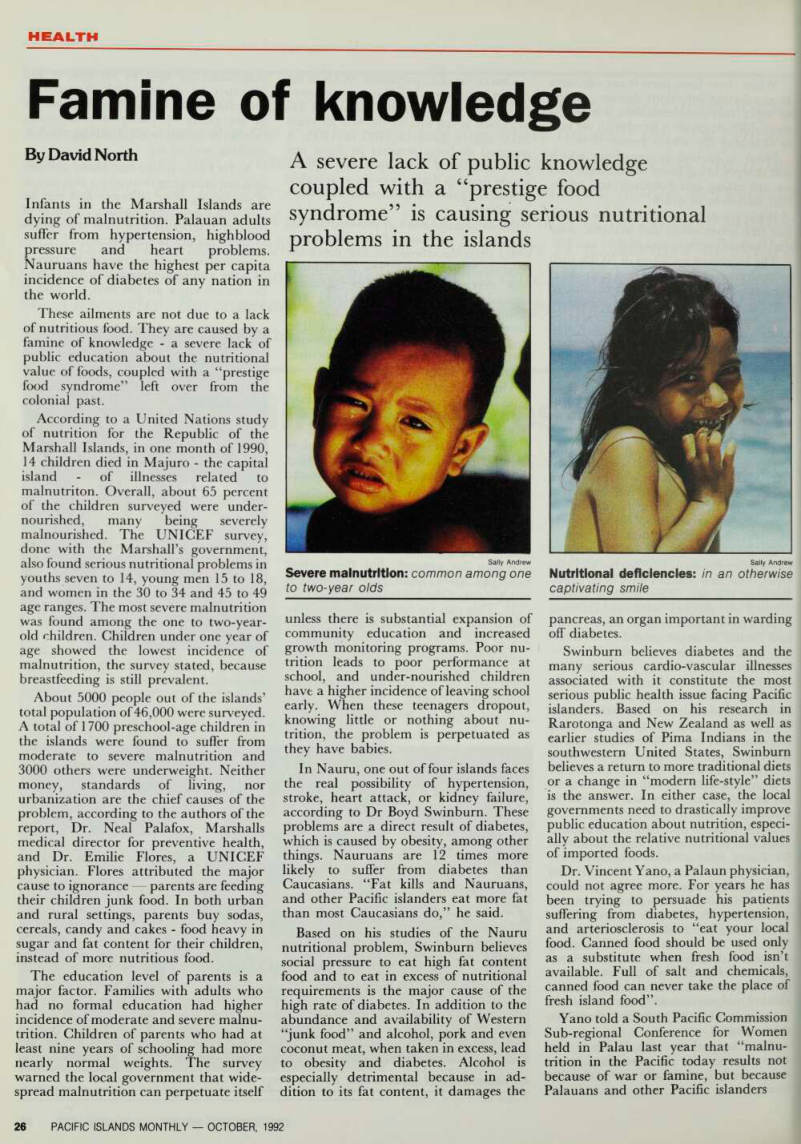
Sally Andrew Severe malnutrition: common among one to two-year olds
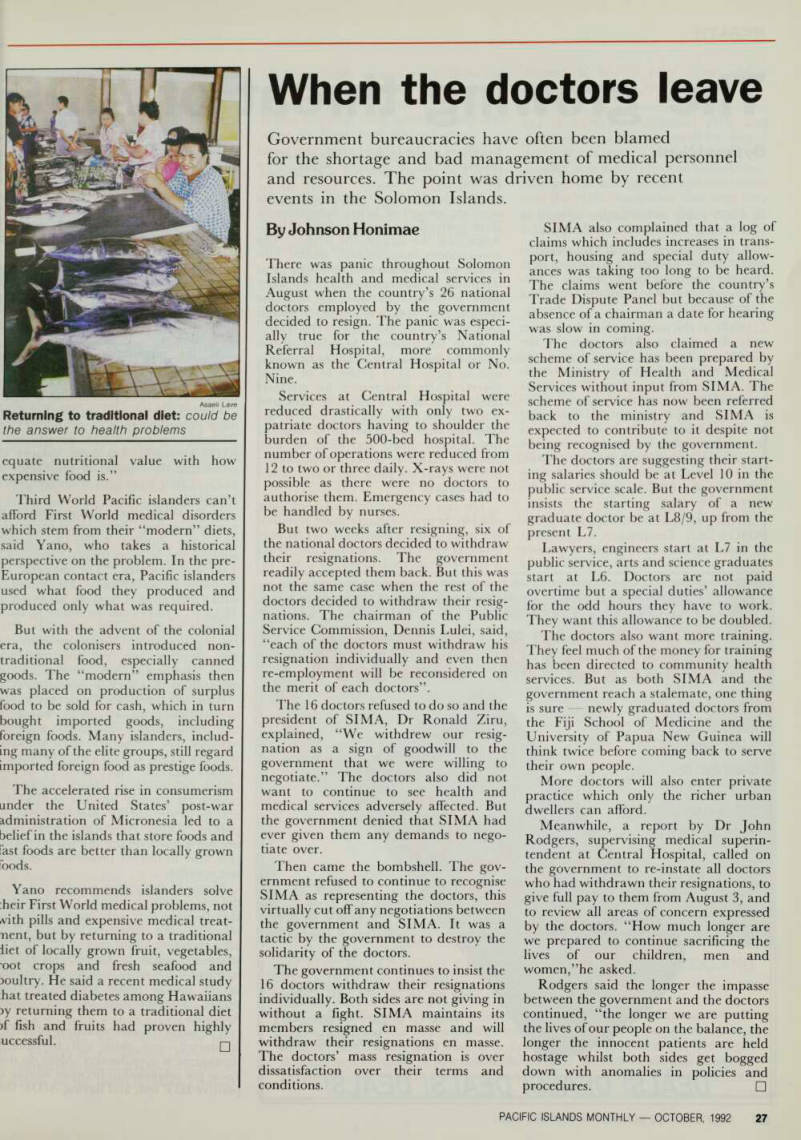
Sally Andrew Nutritional deficiencies: in an otherwise captivating smile
equate nutritional value with how expensive food is.”
Third World Pacific islanders can’t afford First World medical disorders which stem from their “modern” diets, said Yano, who takes a historical perspective on the problem. In the pre- European contact era. Pacific islanders used what food they produced and produced only what was required.
But with the advent of the colonial era, the colonisers introduced non traditional food, especially canned goods. The “modern” emphasis then was placed on production of surplus food to be sold for cash, which in turn
bought imported goods, including
foreign foods. Many islanders, includ ing many of the elite groups, still regard imported foreign food as prestige foods.
The accelerated rise in consumerism under the United States’ post-war administration of Micronesia led to a belief in the islands that store foods and fast foods are better than locally grown bods.
Yano recommends islanders solve :heir First World medical problems, not -vith pills and expensive medical treat ment, but by returning to a traditional iiet of locally grown fruit, vegetables, oot crops and fresh seafood and xmltry. He said a recent medical study hat treated diabetes among Hawaiians )y returning them to a traditional diet )f fish and fruits had proven highly uccessful. |-j
Asaeli Lave Returning to traditional diet: could be the answer to health problems