Competing
pp. 39-42 · Read in the full issue

Fiji
Competing and Niche Marketing
Supply and demand are the usual dictators of market price normally.
Fiji’s banking industry however does not seem to be holding true to this theory.
Despite current high levels of liquidity commercial bank lending rates remain the same and the banks are not going out of their way to encourage borrowing.
The amount of “excess money” or money which banks cannot lend has risen from 50.4 million in the first quarter of 1991 to around S3O million currently.
The banks do not seem concerned, and have provided no real incentive to borrow. Basically the banks are saying there is no demand for it with no viable
proposals coming forward.
But at a time when the economy is showing signs of an up-swing it might have been expected the banks would make it easier for people to borrow to encourage economic growth.
The best explanation is probably that Danks are unwilling to drop rates because hey feel they won’t get volume business.
However the commercial banks are )eing accused by some sectors of Fiji’s
)usiness community of stifling economic
levelopment by keeping lending rates
ligh.
Fiji Chamber of Commerce secretary lay Dunstan said Fiji’s basic interest ate has been set at 13.5 per cent for far oo long. He said this standard rate hould be reduced by about three per ent which would be more realistic, dding interest rates have been falling enerally in neighbouring countries such s Australia and New Zealand.
Dunstan accused the banks of working sgether since interest rates were eregulated in 1987 to keep these rates rtificially propped up. He said it was all ght for the big businesses as they could egotiate interest rates with the banks ut it was the small businesses and the ewcomers to business who were stuck ith the 13.5 per cent rate.
Claims by the Association of Banks in iji that there is fierce competition mong the banks are untrue, according ► Dunstan. He said rates would be much ore competitive if there really was emendous competition.
“If there was real, genuine compe tition as claimed by some banks, I am certain one bank or other would start to give a slightly better interest rate. They would start to drop their interest rates a little bit to get more business,” said Dunstan.
“The fact that it hasn’t come down; the fact that all the commercial banks are locked in to this same percentage figure indicates to me that there is basically a little cartel they are operating.”
The banks, however, are disputing Dunstan’s claims that they are locked into the same interest figure, saying their rates commercial rates especially are competitive. Westpac for example says its ceiling for commercial lending is 12.5 per cent and is not stuck at 13.5 per cent as Dunstan claims. According to the banks, cane farmers are usually given special rates.
The banks are also saying although the high liquidity levels have seen interests on term deposits come down, interest rates on lending have also come down
accordingly.
Competition among the four main commercial banks has dropped signifi cantly since Australia and New Zealand
Banking Group bought out the Fiji
operations of Bank of New Zealand in 1990.
The main commercial banks in Fiji are ANZ with the biggest market share,
followed by Westpac Banking Corpor
ation, the National Bank of Fiji and India’s Bank of Baroda. Last year Pakistan’s Habib Bank set up shop in the country but only has a very small share of the retail accounts. And The commer cial banks seem comfortable with the market share they each have.
Fiji’s minister of finance, Paul
Manueli, recently called on commercial banks to lower their interest rates but they say rates will fall automatically in response to market forces.
According to Dunstan the banks claim dropping interest rates will not generate more business for them. He said this may have been so two or three years ago but in the last two years economic develop ment in the country had advanced and there were many possible businesses “on hold” who would probably be stimulated into action if they could get a favourable interest rate.
“I call a favourable interest rate having a ten-and-a-half per cent maxi mum, and bigger ventures could prob ably negotiate a little bit down from that,” Dunstan said.
He did not see the recent establish ment of new financial institutions including the Habib Bank affecting commercial banks. He said there was a need in the market for these merchant banking, leasing, hire purchase and other services but usually very high interest rates on these services were charged. He did not see them forcing the commercial banks to reduce their interests rates.
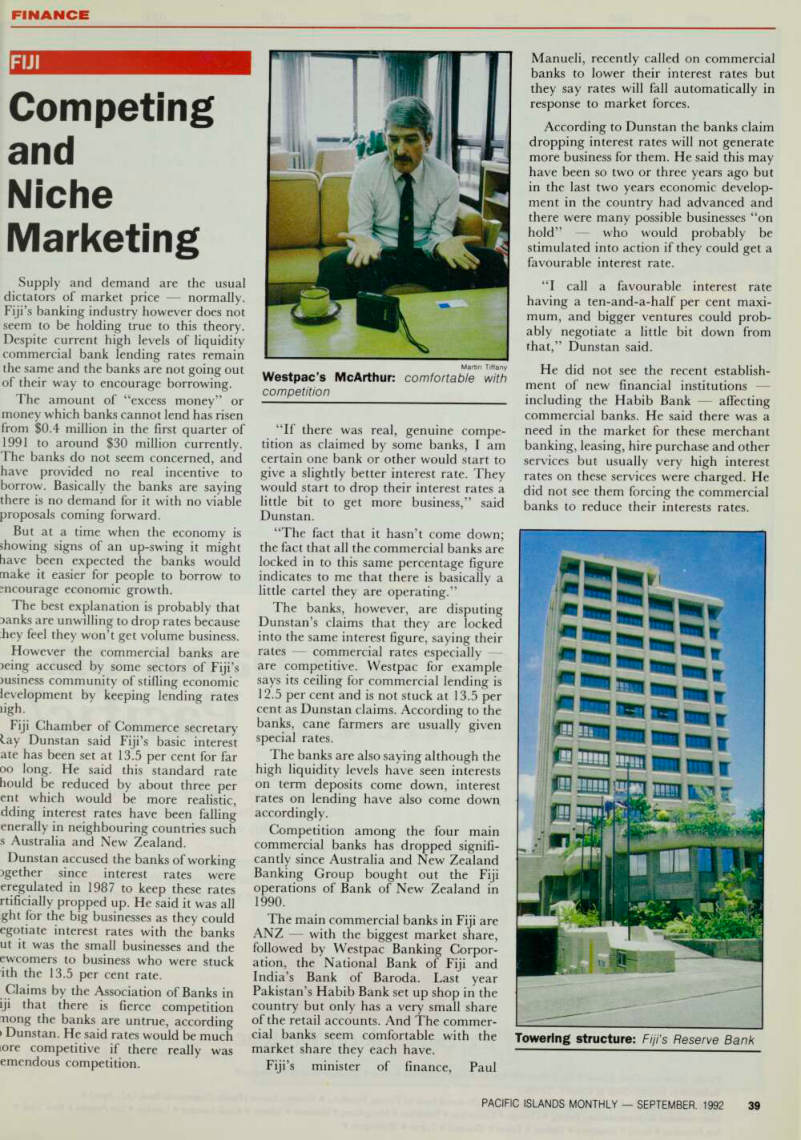
Martin Tiffany Westpac’s McArthur: comfortable with competition
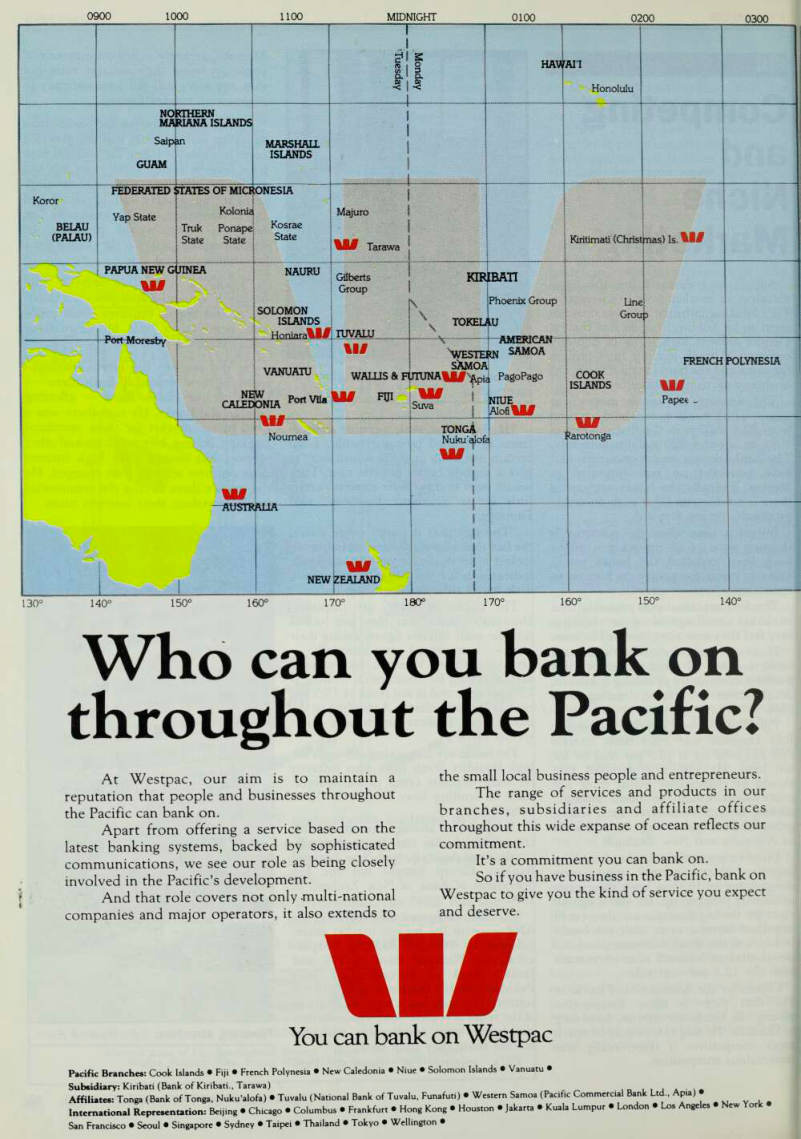
Towering structure: Fiji's Reserve Bank
But it is perhaps a sign that the Fiji economy is picking up and expanding when these overseas finance institutions are willing to set up operations in the country.
In the less than two years one commercial bank and three financial institutions have set up here and indi cations are others have an eye on Fiji.
Commercial banks do not see any threat from the new set ups, saying they basically have a long-established cus tomer relationship.
The new financial players do not see themselves as too much of a threat to the banks as they say they are filling a required niche in the market. But the bottom line is that both old and new institutions on the scene provide services involving cash which has to be borrowed from one and lent to another.
Pakistan’s Habib Bank started this renewed interest in Fiji’s finance sector when it set up operations in Suva a little over a year ago. The bank is obviously not trying to muscle-in on the retail market. Habib’s chief manager Fiji, Matin, said the bank mainly dealt n trade finance and customer advances md only had a small percentage of retail iccounts. The bank is obviously happy vith business so far as Matin is talking ibout expansion within Fiji once it has established itself in Suva.
The 51 -year-old Habib Bank Paki tan’s oldest has a large global letwork comprising 66 overseas branches nd a number of subsidiaries and epresentative offices. These stretch from Bahrain to the United Kingdom and "om Mauritius to Australia. So why Fiji?
Matin’s answer is simple. “We have a ood global network which we wanted to xpand to the Pacific and Fiji is a good usiness centre.”
Over the years Citibank, Britain’s
arclays Bank, Hong Kong and Shang
ai Bank and more recently the Bank of ew Zealand have come and gone from iji’s financial scene. (Although BNZ’s allout had more to do with problems at 3me than trouble in Fiji.) They have >me, tried to get their returns, failed to ?t enough to justify their presence and ft.
This left the four commercial banks, le merchant bank and the various other lancial institutions in a fairly imfortable position. Now, in little over year, Habib, Malaysia’s MBf Finance Thad and Papua New Guinea’s Credit Drporation have set up shop in Fiji and uld give the established institutions a
allenge.
Also set to begin operations on the first of this month is Asset Management (Fiji) Limited, a merchant banking institution.
It is being set up by MBfs former president of South Pacific operations, Alex Lovell, who was responsible for setting up MBfs Fiji operation late last year.
But what can these new kids on the block offer and how much of a threat will they be?
Perhaps the commercial bank most under threat from the new boys is the state-owned National Bank of Fiji (NBF) which owns 51 per cent of MBfs Fiji operation National MBf Finance (Fiji) Limited.
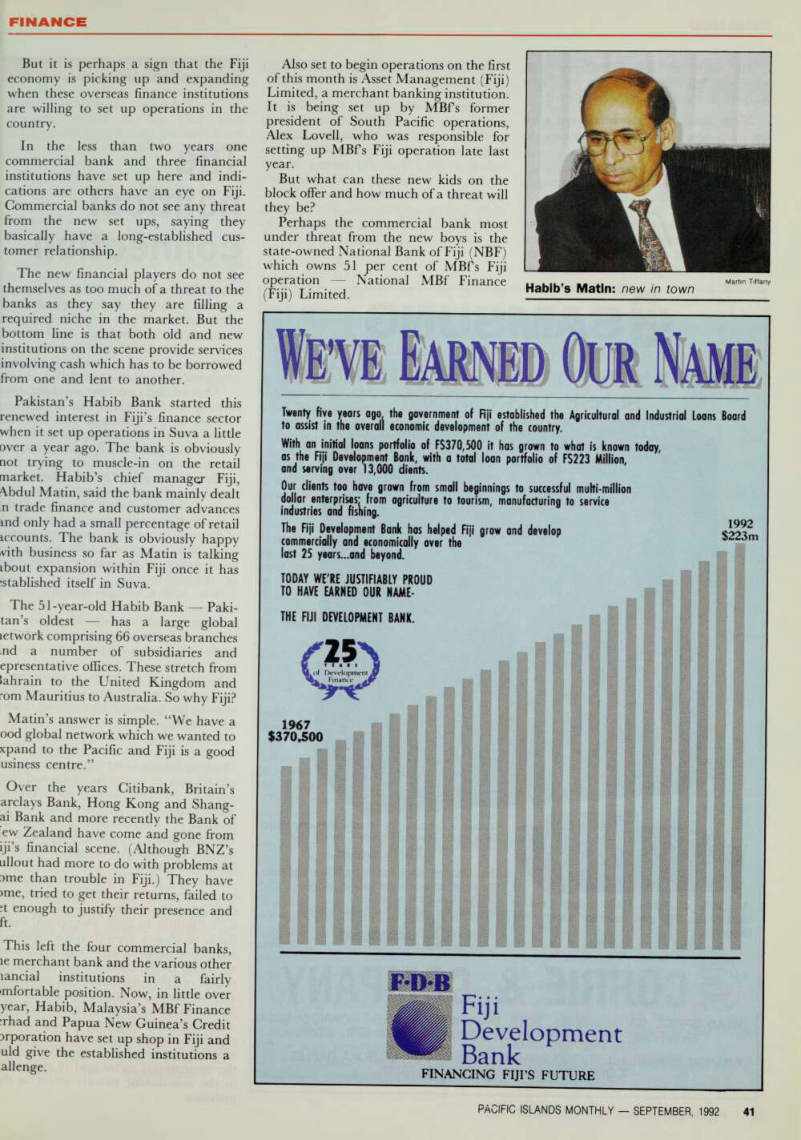
Martin Tiffany Habib's Matin: new in town
So, with all this confidence and expected growth where do the new players in the financial scene fit in?
Niche marketing is a term used a lot by the new financial institutions to explain why they are in Fiji.
But is there any more potential for these niche market players and are any more eyeing Fiji?
Yes, according to McArthur. “There are other banks we are aware of which are looking but the market in Fiji is only so big, so you’ve got to have a resonable
sort of representation and network to get synergy.
“I am sure others will come as they try and service their own clients but they will probably tend to be niche markets.
When there is a capital market estab lished in Fiji, that will attract certain niche players but they won’t necessarily be banks - not traditional retail banks, there will be advisors, people coming in providing advice rather than full bank ing services,” explained McArthur. □