Cashingin
pp. 34-38 · Read in the full issue
Finance
Ed Rampell
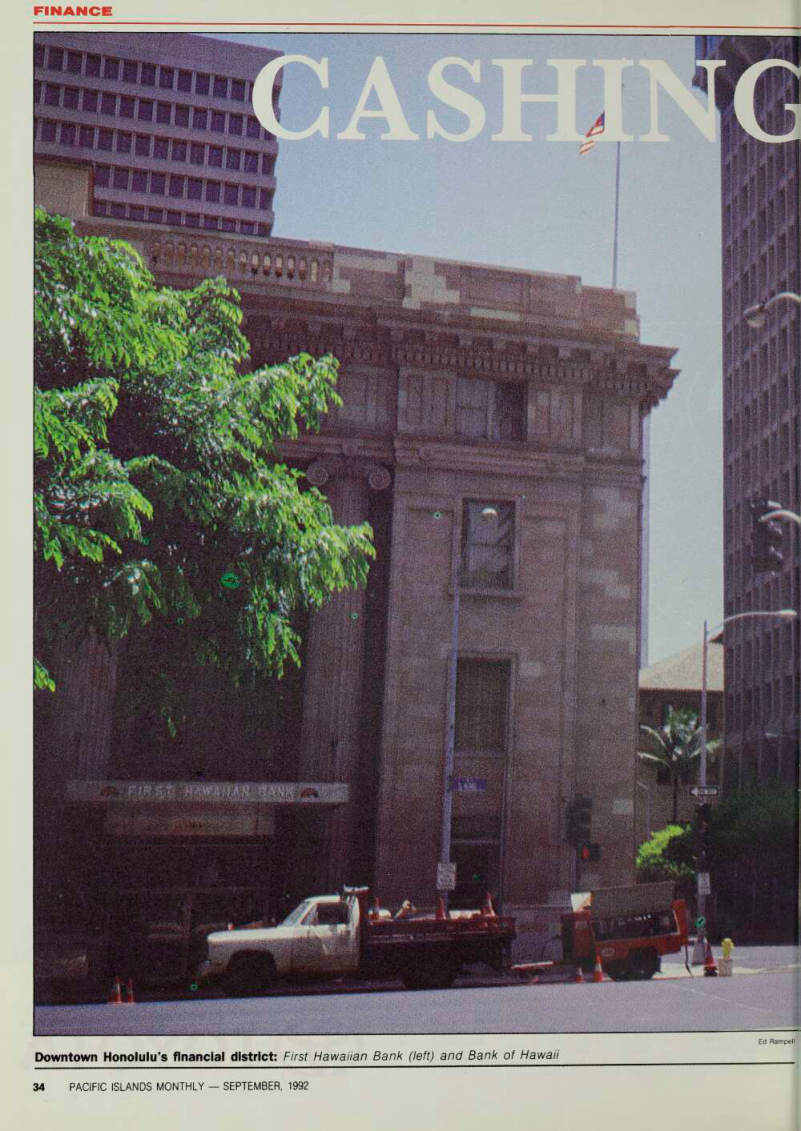
Downtown Honolulu’s financial district: First Hawaiian Bank (left) and Bank of Hawaii
Hawaii
The Boys on Merchant Street
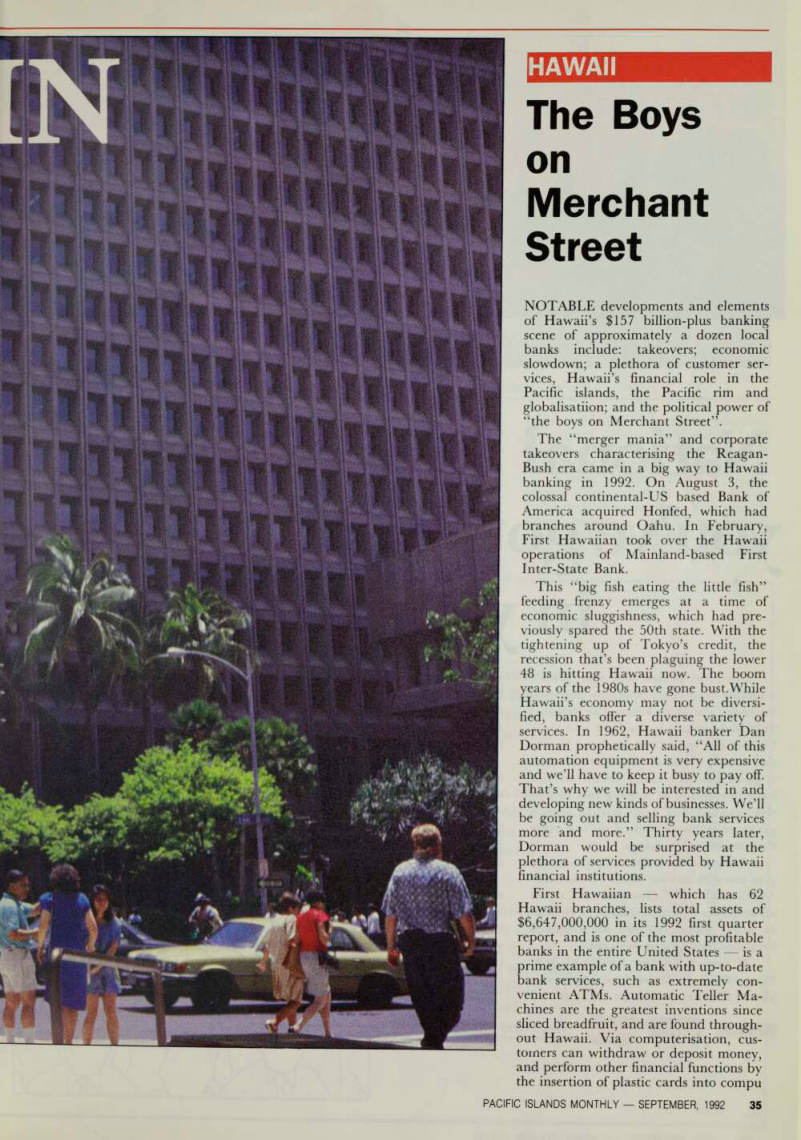
NOTABLE developments and elements of Hawaii’s $157 billion-plus banking scene of approximately a dozen local banks include: takeovers; economic slowdown; a plethora of customer ser vices, Hawaii’s financial role in the Pacific islands, the Pacific rim and globalisatiion; and the political power of “the boys on Merchant Street”.
The “merger mania” and corporate
takeovers characterising the Reagan-
Bush era came in a big way to Hawaii banking in 1992. On August 3, the colossal continental-US based Bank of America acquired Honfed, which had branches around Oahu. In February, First Hawaiian took over the Hawaii operations of Mainland-based First Inter-State Bank.
This “big fish eating the little fish” feeding frenzy emerges at a time of economic sluggishness, which had pre viously spared the 50th state. With the tightening up of Tokyo’s credit, the recession that’s been plaguing the lower 48 is hitting Hawaii now. The boom years of the 1980 s have gone bust. While Hawaii’s economy may not be diversi fied, banks offer a diverse variety of services. In 1962, Hawaii banker Dan Dorman prophetically said, “All of this automation equipment is very expensive and we’ll have to keep it busy to pay off.
That’s why we v/ill be interested in and developing new kinds of businesses. We’ll be going out and selling bank services more and more.” Thirty years later, Dorman would be surprised at the plethora of services provided by Hawaii financial institutions.
First Hawaiian which has 62 Hawaii branches, lists total assets of $6,647,000,000 in its 1992 first quarter report, and is one of the most profitable banks in the entire United States is a prime example of a bank with up-to-date bank services, such as extremely con venient ATMs. Automatic Teller Ma chines are the greatest inventions since sliced breadfruit, and are found through out Hawaii. Via computerisation, cus tomers can withdraw or deposit money, and perform other financial functions by the insertion of plastic cards into compu
ter terminals, and at the touch of a key.
ATMs are not only found outside and adjacent to most Hawaii banks, but at shopping centres, supermarkets, and the like, and unlike bank tellers many are available 24 hours a day. First Hawaiian also features the following services, Teller Phone, which allows “banking at your fingertips” via the telephone, like “loan by phone”; drive through banking from your car; credit cards, such as Mastercard and Visa; IRA retirement programs; investment moni tor accounts, which, like brokers, struc ture portfolios of top mutual funds; tax shelter information; special, streamlined lease and loan arrangements; PayAnyDay, which allows customers to repay loans to First Hawaiian any day of the month instead of on a fixed date; personal checking accounts; Allin One Statements, computerized print outs
detailing monthly deposits, checking,
etc., at a glance; error-free performance guarantee, providing customers $lO per bank mistake; several interest bearing savings plans; real estate functions; trust services, such as estate planning assist ance at no charge; wire transfers; foreign
currency exchange; travellers’ cheques;
money orders; letters of credit; and more, like the typical U.S. bank, accounts ire insured up to $lOO,OOO by the
Federal Deposit Insurance Corp.
First Hawaiian and Bank of Hawaii are the Aloha state’s giants (although the entry of Bank of America and changes in U.S. interstate banking laws may change the picture). According to Business Week Magazine, First Hawaiian is among the top 10 most profitable, steadiest earner, and safest lender U.S. banks, Bankoh (Bank of Hawaii) ranks among the top 10
safest lenders. Both have branches throughout the archipelago and Oceania. Bankoh, for example, has branches at: American Samoa, Guam (3), Kosrae, Majuro, Palau, Pohnpei, Saipan, Yap, plus at Hong Kong, Philippines, Nassau, New York, South Korea, Singapore, and Tokyo. Bankoh also is affiliated with: Bank of Tonga, Banque de Nouvelle Caledonie, Banque
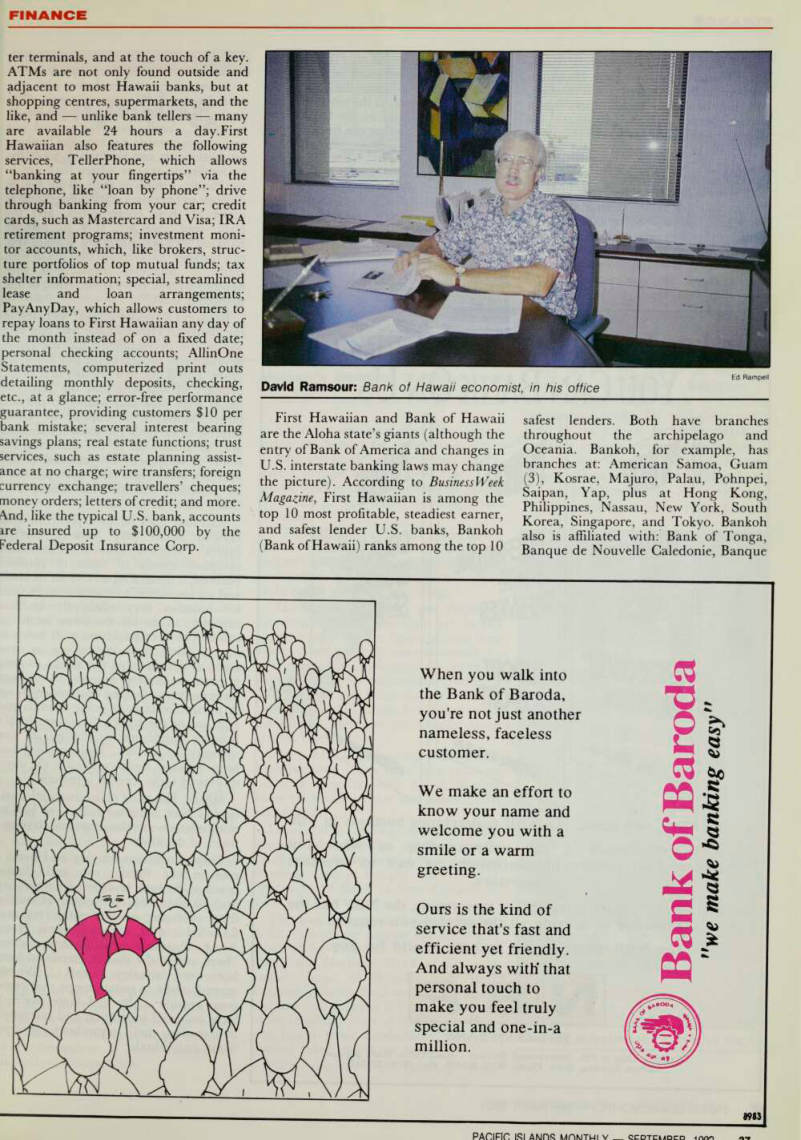
David Ramsour: Bank of Hawaii economist, in his office
Ed Rampell
de Tahiti, Pacific Commercial Bank, Ltd., Western Samoa. First Hawaiian has two Guam branches, a Tokyo office, and, like Bankoh’s Nassau operation, a foreign branch at the Caymans for offshore banking for tax haven purposes.
Are all of the services listed above available at the Pacific island branches?
David Ramsour senior vice president and chief economist of Bankoh candidly says: “What you are really talking about in the Pacific islands quite often is like trying to run a restaurant of major proportions in a community of 100 people. There is simply no way you can support more than one restaurant, and even that one tends to be relatively
expensive on a per customer basis. So the result is, in most instances in the Pacific islands, you have no more than one bank, or maybe two banks at the most, that can survive and pay staff on the basis of the amount of business that can be generated in that community. This means also that per customer charges tend to be higher and those aspects of banking in a small community always seem to be more of an issue for the clients in a small community than they are in larger communities.”
The economist adds that Bankoh’s Pacific island branches are “not profit able in the same sense a bank operation in a large community such as in this state may be ... The basis, the justification for
those operations in these'small communi ties are the relationships that participants in those communities have with the marketplace in Hawaii or some other part of the Pacific. The service we prefer to offer ... really revolves around our capacity to provide a network of banking establishments and facilities to serve the customer, no matter where they are in the Pacific. I think on their own it’s quite difficult to operate a stand alone bank in many of these communities, and the basic way you are able to provide banking services is justified on the basis of a broader marketplace that ties in with trade or financial transactions with another part of the Pacific, Asia, or the mainland USA.”
Bankoh’s Ramsour states: “Very few of the banks in Hawaii have had any role within the development, uh, the resort development process of the last five to six years. This is due to a number of reasons, primary of which is that the Japanese banks were able and willing to provide larger amounts of capital at lower interest rates than the local institutions and so almost all of the financing for resort development by Japanese of the past five to six years have been provided by Japanese financial institutions and that’s where it remains.”
Ramsour goes on to explain the role Hawaii banks play vis-a-vis foreign capital: “When a Japanese or Australian company comes to town to conduct business, it needs a repository for its funds and an institution to transfer funds. And we function very effectively in that capacity, as do all the other banks in town. The foreign investor in town is simply using these institutions as con duits, and holders of the assets, as they prepare to develop projects or conduct business in one fashion or another, so we do see the coming and going of funds into and out of the banks. But there hasn’t been a fundamental change in our capacity to perform business that has been affected significantly by the con ditions of these foreign investors.”
Hence, Hawaii’s main financial insti tutions play a passive role at best as middleman in the economic develop ment of the state.
Despite constant braying on Hawaii’s role in the Pacific rim and Pacific century, the local bourgeoisie’s insularity and passivity has prevented Honolulu
from emerging as a dynamic regional
financial center, as an Oceania Hong Kong. Ramsour says Bankoh focuses “here and in the Pacific islands on local borrowers, industry, clients ... We do extend credit to some groups that come from outside ... By and large, we’re a local financial institution and interested in extending credit to productive groups, firms, individuals.