Guadalcanal
pp. 33-35 · Read in the full issue
Anniversary
The Battle of Guadalcanal
By Carole Bellacera
The marines had a nickname for it.
Starvation Island. But that name hadn’t yet been earned when the Americans caught their first glimpse of Guadalca nal.
Fifty years have passed since the Allied landing on Guadalcanal, one of the islands in the South Pacific Solomon chain. No one knew at the time that the invasion would turn out to be a pivotal point of the war in the Pacific.
America’s forces in the Pacific had suffered one devastating loss after an other since Japan’s surprise attack on Pearl Harbour in December 1941. The Empire of the Rising Sun appeared to be invincible. But with the sinking of four major Japanese aircraft carriers and one cruiser in the Battle of Midway, the tide of war finally began to turn in the Allies’ favour. For the first time since America entered the war, the Allied commanders
were ready to go on the offensive. In May of 1942, the Solomon Islands had been captured by the Japanese during the Battle of the Coral Sea. These islands were strategically important because of the shipping lanes between American ports and Australia. With the Japanese in control, it was nearly impossible to transport supplies and troops. The Am erican commanders decided to plan an invasion of the islands of Little Florida, Tugali, Gavutu and Tanambogo. But when surveillance discovered the Japan ese were building an airbase on the tiny island of Guadalcanal, it too, was added to the invasion plans.
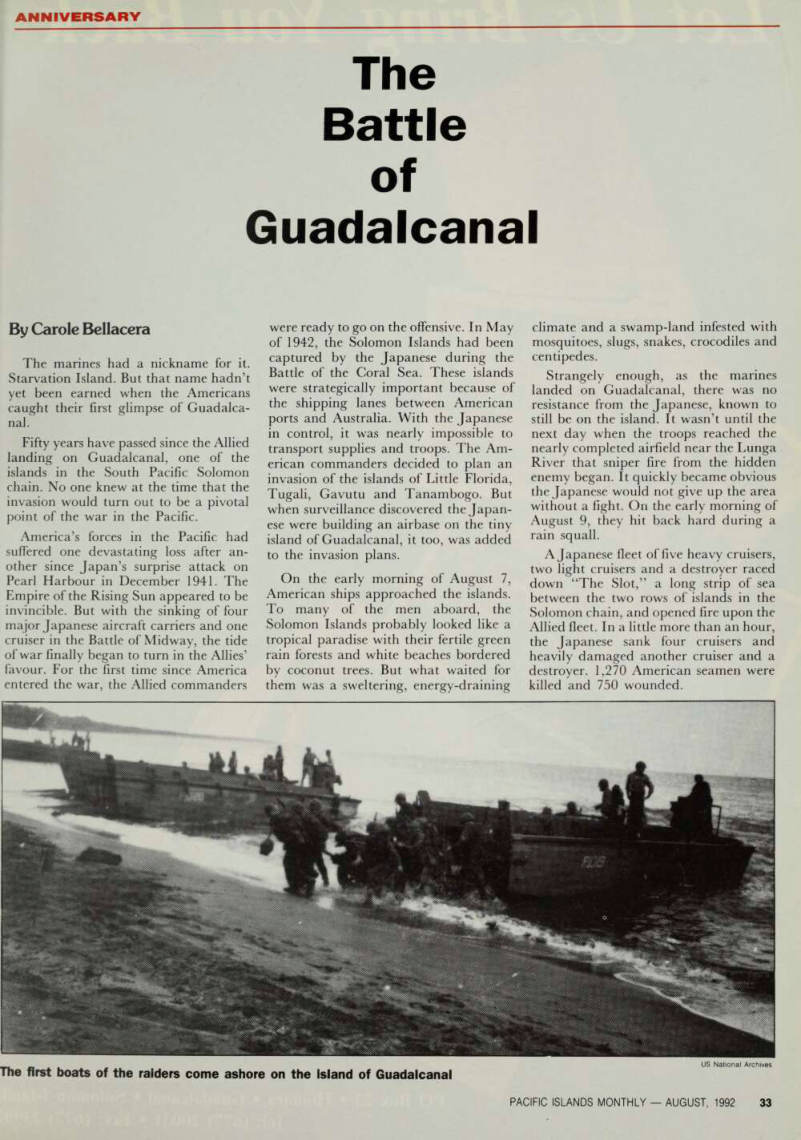
On the early morning of August 7, American ships approached the islands.
To many of the men aboard, the Solomon Islands probably looked like a tropical paradise with their fertile green rain forests and white beaches bordered by coconut trees. But what waited for them was a sweltering, energy-draining
climate and a swamp-land infested with mosquitoes, slugs, snakes, crocodiles and centipedes.
Strangely enough, as the marines landed on Guadalcanal, there was no resistance from the Japanese, known to still be on the island. It wasn’t until the next day when the troops reached the nearly completed airfield near the Lunga River that sniper fire from the hidden enemy began. It quickly became obvious the Japanese would not give up the area without a fight. On the early morning of August 9, they hit back hard during a
rain squall.
A Japanese fleet of five heavy cruisers, two light cruisers and a destroyer raced down “The Slot,” a long strip of sea between the two rows of islands in the Solomon chain, and opened fire upon the Allied fleet. In a little more than an hour, the Japanese sank four cruisers and heavily damaged another cruiser and a destroyer. 1,270 American seamen were killed and 750 wounded.
US National Archives
The first boats of the raiders come ashore on the island of Guadalcanal
Admiral Turner, commander of the cargo and transport ships to the Japanese and gave the order to withdraw from the area. The marines on the invaded islands could only watch with a sickening feeling of foreboding as their supply ships left “Ironbottom Sound” the harbour’s new name since that morning’s fiasco. There was nothing for the Ameri cans to do but grimly dig in and wait for whatever fate had in store for them. The Japanese commanders had managed to land fresh troops on the island in the dark of night. Fierce sporadic fighting broke out, resulting in heavy casualties on both sides. In the lulls of battle, the marines had to deal with illness, near-starvation and the constant fear that lay upon them as thickly as the permeating stink of the jungle around them. In the days after the departure of the supply ships, a grim reality set in. What had looked like a lush oasis from the sea had turned out to be a breeding ground for diseases such as malaria, beriberi and a horrible fungus called “jungle rot” that caused painful sores over the body.
Yet, somehow, the marines held on to one dim ray of hope. From the first day of the landing, American engineers had set about finishing Henderson Field, the airfield that the Japanese had begun.
Within a few weeks, it was operational.
In spite of intervention by Allied fighter squadrons, the enemy managed to land 1500 fresh troops upon Guadalcanal in October, culminating in days of heav y fighting near Henderson Field. Again and again, the Americans held their own,
pushing back the determined Japanese who suffered catastrophic losses. On October 23, the most savage battle was fought when the Japanese swarmed out of the jungle to come again to try to take Henderson Field. They suffered a devas tating loss of over 3500 men. The Japanese command, however, had been so certain of victory they’d sent a fleet of ships toward the Solomons for
“mopping-up” action.
Unfortunately for them, the American task force, including two aircraft carriers, The Hornet and The Enterprise , were waiting. The Battle of Santa Cruz took place on the morning of October 26. It looked bad for the Americans for a while.
Both The Hornet and a cruiser were sunk and The Enterprise and several other American ships were damaged. But the Japanese lost more than one hundred airplanes. They had too few left to make the air attacks needed to help the Japanese commander on Guadalcanal.
As it turned out, General Hyakutaki and his troops were forced to retreat into the
jungle, defeated.
The tenacious Japanese made several more attempts to recapture the island, but all were in vain. In the early morning darkness of February 7, the last Japanese troops boarded a ship and left the island for good.
After six long months of struggle, the Allies had won Guadalcanal. □
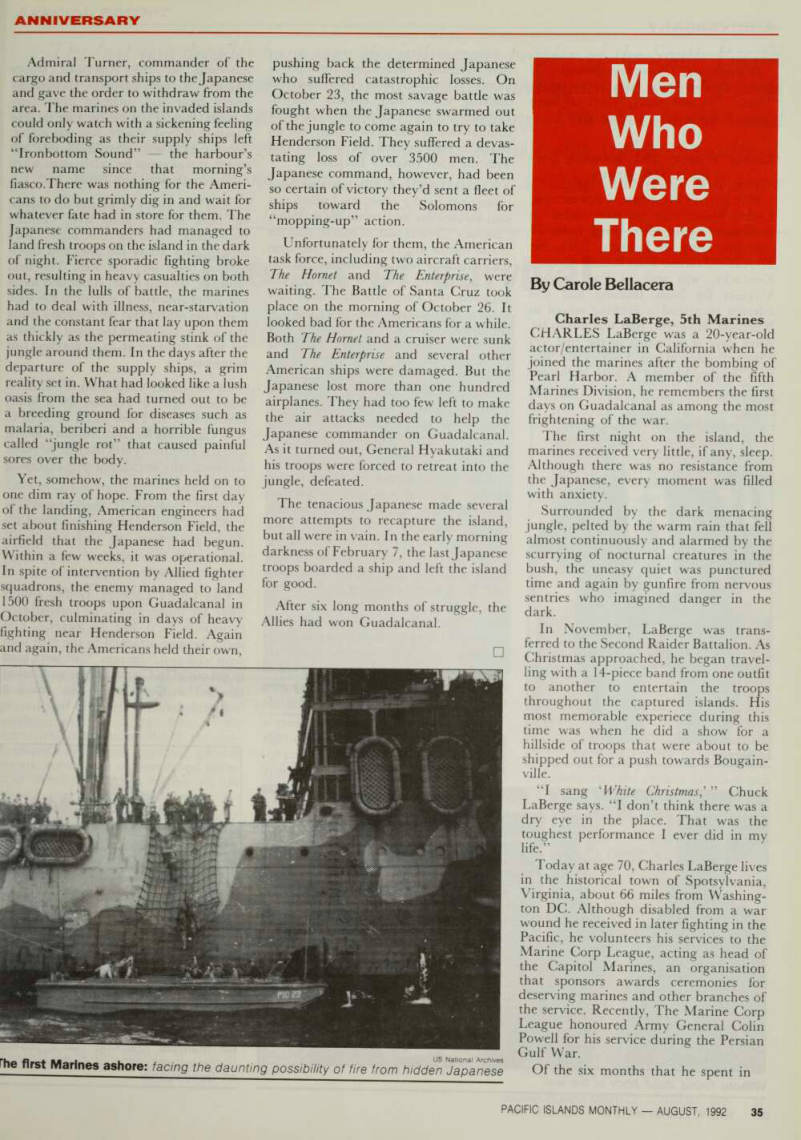
The first Marines ashore; facing the daunting possibility of fire from hidden Japanese