Low priority for AOSIS
p. 32 · Read in the full issue
Environment
By lan Williams
THE declaration adopted by the AOSIS (Association of Small Island States) Summit in Rio has now been submitted to Maurice Strong, Secretary General of the United Nations confer ence on Environment and Development the Earth Summit.
The declaration lamented the fact that “Small island and low lying coastal developing countries continue to see, in a general sense, their needs, concerns and interests assigned relatively low priorities within the United Nations system”, and pointed out that the constructive role AOSIS had played underlined the need for adequate representation of its mem bers on the relevant international bodies.
Most international bodies allocate seats on a regional basis, and while the AOSIS members together formed almost a quarter of members, when split into the different geographical regions, they be come a small minority in every sense of the word.
It is often difficult to persuade the larger, majority, countries that they should abandon their positions to make way for a more vulnerable but small island state in their region.
So, without getting ecstatic about the results of the Earth Summit, the AOSIS members “reiterated the willingness of their governments to accept” it as “what was achievable at this particular stage”, rather than “what was desirable from the perspective of AOSIS”.
They urged that ratification of the Climate Change treaty be effected as soon as possible and that it should be strengthened to ensure that it “effectively addresses the problem of human induced climate change”. It pushed for the development and promotion of new and renewable energy sources to help achieve those ends.
The declaration calls for the vulner ability assessments for the nations con cerned and the development of coastal management plans and financing of measures to adapt to climate change.
The multi-billion dollar Global Environ ment Facility financed by UNDP and the World Bank will not finance such projects unless they have global environ mental significance. So a project to reduce carbon dioxide emissions in the middle of the Sahara Desert can qualify but the protection of an atoll in the Pacific faced with submersion of climate change may not.
The meeting which framed the declar ation was the most extensive yet with attendance from across the oceans of the
world. From the Pacific the delegates included the presidents or prime minis ters of the Cook Islands, Kiribati, the Marshalls, Micronesia, Nauru, Papua New Guinea, Samoa, Solomon Islands, Tuvalu and Vanuatu. Ministers also came from Fiji, Niue, and American Samoa, and of course representatives from SPREP and the Forum.
Summarising, AOSIS Chairman Robert Van Lierop, Vanuatu’s UN ambassador told Pacific Islands Monthly , “In the near future we have to work very hard to make sure that there are targets and timetables adopted for greenhouse gas emissions, particularly of carbon dioxide. We have also got to develop renewable energy sources. But immedi ately, vulnerability assessments for the islands are essential.”
Van Lierop, whose dedication and energy did so much to help AOSIS get launched has expressed a wish to stand down from the chairmanship, perhaps in favour of a Caribbean diplomat. How ever, several UN sources report that a lobby is developing to persuade him to stay on. It remains to be seen whether he will succumb to their blandishments.
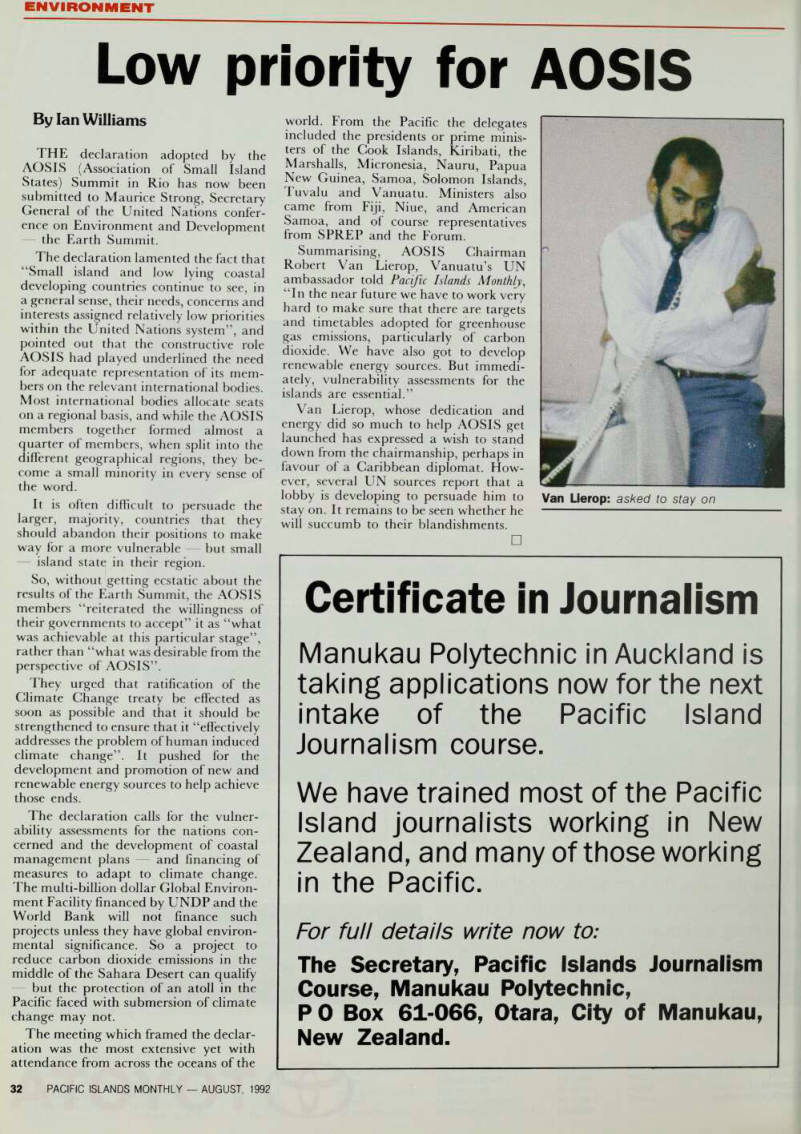
Van Lierop: asked to stay on