of women’s changing role
p. 21 · Read in the full issue
Women
Creating an awareness of women’s changing role
By Eileen Tugum-Kolma
MOST South Pacific island nations have in their constitution a mention of the need to involve women in the develop ment process. But in reality this does not
happen.
Very few women are involved in making decisions regarding development projects. And governments continue to treat women as a special issue, and plan for them separately, instead of including them in the major plans for countries, or
in mainstream development as many develop ment workers are calling it to day.
Josephine Gena, Assistant Secretary for the Women’s Division says, “Women are being treated as a relatively un important sec tor rather than as half the popu lation requiring attention from all sectors and with the poten tial to contrib ute productively to the country’s development.
“Programs to increase
women’s participation and productivity
ire organised separately from main itream programs.”
That is why women and development workers in the region are mounting pressure on their governments and plan lers to change this. Firms steps are being aken to facilitate this change.
Responding to calls by women to iddress this issue, the United Nations
development Programme (UNDP),
Jnited Nations Development Fund for Vomen (UNIFEM), and the Australian development Assistance Bureau AIDAB) have given money for a egional project called Pacific Women in
dainstreaming Development,
Four countries are testing the project
Papua New Guinea, Cook Islands, Tuvalu, and the Marshall Islands.
It aims to: • create an awareness of the role of women in the country’s development and the need to incorporate women’s con cerns into mainstream development planning; • examine how policies are made and why they are necessary; • review information on status of women in each country and; • discuss how women can become better negotiators to assiist in getting women off the special list and onto the mainstream
political, social and economical life of a nation.
In Papua New Guinea where tra ditional attitudes are hard to break, the task of sensitising the population to this issue seems daunting. But the positive response to gender workshops and from
workshop participants hold some hope.
Paul Baglame, a staff development and training officer with the Department of Home Affairs and Youth which is responsible for women’s affairs in Papua New Guinea was overwhelmed: “This workshop has just been an eye-opener for me. It has helped me see my own prejudices and attitudes towards men and women. I see that many of these prejudices and attitudes oppress our
women and we must change them.”
He wanted more men to attend similar
workshops.
“I was so blind. I needed someone, something like this to help me solve my problem. And my problem is just my attitude which is conditioned by my culture and my customs. And I see that many of our attitudes oppress women and we must change them.”
While the Pacific Mainstreaming Proj ect workshops in Papua New Guinea were completed in April this year, gender sensitising will not end there.
Both the participants and the women’s
movement in tend to keep the momentum going. While
participants
have been talk ing about it and trying in their own little ways to sensi tise others, in their homes, at coffee shops, on the streets, the Women’s Div ision is organis ing four re
gional work
shops on gen
der sensitising
for provincial planners and women’s leaders in Aug ust and Sep tember.
Co-ordinat =
or for these workshops Margaret Ratu Misso said: “Our planners are the ones who need to be sensitised most. It is their lack of awareness of women’s needs that continues to exclude women in main
stream development planning.”
There is also scheduled to be a gender sensitising program for politicians and bureaucrats in July as a lead-up to the launching of the National Women’s
Policy.
Misso said: “It’s a long battle to change men’s attitude but we will change it.
“We just have to keep thinking and talking about the multiple roles of women.” □
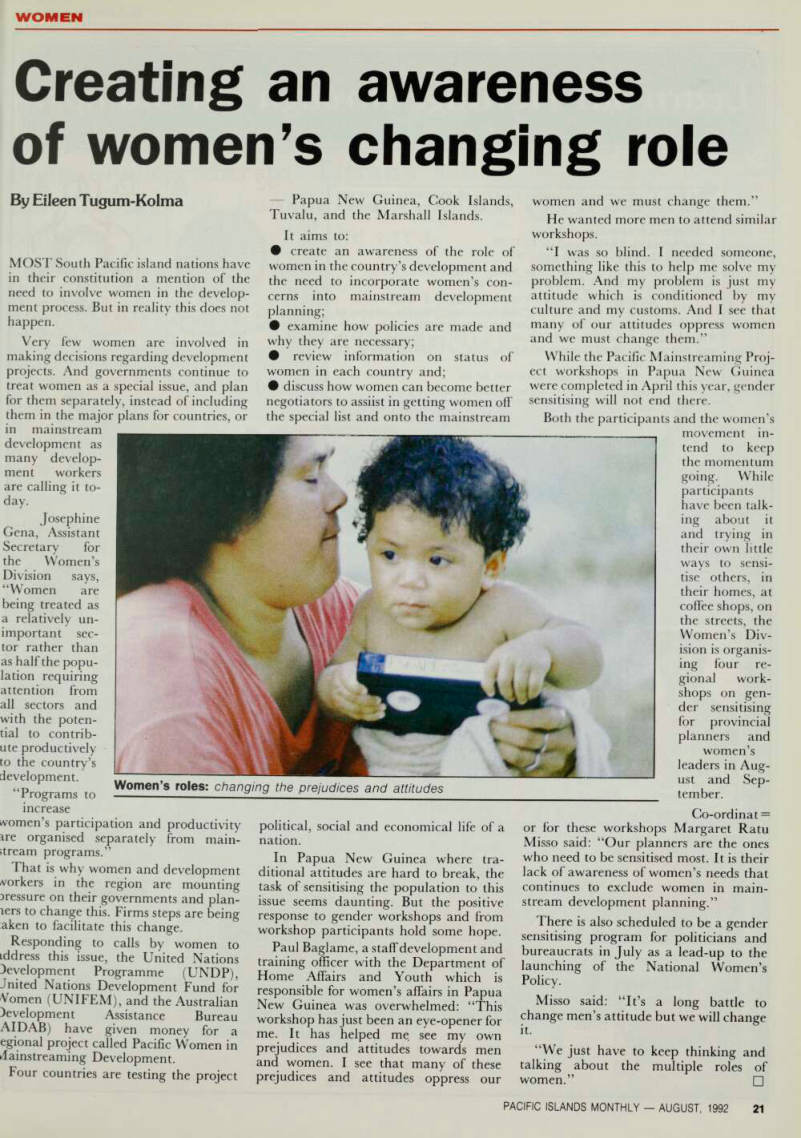
Women’s roles: changing the prejudices and attitudes