A Samoan in Kazakhstan
p. 20 · Read in the full issue
WHEN a delegation of US Repub lican Party activists visited the Republic of Kazakhstan in the former Soviet Union recently, one of its members especially captured the local limelight.
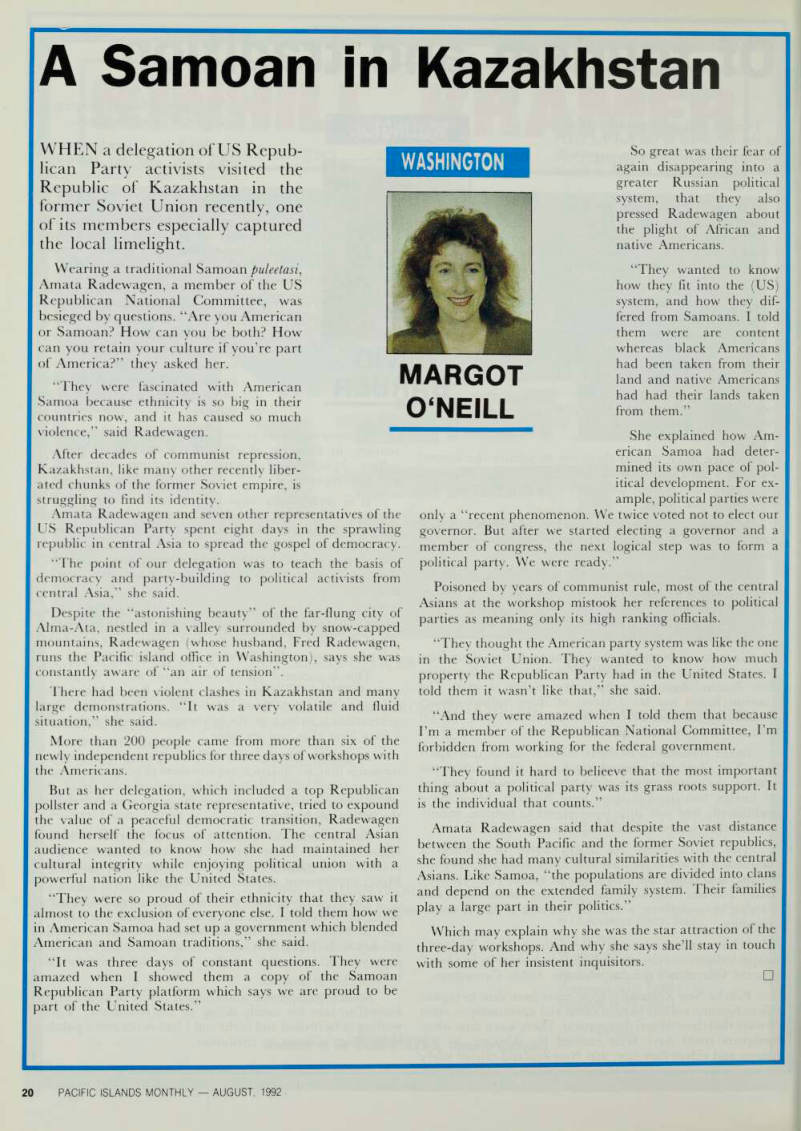
Wearing a traditional Samoan puleetasi , Amata Radewagen, a member of the US Republican National Committee, was besieged by questions. “Are you American or Samoan? How can you be both? How can you retain your culture if you’re part of America?” they asked her.
“They were fascinated with American Samoa because ethnicity is so big in their countries now, and it has caused so much violence,” said Radewagen.
After decades of communist repression, Kazakhstan, like many other recently liber ated chunks of the former Soviet empire, is struggling to find its identity.
Amata Radewagen and seven other representatives of the US Republican Party spent eight days in the sprawling republic in central Asia to spread the gospel of democracy.
“The point of our delegation was to teach the basis of democracy and party-building to political activists from central Asia,” she said.
Despite the “astonishing beauty” of the far-flung city of Alma-Ata, nestled in a valley surrounded by snow-capped mountains, Radewagen (whose husband, Fred Radewagen, runs the Pacific island office in Washington), says she was constantly aware of “an air of tension ".
There had been violent clashes in Kazakhstan and many large demonstrations. “It was a very volatile and fluid situation,” she said.
More than 200 people came from more than six of the newly independent republics for three days of workshops with the Americans.
But as her delegation, which included a top Republican pollster and a Georgia state representative, tried to expound the value of a peaceful democratic transition, Radewagen found herself the focus of attention. The central Asian audience wanted to know how she had maintained her cultural integrity while enjoying political union with a powerful nation like the United States.
“They were so proud of their ethnicity that they saw it almost to the exclusion of everyone else. I told them how we in American Samoa had set up a government which blended American and Samoan traditions,” she said.
“It was three days of constant questions. They were amazed when I showed them a copy of the Samoan Republican Party platform which says we are proud to be part of the United States.”
Washington
So great was their fear of again disappearing into a greater Russian political system, that they also pressed Radewagen about the plight of African and native Americans.
“They wanted to know how they fit into the (US) system, and how they dif fered from Samoans. I told them were are content whereas black Americans had been taken from their land and native Americans had had their lands taken from them.”
She explained how Am erican Samoa had deter mined its own pace of pol itical development. For ex
ample, political parties were
only a “recent phenomenon. We twice voted not to elect our governor. But after we started electing a governor and a member of congress, the next logical step was to form a political party. We were ready.”
Poisoned by years of communist rule, most of the central Asians at the workshop mistook her references to political parties as meaning only its high ranking officials.
“They thought the American party system was like the one in the Soviet Union. They wanted to know how much property the Republican Party had in the United States. I told them it wasn’t like that,” she said.
“And they were amazed when I told them that because I’m a member of the Republican National Committee, I’m forbidden from working for the federal government.
“They found it hard to belieeve that the most important thing about a political party was its grass roots support. It is the individual that counts.”
Amata Radewagen said that despite the vast distance between the South Pacific and the former Soviet republics, she found she had many cultural similarities with the central Asians. Like Samoa, “the populations are divided into clans and depend on the extended family system. Their families play a large part in their politics.”
Which may explain why she was the star attraction of the three-day workshops. And why she says she’ll stay in touch with some of her insistent inquisitors.