PNG’s new government
pp. 9-10 · Read in the full issue
Politics
Over 2.3 million Papua New Guineans went to the polls on June 13 to elect its fourth post-independence parliament.
When the results were declared on July 13, the country had voted out the majority of sitting members of parliament. Frank Kolma reports on the elections and the challenges facing the new government.
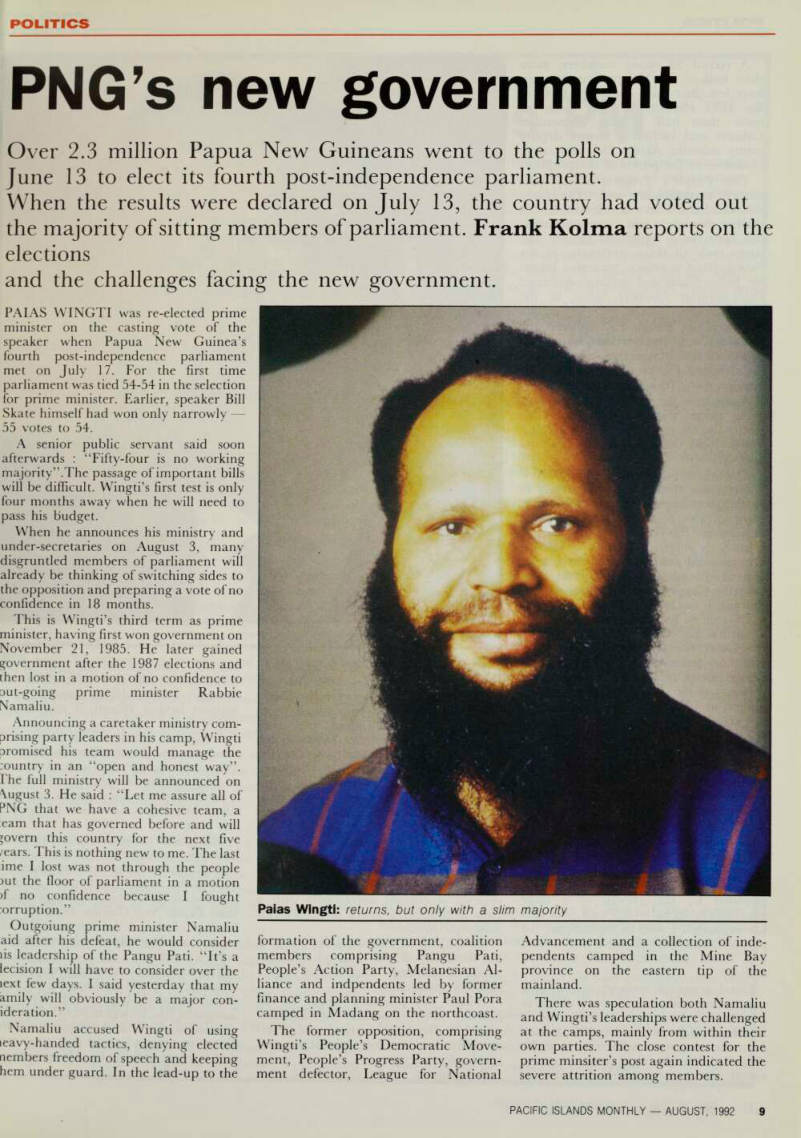
PAIAS WINGTI was re-elected prime minister on the casting vote of the speaker when Papua New Guinea’s fourth post-independence parliament met on July 17. For the first time parliament was tied 54-54 in the selection for prime minister. Earlier, speaker Bill Skate himself had won only narrowly 55 votes to 54.
A senior public servant said soon afterwards ; “Fifty-four is no working majority”. The passage of important bills will be difficult. Wingti’s first test is only four months away when he will need to pass his budget.
When he announces his ministry and under-secretaries on August 3, many disgruntled members of parliament will already be thinking of switching sides to the opposition and preparing a vote of no confidence in 18 months.
This is Wingti’s third term as prime minister, having first won government on November 21, 1985. He later gained government after the 1987 elections and then lost in a motion of no confidence to aut-going prime minister Rabbie Namaliu.
Announcing a caretaker ministry com prising party leaders in his camp, Wingti Dromised his team would manage the xmntry in an “open and honest way”.
Fhe full ministry will be announced on \ugust 3. He said : “Let me assure all of PNG that we have a cohesive team, a earn that has governed before and will govern this country for the next five /ears. This is nothing new to me. The last ime I lost was not through the people )ut the floor of parliament in a motion )f no confidence because I fought :orruption.”
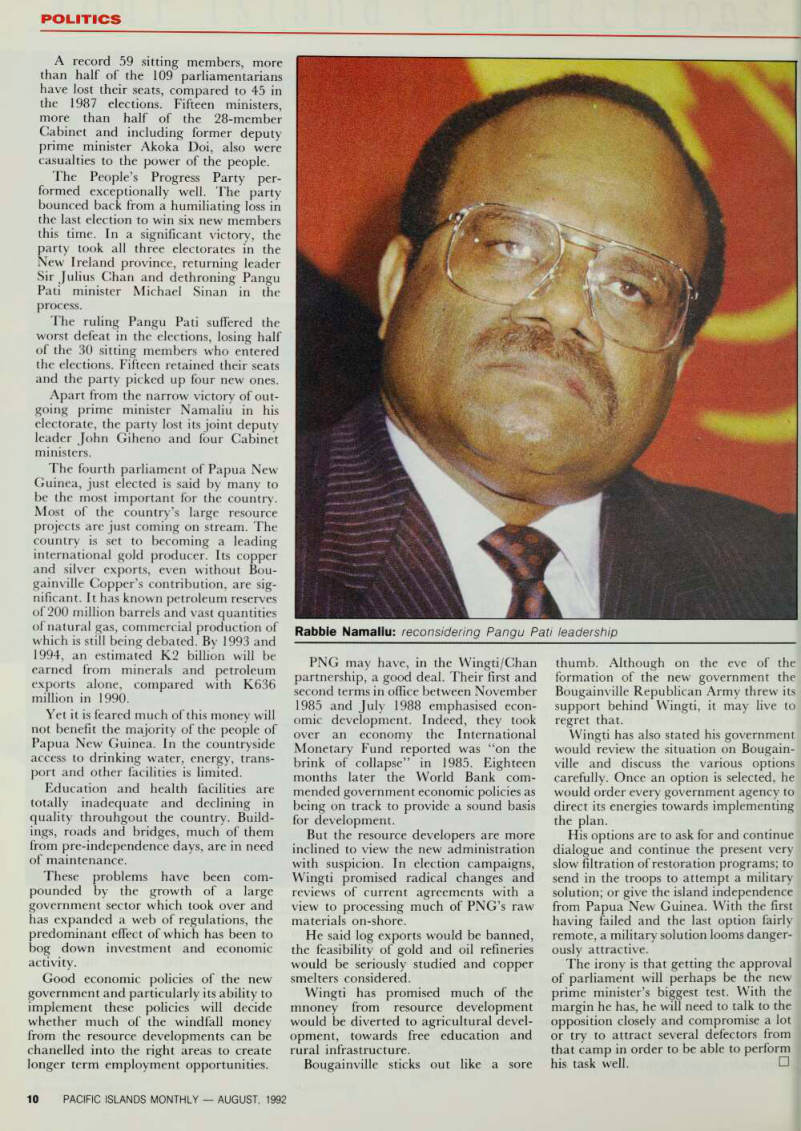
Outgoiung prime minister Namaliu
aid after his defeat, he would consider lis leadership of the Pangu Pati. “It’s a lecision I will have to consider over the icxt few days. I said yesterday that my amily will obviously be a major con ideration.”
Namaliu accused Wingti of using icavy-handed tactics, denying elected aembers freedom of speech and keeping hem under guard. In the lead-up to the
formation of the government, coalition members comprising Pangu Pati, People’s Action Party, Melanesian Al liance and indpendents led by former finance and planning minister Paul Pora camped in Madang on the northcoast.
The former opposition, comprising Wingti’s People’s Democratic Move ment, People’s Progress Party, govern ment defector, League for National
Advancement and a collection of inde pendents camped in the Mine Bay province on the eastern tip of the mainland.
There was speculation both Namaliu
and Wingti’s leaderships were challenged
at the camps, mainly from within their own parties. The close contest for the prime minsiter’s post again indicated the severe attrition among members.
Palas Wingti: returns, but only with a slim majority
A record 59 sitdng members, more than half of the 109 parliamentarians have lost their seats, compared to 45 in the 1987 elections. Fifteen ministers, more than half of the 28-member Cabinet and including former deputy prime minister Akoka Doi, also were casualties to the power of the people.
The People’s Progress Party per
formed exceptionally well. The party bounced back from a humiliating loss in the last election to win six new members this time. In a significant victory, the party took all three electorates in the New Ireland province, returning leader Sir Julius Chan and dethroning Pangu Pad minister Michael Sinan in the process.
The ruling Pangu Pad suffered the worst defeat in the elections, losing half of the 30 sitting members who entered the elections. Fifteen retained their seats and the party picked up four new ones.
Apart from the narrow victory of out going prime minister Namaliu in his electorate, the party lost its joint deputy leader John Giheno and four Cabinet ministers.
The fourth parliament of Papua New Guinea, just elected is said by many to be the most important for the country.
Most of the country’s large resource projects are just coming on stream. The country is set to becoming a leading international gold producer. Its copper and silver exports, even without Bou gainville Copper’s contribution, are sig nificant. It has known petroleum reserves of 200 million barrels and vast quantities of natural gas, commercial production of which is still being debated. By 1993 and 1994, an estimated K 2 billion will be earned from minerals and petroleum exports alone, compared with K 636 million in 1990.
Yet it is feared much of this money will not benefit the majority of the people of Papua New Guinea. In the countryside access to drinking water, energy, trans port and other facilities is limited.
Education and health facilities are totally inadequate and declining in quality throuhgout the country. Build ings, roads and bridges, much of them from pre-independence days, are in need of maintenance.
These problems have been com pounded by the growth of a large government sector which took over and has expanded a web of regulations, the predominant effect of which has been to bog down investment and economic
activity.
Good economic policies of the new government and particularly its ability to implement these policies will decide whether much of the windfall money from the resource developments can be chanelled into the right areas to create longer term employment opportunities.
PNG may have, in the Wingti/Chan partnership, a good deal. Their first and second terms in office between November 1985 and July 1988 emphasised economic development. Indeed, they took over an economy the International Monetary Fund reported was “on the brink of collapse” in 1985. Eighteen months later the World Bank commended government economic policies as being on track to provide a sound basis for development.
But the resource developers are more inclined to view the new administration with suspicion. In election campaigns, Wingti promised radical changes and reviews of current agreements with a view to processing much of PNG’s raw materials on-shore.
He said log exports would be banned, the feasibility of gold and oil refineries would be seriously studied and copper smelters considered.
Wingti has promised much of the mnoney from resource development would be diverted to agricultural development, towards free education and rural infrastructure.
Bougainville sticks out like a sore
thumb. Although on the eve of the formation of the new government the Bougainville Republican Army threw its support behind Wingti, it may live to regret that.
Wingti has also stated his government would review the situation on Bougain ville and discuss the various options carefully. Once an option is selected, he would order every government agency to direct its energies towards implementing the plan.
His options are to ask for and continue dialogue and continue the present very slow filtration of restoration programs; to send in the troops to attempt a military solution; or give the island independence from Papua New Guinea. With the first having failed and the last option fairly remote, a military solution looms danger ously attractive.
The irony is that getting the approval of parliament will perhaps be the new prime minister’s biggest test. With the margin he has, he will need to talk to the opposition closely and compromise a lot or try to attract several defectors from that camp in order to be able to perform his task well. D
Rabble Namaliu: reconsidering Pangu Pati leadership