time immemorial
p. 62 · Read in the full issue
Books
A lesson from time immemorial
By Nicolas Rothwell
MAROONED in the empty waters of the south-east Pacific, windswept Easter Island still obsesses the western imagination, some 172 years after an expedition led by the Dutch commander Jacob Roggeveen sighted its ‘low, flat’ cliffs early on the evening of April 5, and christened the land ‘because it was discovered and found by us on Easter Day’. In the year since, Easter Island’s extraordinary cul ture has been much admired and its savage history pieced together.
Thor Heyerdahl, chief proponent of the idea that South Americans colonised the island, is the best known of these speculators, thanks to the exploits of his ‘Kon-tiki’ expedition. Now, two of the most prominent experts in Easter Island studies have produced the first general volume setting out the state of our knowledge of this most remarkable outpost of Polynesia.
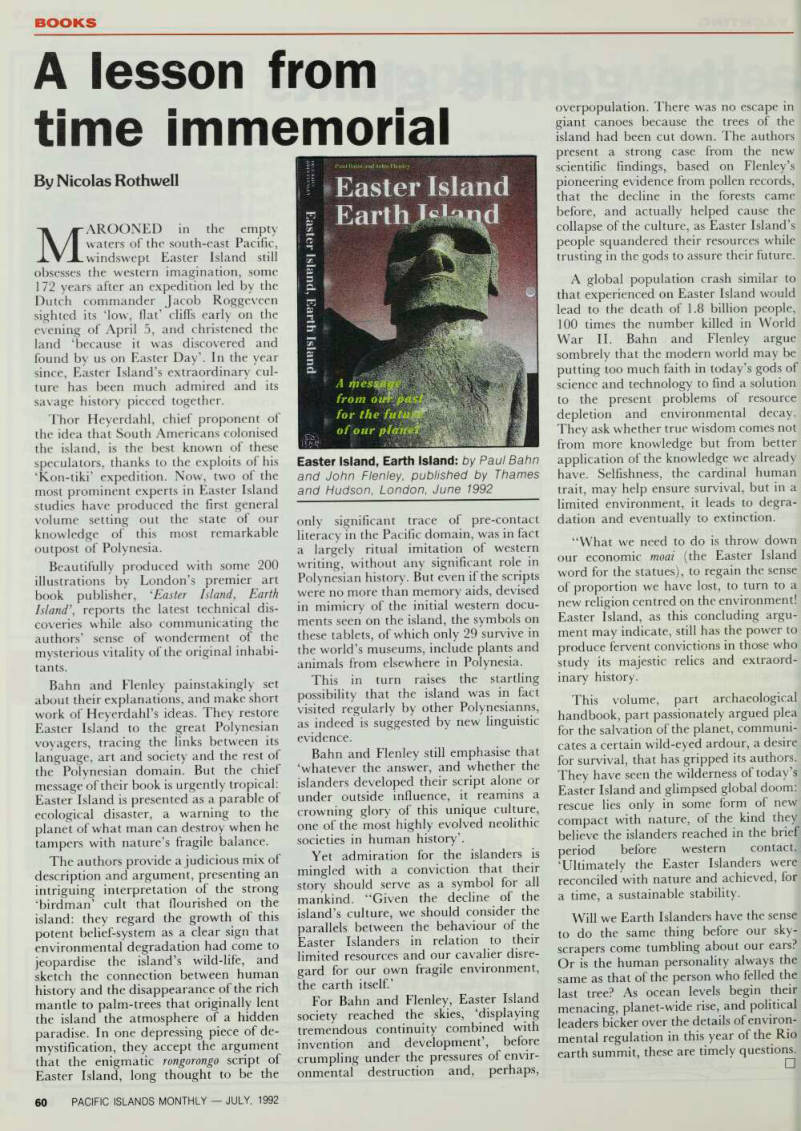
Beautifully produced with some 200 illustrations by London’s premier art book publisher, ‘Easter Island, Earth Island’, reports the latest technical dis coveries while also communicating the authors’ sense of wonderment of the mysterious vitality of the original inhabi tants.
Bahn and Flenley painstakingly set about their explanations, and make short work of Heyerdahl’s ideas. They restore Easter Island to the great Polynesian voyagers, tracing the links between its language, art and society and the rest of the Polynesian domain. But the chief message of their book is urgently tropical: Easter Island is presented as a parable of ecological disaster, a warning to the planet of what man can destroy when he tampers with nature’s fragile balance.
The authors provide a judicious mix of description and argument, presenting an intriguing interpretation of the strong ‘birdman’ cult that flourished on the island: they regard the growth of this potent belief-system as a clear sign that environmental degradation had come to jeopardise the island’s wild-life, and sketch the connection between human history and the disappearance of the rich mantle to palm-trees that originally lent the island the atmosphere of a hidden paradise. In one depressing piece of de mystification, they accept the argument that the enigmatic rongorongo script of Easter Island, long thought to be the
only significant trace of pre-contact literacy in the Pacific domain, was in fact a largely ritual imitation of western writing, without any significant role in Polynesian history. But even if the scripts were no more than memory aids, devised in mimicry of the initial western docu ments seen on the island, the symbols on these tablets, of which only 29 survive in the world’s museums, include plants and animals from elsewhere in Polynesia.
This in turn raises the startling possibility that the island was in fact visited regularly by other Polynesians, as indeed is suggested by new linguistic evidence.
Bahn and Flenley still emphasise that ‘whatever the answer, and whether the islanders developed their script alone or under outside influence, it reamins a crowning glory of this unique culture, one of the most highly evolved neolithic societies in human history’.
Yet admiration for the islanders is mingled with a conviction that their story should serve as a symbol for all mankind. “Given the decline of the island’s culture, we should consider the parallels between the behaviour of the Easter Islanders in relation to their limited resources and our cavalier disre gard for our own fragile environment, the earth itself.’
For Bahn and Flenley, Easter Island society reached the skies, ‘displaying tremendous continuity combined with invention and development’, before crumpling under the pressures of envir onmental destruction and, perhaps,
overpopulation. There was no escape in giant canoes because the trees of the island had been cut down. The authors present a strong case from the new scientific findings, based on Flenley’s pioneering evidence from pollen records, that the decline in the forests came before, and actually helped cause the collapse of the culture, as Easter Island’s people squandered their resources while trusting in the gods to assure their future.
A global population crash similar to that experienced on Easter Island would lead to the death of 1.8 billion people, 100 times the number killed in World War II. Bahn and Flenley argue sombrely that the modern world may be putting too much faith in today’s gods of science and technology to find a solution to the present problems of resource depletion and environmental decay.
They ask whether true wisdom comes not from more knowledge but from better application of the knowledge we already have. Selfishness, the cardinal human trait, may help ensure survival, but in a limited environment, it leads to degra dation and eventually to extinction.
“What we need to do is throw down our economic moai (the Easter Island word for the statues), to regain the sense of proportion we have lost, to turn to a new religion centred on the environment!
Easter Island, as this concluding argu ment may indicate, still has the power to produce fervent convictions in those who study its majestic relics and extraord inary history.
This volume, part archaeological
handbook, part passionately argued plea
for the salvation of the planet, communi cates a certain wild-eyed ardour, a desire for survival, that has gripped its authors.
They have seen the wilderness of today s Easter Island and glimpsed global doom: rescue lies only in some form of new compact with nature, of the kind they believe the islanders reached in the brief period before western contact. ‘Ultimately the Easter Islanders were reconciled with nature and achieved, for a time, a sustainable stability.
Will we Earth Islanders have the sense to do the same thing before our sky scrapers come tumbling about our ears?
Or is the human personality always the same as that of the person who felled the last tree? As ocean levels begin their menacing, planet-wide rise, and political leaders bicker over the details of environ mental regulation in this year of the Rio earth summit, these are timely questions.
Easter Island, Earth Island: by Paul Bahn and John Flenley, published by Thames and Hudson, London, June 1992